
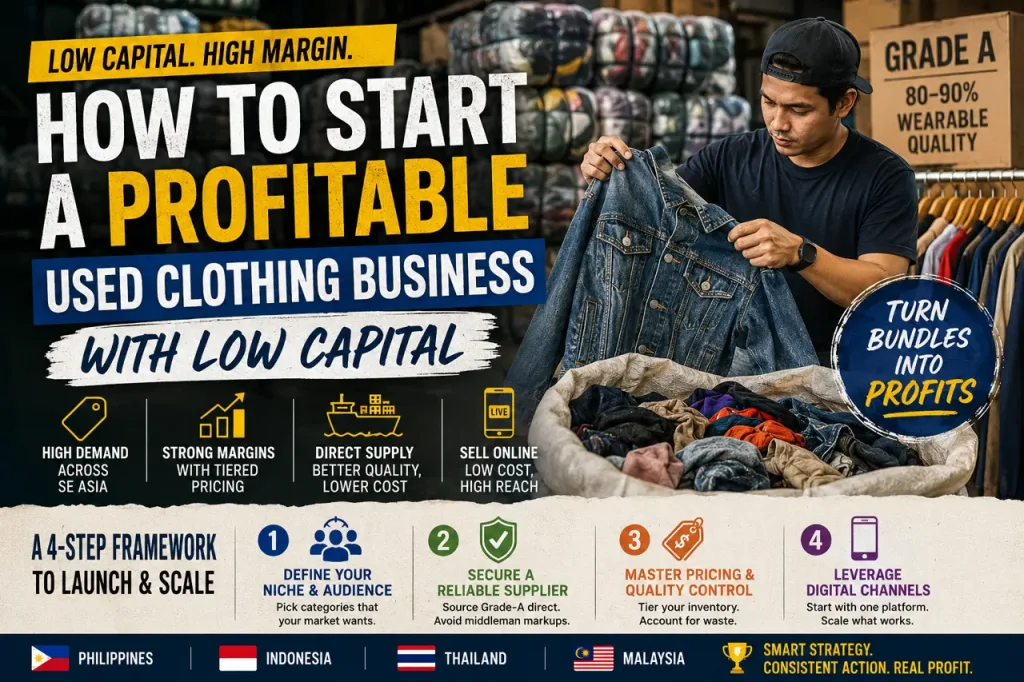
Walk through any market in Manila, Jakarta, Bangkok, or Kuala Lumpur and you will find the same infrastructure that has operated for decades: the ukay-ukay stall, the barang-barang pile, the thrift vendor turning donations into a paycheck. Used clothing in Southeast Asia is not a TikTok trend; it has been consistent consumer behavior for over 30 years. What has changed is distribution. Live selling and social commerce now let a single trader move volume that used to require a physical storefront.
The barrier to entry has never been lower. Here is a four-step framework to launch with limited capital built on margin math and regional market logic, not motivation quotes.
Quick Takeaways
– Category selection determines your channel, not your taste. Pick a niche based on how your customers buy.
– The cheapest supplier adds 20-40% hidden cost through middleman markups and poor grading.
– Tiered pricing transforms one bale into three revenue streams.
– Honest waste rates run 15-25% including sea-shipping humidity.
– Start with one digital channel, master it, then expand.
Step 1: Define Your Niche & Target Audience
The most common mistake new importers make is buying a mixed container without a category strategy. Mixed bales seem safe diversified inventory but they force you to compete on price in every segment. A focused category builds reputation, repeat buyers, and better margins.
Here is how major categories perform across SE Asian markets:
| Category | Philippines | Indonesia | Thailand | Malaysia |
|---|---|---|---|---|
| Men’s Jeans | High rotation, size 32–36 | Moderate, prefer sizes 30–34 | Moderate, branded preferred | Lower volume, better margin |
| Ladies’ Tops | Very high demand, price-sensitive | Very high demand, color-driven | High demand, trend-responsive | High demand, quality over price |
| Kids’ Wear | Moderate demand, growing market | Lower demand relative to adults | Moderate demand | High demand, best margin |
| Footwear | Low demand (transit damage concerns) | Low demand (preference for new items) | High demand, sneaker resale market | Moderate demand |
If you target the Philippines, men’s jeans and ladies’ tops offer the fastest rotation. For Malaysia, kids’ wear delivers the strongest margin. For Thailand, sneakers have a strong resale culture. Pick your market first, then your category.
Step 2: Secure a Reliable Grade-A Supplier
The industry benchmark for Grade A is 80-90% wearable items with no stains, no tears, and minimal visible wear. The middleman trap is the biggest capital killer: two to three layers of intermediaries add 20-40% markup without improving quality. Smart retailers bypass these layers and source directly from established exporters like **[ukay ukay](https://www.indetexx.com/ukay-ukay-fashion-101/)**, eliminating the markup while ensuring consistent Grade-A sorting.
Protect your first investment with this vetting checklist:
1. Verify sorting capacity.
A supplier handling 20 tons per day needs 40-60 sorters on a physical line. If they cannot describe their daily throughput, they are aggregating from multiple sources. Inconsistent grading follows.
2. Demand size-ratio data.
Anyone can promise “60% size 32-36.” The question is whether they track it. Suppliers with their own facilities can provide market-specific ratios because every item passes through a trained sorter’s hands, not a random grab-and-pack process.
3. Get Grade B tolerance in writing.
A reputable supplier commits to a maximum Grade B percentage (typically 15-20%) on the proforma invoice. If they refuse, you carry all the risk.
A cheap supplier is the most expensive decision you will make. Treat selection accordingly.
Step 3: Master Pricing & Quality Control
A single bale contains three distinct tiers. Pricing them the same destroys margin on the high end and kills turnover on the low end.
| Tier | Share of Bale | Cost per kg | Online Resale Price (per kg) | Market Resale Price (per kg) | Waste Rate |
|---|---|---|---|---|---|
| Premium (minimal wear, known brands) | 20–25% | $1.20–$1.80 | $5.00–$8.00 | $3.00–$4.50 | 3–5% |
| Standard (good condition, unbranded) | 55–60% | $0.60–$1.00 | $2.50–$4.00 | $1.50–$2.50 | 10–15% |
| Flawed (minor repairs needed) | 15–20% | $0.25–$0.40 | $1.00–$1.50 | $0.50–$1.00 | 25–35% |
Be honest about waste. 10-20% of any Grade A bale ends up needing donation or discard. In SE Asia, sea shipping humidity adds another 5-8% moisture and accelerates fabric wear, especially in cotton-heavy bales. If you are not factoring 15-25% total waste into your cost calculation, your profit projections are wrong.
One practical strategy: sell raw, uncleaned items at a discount on Facebook Marketplace as mystery bundles. Budget buyers care more about price than presentation.
Step 4: Leverage Low-Cost Digital Channels
You do not need a shop or a website. You need a phone and a platform strategy.
Shopee Live works best for Premium items in Indonesia and the Philippines. Real-time bale openings create urgency, and commissions run only 3-5%. TikTok Shop rewards bale-opening videos that go viral organically a single video can reach 50,000 views without paid promotion. Facebook Marketplace remains the highest-volume classified platform across the region, ideal for bundle deals with no commission. Instagram micro-influencers on a 15-20% commission basis cost nothing upfront and work well for Premium ladies’ items.
The critical rule: match inventory tier to channel. Premium on Shopee Live. Standard and Flawed on TikTok and Facebook Marketplace. Start with one channel, master it, then expand.
Frequently Asked Questions
How much capital do I actually need?
A trial 20ft container of Grade A used clothing costs $3,500-5,000 FOB. Total landed cost in SE Asia is $5,000-8,000. If that exceeds your budget, start with commission-based selling first.
Is Grade A worth the higher price?
Yes a mixed-grade bale may have 40-50% unsellable items, making your effective cost per sellable kilo higher than paying more for 80-90% wearable Grade A stock.
Which SE Asian country is best?
The Philippines offers the fastest rotation. Thailand has the strongest sneaker resale market. Malaysia delivers the best kids-wear margins. Indonesia has the largest addressable market but is most price-sensitive.
Conclusion
Launching a used clothing business with limited capital comes down to four decisions: narrowing your category, vetting your supplier, pricing by tier, and mastering one channel before expanding. If you do not have three months of working capital buffer, start with drop-selling first and use your first container as market research, not a make-or-break bet. The entrepreneurs who succeed are not the ones with the biggest budgets. They take action and learn fast.
*John is an account manager at [ukay ukay](https://www.indetexx.com/ukay-ukay-fashion-101/) wholesale supplier Indetexx, supplying importers across 110+ countries from their 20,000m2 sorting facility in China.*