
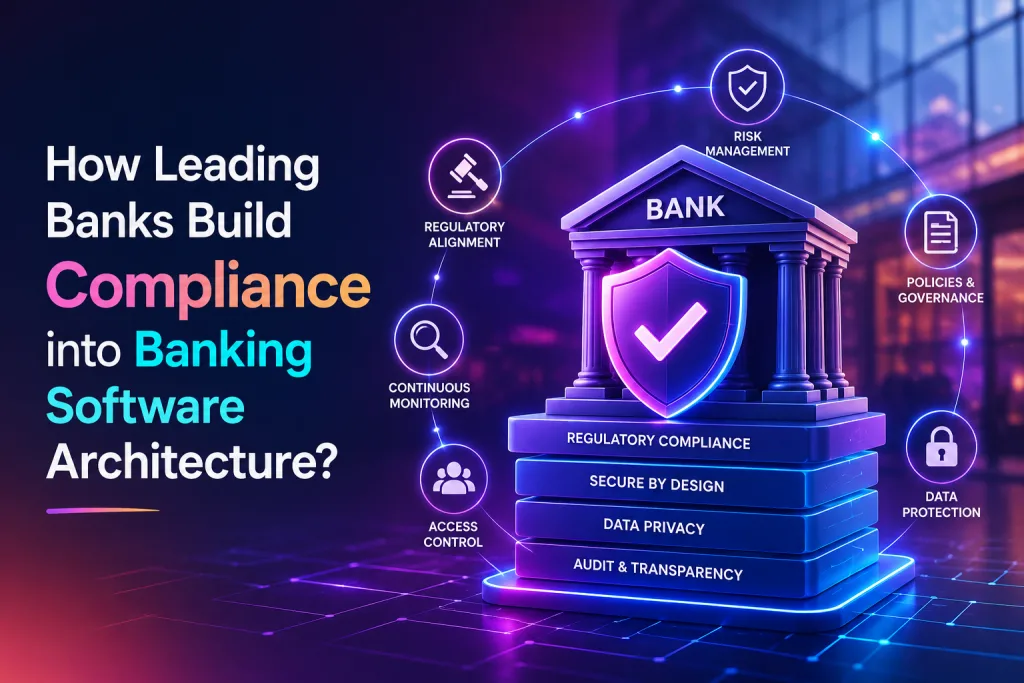
Leading banks develop compliance into banking software architecture by treating regulations as a design input, not a final checklist.
They map rules like KYC, AML, PCI DSS and GDPR directly into system layers, so every transaction, API call, and data flow is checked and logged as it happens, not audited after the fact.
Leading banks embed compliance into system design from the start, mapping rules like KYC, AML, PCI DSS, and GDPR into service layers, data flows, and audit logs, so checks happen automatically instead of being reviewed after the fact.
This is the short answer. Here is what it actually looks like and where most guides on this topic fall short.
Why Does Bolt-On Compliance Fail?
Many banks still treat compliance as a layer added at the end. A team builds a lending app or a payments engine, and compliance checks get added later through a separate review process.
This creates gaps. A rule changes, and someone has to manually find every place it applies. An auditor asks for a report, and three teams pull data from three different systems that do not agree with each other.
This approach breaks down as banks grow. More products mean more regulators. More regions mean more overlapping rules. A bank running on patched-together systems cannot answer a regulator’s question quickly, and slow answers cost money and trust.
That’s why partnering with a banking software development company like Nimble AppGenie helps financial institutions build scalable, compliant, and integrated systems that simplify regulatory reporting and support sustainable growth.
The Architecture Patterns That Actually Support Compliance
Good banking software architecture is not one big system. It is a set of smaller decisions, repeated consistently across every service a bank runs. Here are the ones that slow up again and again at banks with mature compliance programs.
- Isolate the core budget
Banks keep the ledger and settlement systems separate from customer-facing apps. Only specific, audited interfaces can touch the ledger. This limits the blast radius if something goes wrong and makes it easier to prove control over sensitive data.
- Build services with clear boundaries
Instead of one large application, banks split systems into small services, each handling one job. For example, onboarding payments, fraud checks, and reporting. Each service is easier to audit, and a change in one does not risk breaking three others.
- Log everything by default
Every request between services is authenticated and recorded. This is not optional logging added for a particular report. It is developed into how services talk to each other, so an audit trail exists whether or not anyone asked for one that day.
- Encrypt data at rest and in transit
Modern banks apply strong encryption everywhere, not just on the parts a regulator is likely to check. TLS 1.3 for connections, encryption for stored data, and strict key management are standard.
- Treat regulations changes as a code problem
When a rule changes, banks want to update one place, not fifty. This means rules for KYC, AML thresholds, and reporting formats live in a dedicated service or rules engine, separate from the core business logic. A compliance officer can review a rule change without needing a developer to trace it through the entire codebase.
- Automate reporting instead of assembling it by hand
Suspicious activity reports, transaction reports, and audit packages get generated from the same data the system already tracks. Nobody is copying numbers between spreadsheets the night before a deadline.
What Does This Means for a Compliance Officer?
A compliance officer does not need to know the workflow of microservices. They need three things from the system. They are an accurate audit trail, fast answers when a regulator asks a question, and confidence that a new rule can be applied without weeks of manual rework. Good architecture delivers all three quietly, in the background, without anyone needing to think about it day to day.
Build vs Buy: The Right Approach to Compliance in Banking Software
Off-the-shelf compliance software gets a bank running fast. It works well for standard checks like AML screening or KYC verification, where the rules are common across most institutions.
But it has limits. A bank with unique products, multiple regulators, or a legacy core system often finds that a bought tool does not fit its actual data model.
Custom-built compliance logic costs more upfront and takes longer, but it fits the bank’s specific rules, systems, and regions instead of forcing the bank to adapt to the software.
Most banks end up doing both: buying tools for common, well-defined checks, and building custom logic for anything particular to their business or region. The architecture has to support both paths without becoming a mess of point-to-point integrations.
This is usually where projects stall. A bank chooses a vendor tool, then spends months building custom connectors to make it talk to the core system.
If the underlying architecture was not designed for this from the start, every new integration adds risk instead of reducing it. Planning for this at the design stage, not after the vendor contract is signed, saves most of that pain.
Conclusion
Compliance in banking software is not a feature you add near launch. It is a set of decisions made at the architecture stage, where data lives, how services talk to each other, and how rules get updated when regulations change.
Banks that get this right spend less time firefighting audits and more time shipping products. Banks that do not spend years untangling systems that were never built to answer a regulator’s question quickly.
Nimble AppGenie works with banks and fintechs on exactly this problem: designing banking software where compliance is part of the architecture, not an afterthought.
That means KYC and AML checks built into onboarding flows, audit trails built into how services communicate, and reporting that pulls from live data instead of manual exports.
The goal is a system a compliance team can trust and a development team can actually maintain, without either side blocking the other.
Author Bio
Niketan Sharma is the CTO of Nimble AppGenie, with a strong focus on delivering innovative Fintech Software Development Services for startups and enterprises. Passionate about financial technology and digital innovation, he specializes in building secure, scalable, and user-centric fintech solutions, including digital banking, payment platforms, eWallets, and lending applications that help businesses thrive in the evolving financial landscape.