
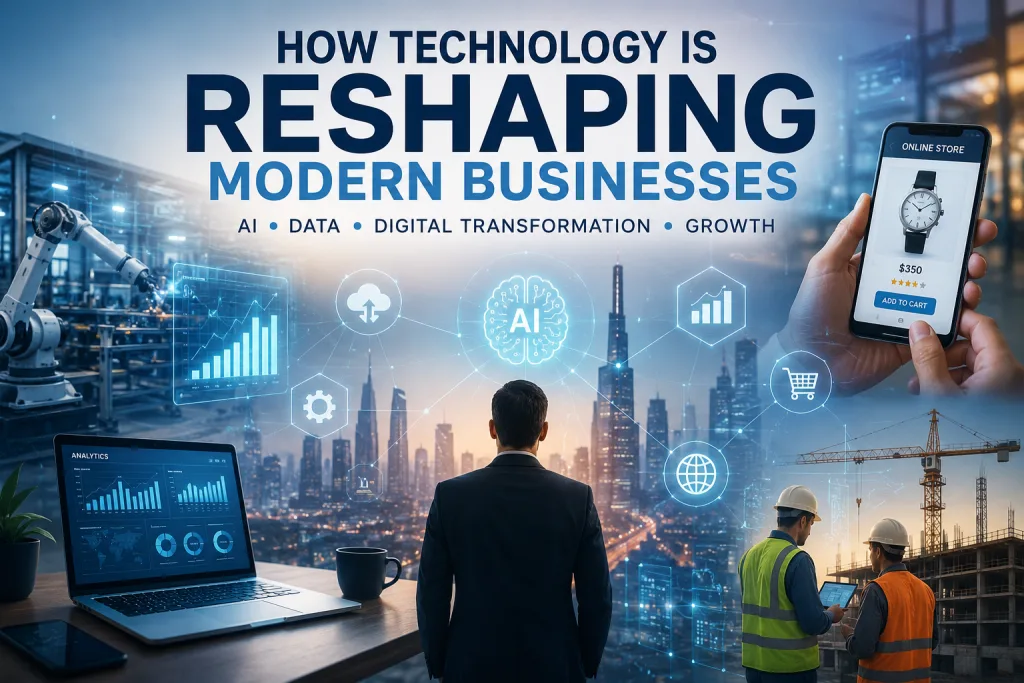
Technology Is Quietly Rewriting How Every Business Operates
I was talking to a client last month, small manufacturing outfit, maybe 40 people on payroll, and he said something that stuck with me longer than I expected. “We didn’t decide to go digital. We just woke up one day and realized we already had.” Honestly, that’s about where most industries are right now. Retail, construction, finance, pick one. Technology stopped being the “new thing” a while back. Now it’s just… how decisions get made. Nobody sends a memo about it.
And no, this isn’t about buying a piece of software and slapping “digital transformation” on next year’s report to shareholders. It’s slower than that. Messier too, if I’m being honest. Companies end up rethinking how they talk to customers, how work flows on a random Tuesday, what happens when the market moves faster than the org chart can keep up. Nobody gets a pass here. Not retail, not construction, not the plumber two streets over from you.
Which, oddly enough, is good news if you’re small. You can move faster than the giants can. Sometimes, anyway.
AI stopped being a buzzword a while ago.
Somewhere in the past few years it went from “thing people argue about on stage at conferences” to “thing quietly running the customer service inbox at 2am.” Nobody announced the switch. It just sort of happened while everyone was looking somewhere else.
Most of the actual work is unglamorous, if I’m honest. Automating the repetitive stuff nobody wanted to do anyway. Making sense of a dataset too big for a human to eyeball in a reasonable afternoon. Forecasting based on real numbers instead of whatever a manager’s gut happened to say in the Monday meeting.
There’s one piece of this that doesn’t get nearly enough credit: enterprise ai architecture. I know, sounds dry as toast. But it’s the actual scaffolding that lets a company run AI securely across departments, instead of every single team bolting on their own random tool that refuses to talk to anything else. Boring name. Bigger consequences than the name suggests.
What tends to follow once this is set up properly: decisions happen faster because nobody’s stuck waiting on a report. Data actually gets used instead of sitting untouched in some shared drive. Automation spreads instead of getting stuck in one lonely department. Security tightens up, so there are fewer “wait, who even has access to this?” moments. And scaling stops being the nightmare it used to be.
Get the architecture right early, and you’re not scrambling six months later when some new AI tool drops out of nowhere. You just plug it in and keep going.
Retail rewired itself around the shopper, not the store.
Ten years back, retail meant a building with posted hours. Now it means whatever the customer wants, whenever they want it, on whatever device is closest to their hand at that exact moment.
Luxury goods make this obvious pretty fast. Nobody buying tissot watches is doing it on a whim at 11pm mid-scroll on Instagram. They’re comparing craftsmanship. Reading the warranty fine print twice. Checking three different review sites before they even think about clicking “buy now.” That’s not indecision, by the way, whatever the sales team thinks. That’s just what a real purchase decision looks like once the price tag has a few zeros attached to it.
The brands winning here aren’t necessarily the ones with the prettiest homepage design. They’re the ones who stopped fighting that research process and just made it easier instead.
People don’t buy big-ticket items on impulse anymore, full stop.
Jewelry’s the same story, arguably even more so. Somebody shopping for Diamond rings isn’t grabbing the shiniest thing off a shelf and calling it a day. They’re reading about gemstone grading. Certification papers. Where the stone actually came from and whether that matters to them. How it’s made, how you’re supposed to take care of it a decade from now. That’s a lot of homework for one purchase, and most people finish all of it before they ever say a word to a salesperson.
Which is exactly why a decent buying guide or an honest comparison piece beats a slick ad campaign nine times out of ten. Educate first, sell second. The trust that builds from that tends to actually stick around.
Even the local electrician’s gone digital, which, fair enough.
It’s not just the big brands figuring this out. Local trades are right there too, sometimes moving quicker than you’d expect from a two-person crew.
Electricians, plumbers, the renovation guy down the road, they’re all leaning on booking platforms these days. Search sähkömies vantaa (that’s “electrician in Vantaa,” for anyone not local) and you can compare providers, check ratings, grab a quote, book a slot, all without picking up a phone once. Less back-and-forth for the customer. Less admin headache for the business owner. Small win, honestly, for pretty much everyone involved.
The tradespeople doing well out of this aren’t necessarily better at the actual job than the guy who isn’t online yet. They’re just easier to hire. Turns out that alone wins a surprising number of customers.
The real payoff was never the software. It’s what the software spits out.
Here’s the part nobody puts on the glossy marketing slide: the software’s basically just a delivery mechanism. The actual value sits in what it generates behind the scenes.
Websites, customer chats, supply chains, ad campaigns, sales records, all of it throws off data constantly, whether or not anyone’s bothering to look at it that week. Read it properly, though, and patterns show up that used to just be somebody’s hunch in a Tuesday meeting.
That usually plays out as figuring out which products are actually carrying the business, tightening inventory instead of guessing and overordering every quarter, catching a seasonal dip before it lands instead of after the damage is done, putting ad spend where it’s genuinely working instead of where it always went, and making support less painful for the person stuck waiting on hold.
Guessing still happens, sure. It just happens less. That’s really the whole point of collecting any of this in the first place.
Employees benefit too, when it’s actually done right.
Tech isn’t only for the customer-facing side of the business. It quietly reshapes what a normal Tuesday looks like inside the building too.
Cloud tools. Automated workflows. An AI assistant handling paperwork nobody ever wanted to do in the first place. All of it frees people up for the parts of the job that genuinely need a human brain behind them. Companies that get this balance right tend to see it show up as faster projects, fewer communication breakdowns, lower costs, and staff who aren’t completely running on fumes by Thursday afternoon.
The trick, and it’s a bigger trick than it sounds like on paper, is using tech to support people instead of quietly nudging them out the door. Get that balance wrong, even slightly, and morale falls off a cliff faster than anyone predicted in the budget meeting.
Wellness finally made it onto the actual business agenda.
Took long enough, if you ask me, but companies are catching on: a burnt-out, running-on-empty team doesn’t perform well no matter how impressive the tech stack looks in a slide deck.
More offices are building movement into the actual workday now, and not in some dramatic wellness-retreat way either. A rebounder tucked into the corner of a break room can give someone ten honest minutes of low-impact movement without needing a whole gym down the hall. Sounds almost too simple to matter, I get it. But it helps more than people expect, especially around that 3pm slump that coffee alone never quite fixes.
Companies that take this seriously tend to notice it in more than just health numbers on some HR dashboard. Engagement creeps up a little. Sick days creep down a little. Small changes. Real results, though, over enough time.
Innovation stopped staying in its lane a while back.
This kind of shift used to feel like strictly a tech-company thing, something happening somewhere else, to someone else. Not anymore. It’s everywhere now, whether an industry asked for it or not.
Manufacturers run predictive maintenance instead of waiting around for a machine to just die on them mid-shift. Healthcare providers automate documentation that used to eat entire afternoons nobody could spare. Financial firms catch fraud before it turns into a headline somebody has to explain. Retailers personalize the shopping experience down to one actual person, not just some broad customer segment on a spreadsheet.
Even fitness equipment got smarter somehow, which still feels a little strange to say out loud. A trampoline built for exercise these days might sync with an app, track progress, connect you to a coach through a screen somewhere. What used to be a simple bounce in the backyard is now closer to a full connected fitness platform. Strange world we’re in, honestly.
None of it stays in its original lane anymore. It’s just business now. Full stop, no asterisk.
Playing the long game, because there’s no real finish line here.
Digital transformation doesn’t wrap up neatly. Companies that treat it like a project with a deadline usually stall out right around the point they think they’re “done” with it.
The businesses that keep pace tend to circle back to the same handful of habits, over and over, almost annoyingly so: invest in tech that can actually scale rather than just impress in a demo, keep training people instead of onboarding once and hoping for the best, let real data guide decisions instead of a gut feeling from the corner office, smooth out the customer experience instead of just making it look flashier, automate what’s genuinely repetitive and leave the meaningful work to actual people, and stay flexible because the market’s going to shift again whether anyone in the building is ready or not.
Chasing innovation because it’s trendy rarely pays off in the long run. Chasing it because it solves an actual, measurable problem, that version tends to stick around long after the trend fades.
This used to be a story mostly about big companies with big budgets. It isn’t anymore, not really. Any business, any size, can use these tools to run leaner, build relationships that actually hold up under pressure, and still be standing when the next shift inevitably comes, as long as the planning behind it is deliberate and not just reactive scrambling after the fact.