
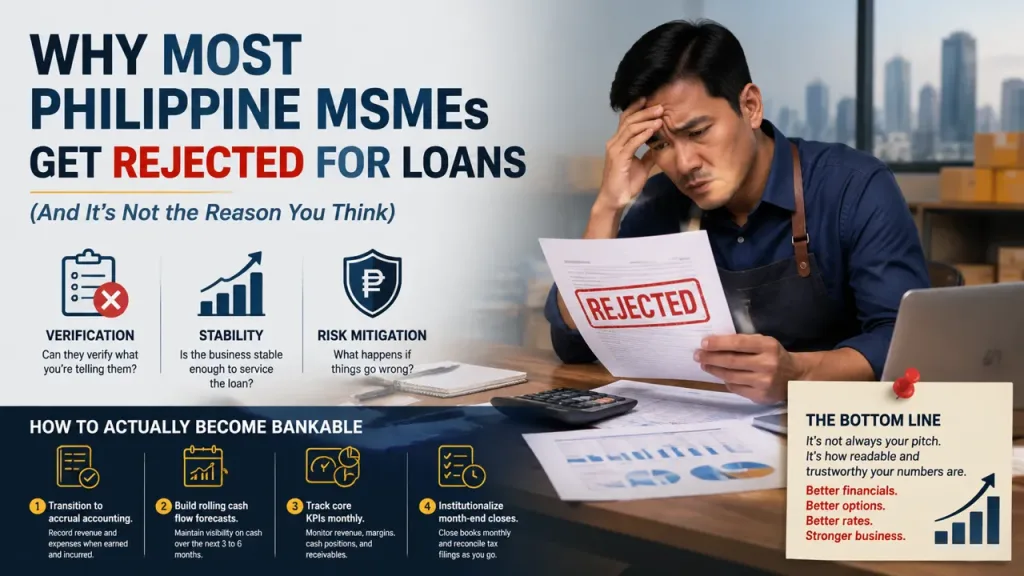
You’ve talked to a few banks. The rates feel high, the requirements feel endless, and the answer keeps coming back as a polite no. So you check another lender’s rate sheet, then another.
Here’s what we’ve learned working with hundreds of SME clients across the Philippines: the businesses that get funded aren’t always the ones with the best pitch. They’re the ones whose financials can actually be read and trusted.
The Real Problem
MSMEs make up 99.5% of registered businesses in the Philippines and employ around 65% of the workforce. Yet banks historically allocate less than 5% of their total lending portfolios to MSMEs, falling well short of the mandatory targets set by the Magna Carta for MSMEs (R.A. 9501).
The capital is actually there. Government banks, commercial banks, digital lenders, fintechs, and asset based financiers are all active in the market. Most MSMEs simply can’t present themselves in a way these lenders can underwrite. That’s the bankability gap, and it’s usually a financial reporting problem, not a business performance problem.
What “Bankable” Actually Means
Every lender is really asking three things:
Verification. Can they verify what you’re telling them through audited financial statements, BIR filings, and bank records that actually match your internal books?
Stability. Is the business stable enough to service the loan, based on consistent revenue and predictable cash flow?
Risk mitigation. What happens if things go wrong, in terms of collateral or transaction history that lets them price the risk accurately?
Most MSMEs stumble at the very first question. We regularly see businesses earning ₱30M to ₱80M a year whose books are kept strictly on a cash basis, whose BIR filings don’t match internal reports, and whose owners run personal expenses through the company. The business is profitable. The reporting simply makes it unfundable.
Common Misconceptions
“I need to find a lender who’ll accept my situation.”
Lender selection isn’t the real variable. Your finances are. Fix the books, and lenders who previously declined you often become competitive on rate.
“My accountant handles all that.”
Filing tax returns to minimize liability and producing lender ready financials are two entirely different jobs. If no one is preparing accrual basis financials or a rolling cash flow forecast, what you have is basic tax compliance, not financing readiness.
“I’ll just go to a fintech, they’re more flexible.”
Fintechs are faster and often collateral free, but they underwrite alternative data like bank activity and invoice flow. Thin or inconsistent transaction data can push effective rates significantly higher than a traditional bank loan.
The Philippine Financing Landscape
The local market spans several tiers, each presenting a distinct trade off between cost, speed, and documentation complexity.
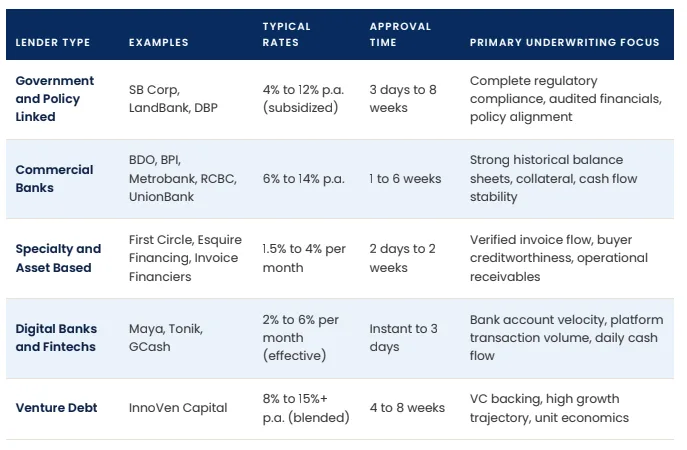
Government lenders sit at the lowest cost point but require the most exhaustive paperwork. Commercial banks are competitive on rate but remain conservative on credit underwriting. Specialty and asset based financiers trade slightly higher rates for operational speed. Digital lenders offer instant velocity, but their smaller ticket sizes make them better suited for short term working capital gaps rather than long term expansion capital. Venture debt remains reserved for funded, high growth startups.
How to Actually Become Bankable
Becoming bankable isn’t a one time project. It’s a set of financial habits, run consistently for a few quarters, that fundamentally change what a credit officer sees when they open your file.
1. Transition to accrual accounting. Record revenue and expenses when earned and incurred, not just when cash changes hands.
2. Build rolling cash flow forecasts. Maintain dynamic visibility on cash coming in over the next 3 to 6 months, not just what sits in the bank account today.
3. Track core KPIs monthly. Maintain a simple dashboard monitoring top line revenue, gross and net margins, cash positions, and aging receivables.
4. Institutionalize month end closes. Treat financing readiness as an ongoing operational discipline. Close your books monthly and reconcile tax filings as you go.
None of these steps change your underlying products or services. They change how readable your business is to an underwriter, and that readability is usually the true difference between a decline and an approval.