
By FarmyHub
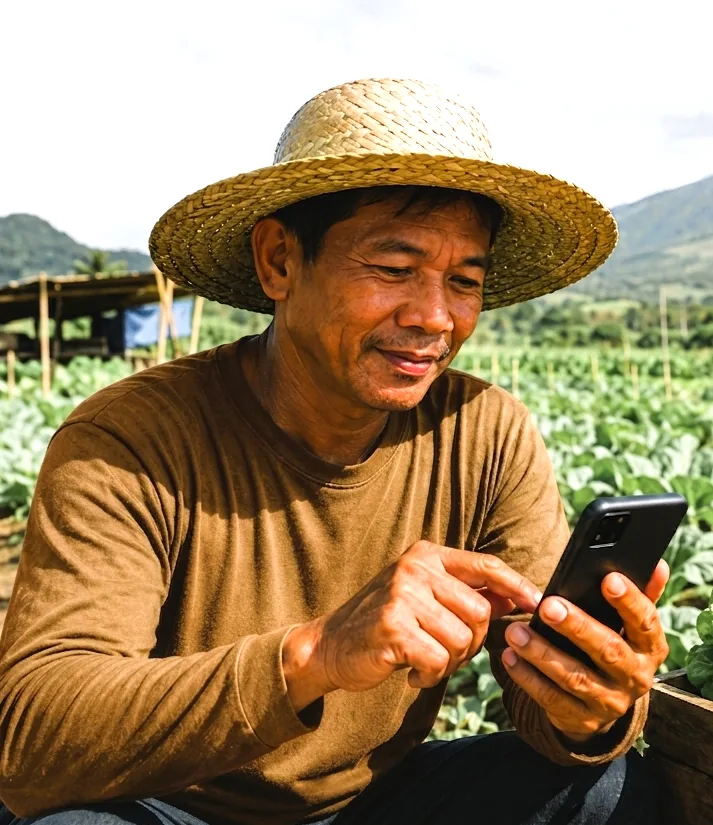
Every day, thousands of Filipino farmers wake up before sunrise to tend their fields, planting, harvesting, and hoping their hard work will translate into a fair price at the market. For many, it often does not. Despite producing some of the region’s freshest vegetables, fruits, and grains, smallholder farmers in the Philippines continue to face a familiar challenge: getting their produce to buyers quickly and at a price that makes their labor worthwhile.
The good news? A quiet revolution is underway and it is being driven not just by policy, but by technology.
The Old Problem with the Old System
The traditional agricultural supply chain in the Philippines has long been dominated by middlemen, traders and consolidators who buy low from farmers and sell high to markets, supermarkets, and restaurants. While these middlemen serve a real logistical function, the margins they capture can be significant, leaving farmers with only a fraction of the final retail price.
According to the Philippine Statistics Authority, agriculture accounts for nearly 10% of the country’s GDP and employs roughly 25% of the labor force. Yet many farming households remain among the most economically vulnerable. The gap between what a farmer earns and what a consumer pays has always been wide, and closing that gap requires shortening the chain.
Connecting the Dots: The Rise of Agricultural Platforms
Over the past few years, digital platforms have begun to bridge this gap. Platforms that connect farmers directly with buyers, whether small retailers, restaurants, food processors, or individual consumers, are gaining traction across the country.
FarmyHub is one such platform. Built with the Filipino farming community in mind, FarmyHub connects local farmers, suppliers, and buyers in a single digital marketplace. The goal is straightforward: give farmers a direct channel to reach buyers without going through layers of middlemen, while giving buyers access to fresh, traceable, locally sourced produce.
The model benefits both sides. Farmers gain better price visibility and a wider pool of potential buyers. Buyers from sari-sari store owners to large food businesses can source directly from producers, often at lower cost and with greater transparency about where their food comes from.
Why This Matters for Small Farmers
Consider a vegetable farmer in Bukidnon or a rice producer in Nueva Ecija. In the past, their options were limited: sell to the nearest trader, bring produce to the local market themselves, or risk spoilage while waiting for better offers. All of these options come with real costs, in time, in transport, and in bargaining power.
A digital platform changes the equation. With a smartphone and an internet connection, a farmer can list produce, set a price, and reach buyers across the region. More importantly, they can build ongoing relationships with buyers who value consistency and quality, creating a more stable income stream rather than a one-time transaction.
For suppliers and input providers, these platforms also create value. Connecting with the farmers who need seeds, fertilizers, or farming equipment becomes easier when there is a shared digital space that both parties already use.
The Broader Ecosystem: Supporting Local Agri-Business
Agricultural platforms do not operate in isolation. Their success depends on and in turn supports, a wider ecosystem of small businesses, logistics providers, and local government initiatives.
When a farmer sells more, they buy more inputs. When buyers source locally, they reduce dependence on imports and support rural economies. When logistics providers gain consistent agricultural clients, they can build routes and capacities that serve entire farming communities.
This multiplier effect is one reason why the Department of Agriculture and various local government units have shown growing interest in digital agriculture initiatives. Programs that support farmer connectivity through subsidized smartphones, rural broadband, or e-commerce training, are investments that pay dividends across the entire supply chain.
Challenges Still to Overcome
No honest account of digital agriculture in the Philippines would be complete without acknowledging the real barriers that remain.
Connectivity. Many farming communities, particularly in upland or island areas, still lack reliable internet access. A digital marketplace is only useful if farmers can actually access it.
Digital literacy. Older farmers, in particular, may be unfamiliar with smartphones or apps. Meaningful adoption requires training, community support, and interfaces designed for first-time users.
Logistics. Getting produce from farm to buyer quickly before it spoils, requires cold chain infrastructure and reliable transport networks that are still underdeveloped in many parts of the country.
Trust. Farmers who have dealt with exploitative middlemen for decades may be understandably cautious about new platforms. Building trust takes time, transparency, and demonstrated results.
These are real challenges, but they are not insurmountable. Platforms that invest in farmer education, partner with local cooperatives, and design for low-bandwidth environments can make meaningful inroads even in difficult conditions.
Stories from the Field
The most compelling evidence for the value of agricultural platforms comes not from data, but from the farmers themselves.
A cacao grower in Davao who used to sell all his harvest to a single local buyer at a fixed price now has multiple buyers competing for his beans and has been able to invest in fermentation equipment that further raises the value of his product.
A vegetable cooperative in the Cordillera that struggled to move produce during typhoon season now maintains a roster of buyers in Metro Manila who have committed to regular orders year-round.
These are not exceptional cases. They are examples of what becomes possible when farmers have more information, more connections, and more choices.
The Road Ahead
The Philippine government has set ambitious targets for agricultural modernization, and digital platforms are increasingly recognized as part of the solution. But technology alone is not enough.
What transforms a platform into a genuine development tool is the community it builds. Farmers who help each other navigate the system. Buyers who commit to fair prices and honest feedback. Local leaders who champion connectivity in their communities. And platform builders who listen to farmers first, and design second.
FarmyHub was built with that philosophy at its core, not as a technology product looking for a market, but as a marketplace built around the real needs of Filipino farmers and the businesses that depend on them.
The potential of Philippine agriculture is enormous. With the right tools and connections, more Filipino farmers can move from surviving to thriving and more Filipino businesses can build supply chains they are proud of.
FarmyHub is a Philippine-based digital platform that connects local farmers, suppliers, and buyers across the country. To learn more, visit FarmyHub.