
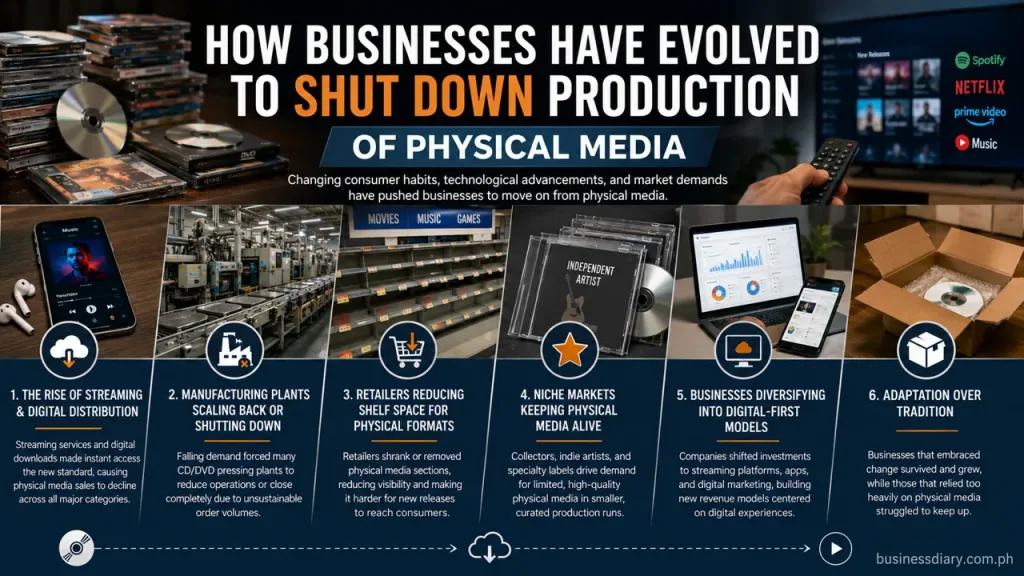
For decades, physical media formed the backbone of how people consumed music, movies, software, and games. CDs, DVDs, and cassette tapes lined store shelves and factory floors churned out millions of copies to meet consumer demand. That world has shifted dramatically over the past two decades, and businesses across nearly every industry have had to rethink their entire approach to production, distribution, and even what counts as a finished product. Understanding how this transition unfolded reveals a lot about how quickly consumer behavior can reshape entire industries, sometimes faster than the businesses themselves are prepared to adapt.
The Rise of Streaming and Digital Distribution
The most significant factor driving the decline of physical media production has been the rapid rise of streaming and digital distribution platforms. Music services eliminated the need for consumers to purchase individual albums, while video streaming platforms did the same for movies and television. Software companies followed a similar path, shifting toward digital downloads and subscription models rather than boxed products sold on store shelves. This shift did not happen overnight, but once digital infrastructure caught up with consumer expectations for convenience and instant access, physical media sales began declining steadily across nearly every category, forcing manufacturers to reevaluate their production capacity and long-term business models.
Manufacturing Plants Scaling Back or Shutting Down Entirely
As demand for physical formats declined, many manufacturing facilities that once operated at full capacity found themselves scaling back production significantly or closing altogether. Large-scale CD and DVD pressing plants, once essential infrastructure for major entertainment companies, became increasingly difficult to justify financially as order volumes shrank year after year. Some facilities pivoted toward niche markets or smaller-batch production runs to stay relevant, while others simply could not sustain operations and shut down entirely. This consolidation left fewer manufacturers standing, which in turn changed the economics of physical media production for the businesses and independent artists who still relied on it.
Retailers Reducing Shelf Space for Physical Formats
Retail environments underwent a parallel transformation as physical media sales declined, with major retailers steadily reducing shelf space dedicated to CDs, DVDs, and related products. What once occupied entire sections of big box stores gradually shrank to a few aisles, and eventually, some retailers phased out physical media entirely in favor of digital gift cards, electronics, or other higher-margin products. This retail contraction created a difficult feedback loop for remaining physical media producers, since reduced shelf visibility made it even harder for new releases to reach consumers who might have otherwise purchased them on impulse while browsing in-store.
Niche and Specialty Markets Keeping Physical Media Alive
Despite the broader industry decline, certain niche markets have kept physical media production from disappearing entirely. Independent musicians, collectors, and specialty labels continue to value physical formats for their tangible appeal and perceived value, particularly among fans who want something more meaningful than a digital file. Businesses serving these markets have adapted by focusing on smaller, higher-quality production runs rather than mass manufacturing. Services offering custom CD printing have found a sustainable niche catering to independent artists and small businesses who want professional, personalized physical products without needing the massive volume that once defined the industry. This shift toward specialization has allowed physical media to survive in a much smaller, more curated form.
Businesses Diversifying Into Digital-First Models
Beyond scaling back physical production, many businesses have fundamentally restructured their operations around digital-first strategies rather than treating digital distribution as a secondary channel. Companies that once built their entire business model around manufacturing and distributing physical products have shifted resources toward app development, streaming infrastructure, and digital marketing instead. This transition required significant investment in new technology and expertise, along with a willingness to abandon long-established revenue models that no longer matched consumer behavior. Businesses that adapted quickly to this digital-first mindset generally fared better than those that clung too long to physical media as a primary revenue source.
Conclusion
The decline of physical media production reflects a broader story about how quickly industries must adapt when consumer preferences shift, sometimes faster than manufacturing infrastructure or business models can keep pace. From manufacturing plant closures to retail space reductions and the rise of digital-first business strategies, nearly every part of the supply chain has had to evolve. While physical media has not disappeared entirely, its role has narrowed considerably, surviving mostly through specialized niches rather than the mass production that once defined the industry.