
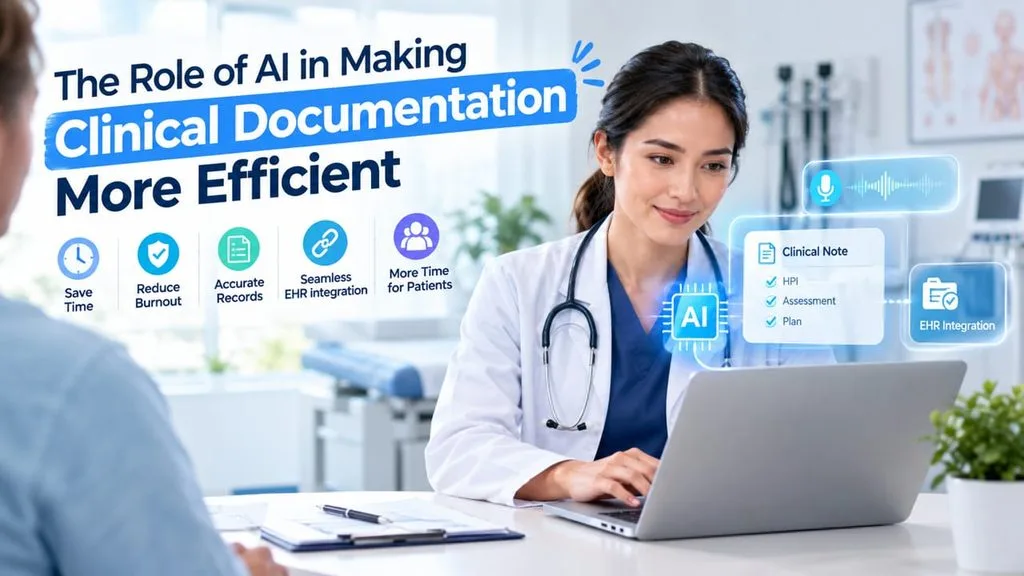
Clinical documentation is essential for maintaining accurate patient records, supporting communication between healthcare professionals, and keeping medical workflows organized. However, creating detailed records can consume a significant amount of a physician’s working day. As healthcare organizations look for ways to improve efficiency, ai clinical documentation is emerging as a practical solution for reducing repetitive administrative work.
By combining artificial intelligence with existing healthcare workflows, providers can streamline documentation while allowing clinicians to spend more time focusing on patients.
The Growing Documentation Burden in Healthcare
Traditional documentation in healthcare often involves manually recording information during or after a patient consultation. Physicians may need to write notes, update records, review information, and complete other administrative tasks.
Over time, this workload can contribute to Physician Burnout, particularly when clinicians have to complete documentation outside normal consultation hours. Reducing repetitive administrative responsibilities has therefore become an important part of improving the overall healthcare experience.
AI can help by capturing relevant information and assisting with the organization of clinical notes, reducing the amount of manual work required from healthcare professionals.
How AI Medical Scribes Improve Documentation
An AI Medical scribe uses artificial intelligence to assist with capturing and organizing information from clinical encounters. Instead of requiring physicians to manually document every detail, the technology can process conversations and generate structured documentation for review.
This approach can make the documentation process more efficient without removing the physician from the decision-making process. Clinicians can review, edit, and approve generated notes before they become part of the patient’s record.
For many practices, this creates a workflow in which technology handles repetitive documentation tasks while healthcare professionals remain responsible for the accuracy and final content.
The Role of Ambient Clinical Intelligence
One of the most significant developments in this area is ambient clinical intelligence. Unlike traditional systems that depend heavily on manual input, ambient solutions can capture relevant information from clinical conversations and help transform it into usable documentation.
Ambient voice technology can support this process by recognizing speech and identifying information that may be relevant to the patient’s encounter. This can help reduce the need for constant typing or traditional medical dictation.
The broader development of ambient ai healthcare applications could make clinical workflows more natural, allowing physicians to focus on conversations rather than constantly switching their attention between patients and computer screens.
Supporting Better EHR Workflows
AI documentation becomes even more useful when it works effectively with existing healthcare systems. ehr integration allows AI-generated information to move into established workflows instead of creating another disconnected process.
Modern ehr software is central to managing patient information, so compatibility can have a major impact on the usefulness of an AI solution. A well-integrated system can help clinicians review documentation within familiar environments and reduce duplicate data entry.
This is particularly important for organizations handling large volumes of patient information, where small workflow improvements can produce significant efficiency gains over time.
Beyond Clinical Notes
The potential of AI extends beyond documentation alone. Technologies such as ai patient intake can help healthcare organizations collect and organize information before a consultation begins.
AI can also assist with transforming conversations into structured soap notes, organizing relevant information, and supporting broader healthcare documentation workflows.
An ai transcription tool can further reduce the time spent converting spoken information into written text. When these technologies are connected effectively, they can contribute to a more streamlined digital healthcare environment.
Measuring the Business Value of AI Documentation
Efficiency improvements also have financial implications. Healthcare organizations evaluating these technologies may consider medical scribe roi alongside productivity, staffing requirements, and administrative time.
AI scribe cost savings can come from reducing repetitive work and allowing clinicians to dedicate more time to patient-facing activities. However, the actual return depends on factors such as implementation, workflow compatibility, adoption, and the volume of documentation handled by the organization.
The most valuable solution is therefore not necessarily the one with the most features, but the one that integrates effectively into everyday clinical operations.
The Future of Efficient Clinical Documentation
AI is changing how healthcare organizations approach administrative and clinical workflows. From automated transcription to ambient intelligence, these technologies can reduce documentation demands while supporting more efficient patient care.
The goal is not to replace clinical expertise. Instead, AI can handle time-consuming documentation tasks so physicians can concentrate on decisions, communication, and patient relationships.
As healthcare technology continues to evolve, ai clinical documentation will likely become an increasingly important component of modern clinical workflows. Organizations that adopt AI thoughtfully—with attention to integration, accuracy, security, and usability—can build more efficient documentation processes while creating a better experience for both clinicians and patients.