
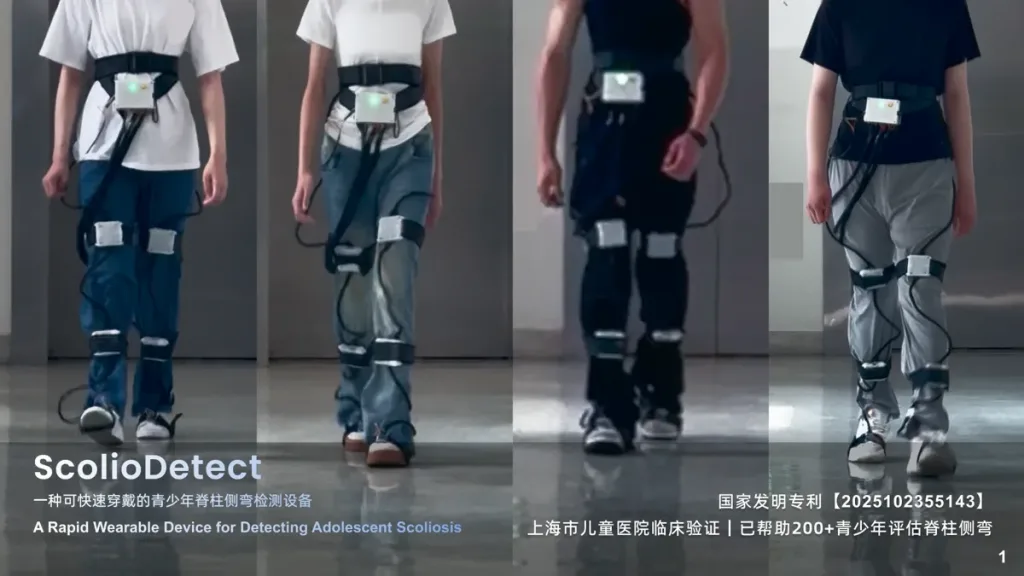
ScolioDetect, an AI-powered wearable sensor developed by Lu Hanwen and Song Xinyuan of Mainland China—and a finalist in the 2025 James Dyson Award—is redefining how medical professionals approach scoliosis screening. Scoliosis affects millions of young people worldwide, yet early detection remains one of the biggest challenges in adolescent health. Studies estimate that 1–3% of adolescents globally are affected by Adolescent Idiopathic Scoliosis (AIS)—a condition that can silently progress without timely intervention (StatPearls, 2024; Scoliosis Research Society, 2024).
Traditional scoliosis screening methods, such as the Adam’s Forward Bend Test, often yield up to 90% false positives, leading to unnecessary imaging, anxiety, and healthcare costs (American Academy of Family Physicians, 2018). This is where ScolioDetect transforms the process—turning gait patterns into real-time, radiation-free spinal assessments with 3° accuracy, making early diagnosis faster, safer, and more accessible.
What Is ScolioDetect and How It Works
ScolioDetect uses intelligent motion analysis to detect spinal asymmetry before it becomes visible to the naked eye. The system consists of wearable IMU (Inertial Measurement Unit) sensors strategically placed along key anatomical landmarks of the body. These sensors capture spinal and lower limb dynamics while the user walks naturally.
Data from these movements are collected at 100Hz through synchronized microcontrollers, ensuring real-time sampling precision. The information is then processed by an AI algorithm trained using musculoskeletal simulation models and reinforcement learning to identify subtle asymmetries.
Unlike X-rays, which expose patients to radiation, or scoliometers, which rely on subjective assessments, ScolioDetect provides an objective, quantitative measure of spinal curvature. Its cloud-based continuous learning system improves accuracy over time, adapting to diverse body types and movement patterns.
Why Early Detection Matters
Early diagnosis of scoliosis is critical for preventing spinal deformities that can lead to chronic pain, respiratory issues, and surgical interventions.
A 2024 review in Frontiers in Pediatrics revealed a global AIS prevalence of 1.7%, emphasizing the need for widespread and accurate screening in schools and communities (Zhang et al., 2024). Similarly, StatPearls (2024) notes that up to 3% of adolescents are affected, with progression risks increasing during growth spurts.
Conventional screening methods such as the Adam’s test and surface topography often misclassify normal postural variation as scoliosis, yielding up to 90% false positives (American Academy of Family Physicians, 2018). Moreover, reliance on visual inspection and manual testing leads to inconsistent results.
ScolioDetect addresses this diagnostic gap by turning motion data into a digital health metric, capable of distinguishing true spinal curvature from temporary asymmetries caused by poor posture or uneven gait.
Design and Development Process
The development of ScolioDetect followed a three-phase engineering and clinical validation process:
- Phase I – System Design and Engineering:
Engineers established the sensor configuration, sampling frequency, and anatomical placement standards. Synchronization across the multi-channel IMU array was achieved using hardware-triggered timing technology, ensuring minimal latency and high precision. - Phase II – Clinical Integration:
Collaborations with orthopedic specialists guided improvements in comfort, usability, and setup efficiency. The sensor array was refined with flexible housings, lightweight materials, and efficient data cables to suit adolescents in real-world conditions. - Phase III – Validation and Testing:
Clinical trials conducted on over 200 adolescent participants confirmed ScolioDetect’s 3° mean absolute error in detecting spinal curves. The tests validated its ability to identify early spinal asymmetry through gait analysis, achieving accuracy levels comparable to advanced imaging—but with zero radiation exposure.
What Makes ScolioDetect Different
ScolioDetect stands out from traditional diagnostic tools for several reasons:
| Feature | Traditional Screening (e.g., Adam’s Test, Scoliometer) | ScolioDetect |
|---|---|---|
| Detection Basis | Static posture assessment | Dynamic gait and movement analysis |
| Accuracy | ±7° error or higher | ±3° mean absolute error |
| False Positives | Up to 90% | Significantly reduced |
| Radiation Exposure | Yes (X-ray-based confirmation) | None |
| Operator Dependence | High | Minimal (AI-driven) |
| Usability | Requires specialists | Portable, easy-to-use, suitable for schools |
This system offers a portable, non-invasive, and clinically reliable alternative to conventional diagnostics. Its ability to detect spinal deformities dynamically makes it particularly effective for mass school-based screenings—a crucial advancement in global adolescent healthcare.
Future Plans and Global Impact
ScolioDetect’s creators plan to launch pilot programs across clinics and schools, targeting 5,000 students to benchmark performance and collect large-scale data. Following this, the team aims for medical certification, mass production, and distribution through educational and healthcare institutions.
Once fully deployed, ScolioDetect could transform community-based scoliosis screening, reducing hospital bottlenecks, healthcare costs, and missed diagnoses worldwide.
By combining AI with biomechanics, this innovation paves the way for a future where scoliosis screening is quick, accurate, and accessible to every adolescent—no X-rays, no guesswork, just smart prevention.
Conclusion
ScolioDetect embodies the fusion of AI innovation, clinical accuracy, and accessibility. With scoliosis affecting millions of adolescents globally, its arrival couldn’t be timelier. By capturing the subtle language of body movement, ScolioDetect empowers parents, schools, and healthcare providers to detect scoliosis earlier—before irreversible deformities develop.
As one of the finalists in the 2025 James Dyson Award, ScolioDetect stands as a powerful example of how technology can bridge the gap between medicine and mobility, ensuring every young spine gets the care it deserves.
References
- American Academy of Family Physicians. (2018). Screening for adolescent idiopathic scoliosis. Retrieved from https://www.aafp.org/pubs/afp/issues/2018/0515/od1.html
- James Dyson Award. (2025). ScolioDetect – A wearable sensor for scoliosis detection. Retrieved from https://www.jamesdysonaward.org/2025/project/scoliodetect
- Scoliosis Research Society. (2024). Idiopathic scoliosis: Facts and figures. Retrieved from https://www.srs.org/Patients/Conditions/Scoliosis/Idiopathic-Scoliosis
- StatPearls. (2024). Adolescent idiopathic scoliosis. National Center for Biotechnology Information. Retrieved from https://www.ncbi.nlm.nih.gov/books/NBK499908
- Zhang, Y., Li, C., & Zhou, H. (2024). Global epidemiology and prevalence of adolescent idiopathic scoliosis: A systematic review and meta-analysis. Frontiers in Pediatrics. Retrieved from https://www.frontiersin.org/articles/10.3389/fped.2024.1399049/full
Photo and project details courtesy of the James Dyson Award (2025) official project page.