
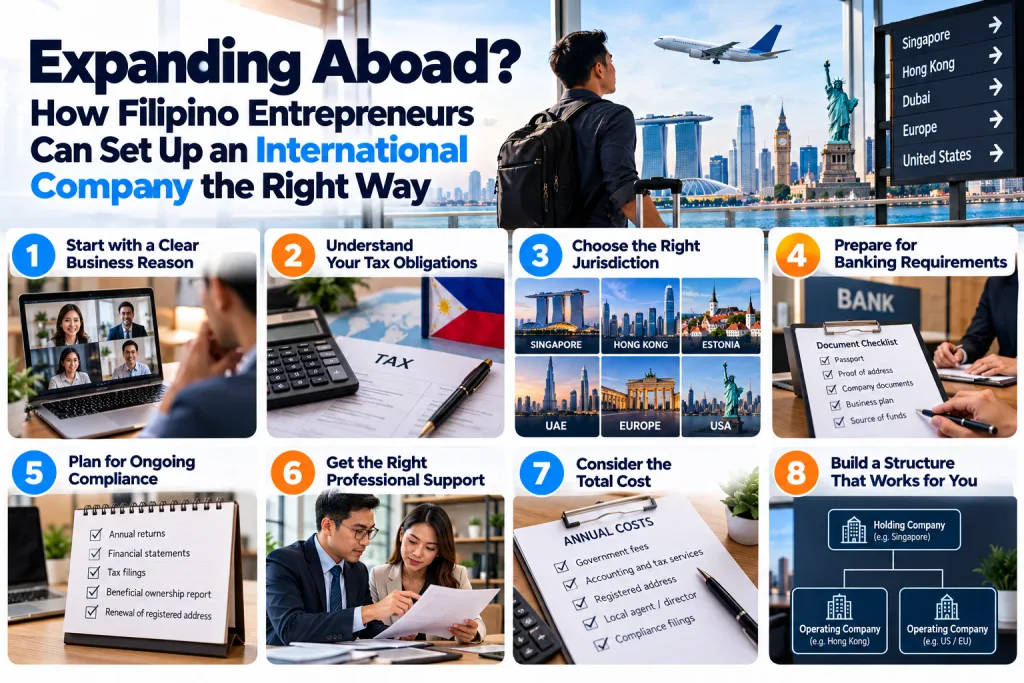
More Filipino business owners are selling beyond the Philippines than ever before. A Cebu-based software shop lands a client in Germany, an online seller in Davao starts shipping to Singapore, or a BPO founder in Makati gets asked by a US customer to “invoice from a foreign entity.” Sooner or later, a question comes up: should I set up a company outside the Philippines?
Sometimes the answer is yes. Sometimes it’s a costly mistake. Here’s a practical look at how to think it through before you spend money on lawyers, registration fees and bank paperwork.
Start with the business reason, not the tax rate
The most common mistake is choosing a country because someone online said it has “zero tax.” Low tax alone is rarely a good reason to open a foreign company, and it can attract exactly the wrong kind of attention from banks and regulators.
Good reasons usually look like this:
- Your customers require it. Some large clients, especially in the EU and US, prefer contracting with a local or regional entity.
- You need access to payment rails. Certain payment providers and marketplaces only onboard companies registered in specific countries.
- You’re raising money. Foreign investors often prefer to invest through a holding company in a jurisdiction they know, such as Singapore or Delaware.
- You need a licence. Regulated activities like payments, crypto services or financial advice may need a licence in the market you’re serving.
- You’re physically operating there. If you hire staff or rent an office abroad, you’ll likely need a local entity anyway.
If none of these apply, staying a Philippine corporation (registered with the SEC) or a sole proprietorship (registered with the DTI) and simply exporting your services may be the cleaner option.
Understand where you’ll actually pay tax
Here’s the part many founders miss. Registering a company abroad does not automatically move your taxes abroad.
The Philippines taxes resident citizens on their worldwide income. If you live in Manila and run a foreign company from your laptop, tax authorities may argue that the company is effectively managed from the Philippines. On top of that, many countries now apply “substance” rules: they expect a company to have real management, staff or decision-making in the country where it’s registered.
Before you register anything, sit down with a Philippine tax adviser and ask three direct questions:
- Where will this company be considered tax resident?
- How will the money I take out (salary, dividends, service fees) be taxed here?
- Is there a tax treaty between the Philippines and the country I’m considering?
The Philippines has double taxation agreements with a long list of countries, including Singapore, Japan, the US and several EU member states. A treaty can make a big difference to how dividends and service fees are taxed, so check the specific agreement rather than assuming.
Choosing a jurisdiction: the usual shortlist
There’s no single “best” country. It depends on who your customers are and what you sell. A rough way to think about popular options:
Singapore is the natural first stop for many Southeast Asian founders. It’s close, English-speaking, well regarded by banks and investors, and has a straightforward registration process. Note that a Singapore company needs at least one locally resident director, so foreign founders usually appoint a nominee or relocate.
Hong Kong remains a trading and sourcing hub, particularly for businesses dealing with mainland China, and uses a territorial tax system.
Estonia is popular with digital businesses that sell into the European Union. Its e-Residency programme lets non-residents start and manage an Estonian company online, and corporate income tax is only charged when profits are distributed. You will still need a contact person or registered address in Estonia, and a bank or payment account that accepts you.
Other EU countries such as Ireland, the Netherlands or Cyprus may make sense if you’re serving European clients at scale or need an EU licence that can be “passported” to other member states.
The UAE has grown fast as a base for consultancies and trading businesses, with free zones offering simple setups. The UAE introduced a federal corporate tax in 2023, so the old “no tax” reputation needs updating.
The US (often Delaware or Wyoming) suits founders selling mainly to American customers or raising from US investors. Federal and state filing obligations apply even if the company earns little, so budget for an accountant.
Whatever you pick, think in terms of structure, not just one entity. Many growing companies end up with a holding company in one country and an operating company in another, with clear agreements between them. Getting this right early is far cheaper than untangling it later, which is why specialist firms that handle cross-border business structuring are worth a conversation before you file any registration forms.
Banking is the real bottleneck
Registering a foreign company can take a few days. Opening a bank account for it can take months.
Banks worldwide have tightened anti-money laundering (AML) and “know your customer” (KYC) checks. When a Filipino founder applies for a business account abroad, expect to provide:
- Certified passport copies and proof of address
- The company’s registration documents and shareholder register
- A business plan showing where clients and suppliers are
- Proof of where your money comes from (source of funds)
- Sometimes an in-person interview
Practical tips:
- Prepare a clear one-page business summary. Banks reject applications they don’t understand.
- Be consistent. The activity on your registration, website and bank application should match exactly.
- Consider electronic money institutions (EMIs) as a stepping stone. Fintech account providers often onboard faster than traditional banks, though they may have lower limits and fewer services.
- Keep your Philippine accounts healthy. A clean local banking history helps your credibility.
Don’t forget ongoing compliance
A foreign company is not a “set and forget” asset. Typical recurring obligations include:
- Annual returns or confirmation statements
- Annual financial statements, sometimes audited
- Local tax filings, even if the tax due is zero
- Beneficial ownership reporting
- Renewal of registered address and local agent services
Missing deadlines can mean fines, a struck-off company, or a frozen bank account. Put every deadline in a calendar, and budget for a local accountant or corporate service provider from day one. The yearly cost of keeping a company in good standing is often higher than the cost of setting it up.
A simple checklist before you commit
Before you sign anything, make sure you can answer these:
- Why do I need a foreign company? (Customers, payments, investors, licence, or operations.)
- Where will it be tax resident, and how will I be taxed in the Philippines?
- Which bank or payment provider will realistically accept it?
- Who will act as director, company secretary or local agent?
- How much will it cost per year to stay compliant?
- What happens to my existing Philippine business? Will the two companies trade with each other, and on what terms?
Final thoughts
Going international is one of the most exciting steps a Filipino business can take. Done well, a foreign entity can open doors to bigger clients, better payment options and serious investors. Done badly, it becomes an expensive shell that banks won’t touch and tax authorities question.
Take your time, get advice from both a Philippine tax professional and someone who knows the target jurisdiction, and build your structure around how your business actually works. The paperwork is the easy part. The planning is what makes it pay off.