
Most businesses have a number of automated processes in place. They may have a small number of scripts or rules in place, or they may even have an older robotic process automation (RPA) tool in use from several years ago which no one has had time to update since its initial implementation.
These systems work well enough until they don’t. When a data field is re-named, or when a supplier begins sending invoices in a new format, the system simply stops operating. Then someone spends time fixing the issue late at night on a weekend. This is where generative AI and AI agents fit into the picture.
Generative AI and AI agents aren’t simply upgrades to existing systems; rather, they provide another method for automating processes which are capable of handling unstructured input and making minor decisions as required throughout the process.
Why Rule-Based Automation Keeps Hitting a Wall
Rules require clean inputs. In reality, the data that businesses create is messy. It’s an email containing multiple questions. It’s an image of a PDF that was scanned crookedly. It’s the hurried typing of a chat message. It’s notes only the person who wrote them could understand. Because old style automation cannot process this type of information, people are left to copy, verify, make decisions and type again. These human steps take days to accomplish and were never intended to occur. They simply evolved over time.
Two Different Types of Jobs for Two Different Parts of AI
Two different jobs are done by generative AI. Think of generative AI as a very fast reader and writer. Generative AI reads through contracts, complaints or even a long email exchange and tells you the most important things in each document. After reading the documents, generative AI will either create a response or a brief summary of the documents.
The majority of generative AI development focuses on creating a reliable way for generative AI to understand the content of the documents. Generative AI uses data from companies to test its ability to understand the content.
When generative AI creates a response or a summary of the documents, the response/summary should stay focused on the content of the documents. An agent is a very similar type of reader as generative AI, however an agent also has a checklist of tasks to complete, a username/password to log into systems with and a specific objective. An agent can read information, determine the next step to take based on that information, update systems and verify that its actions were successful.
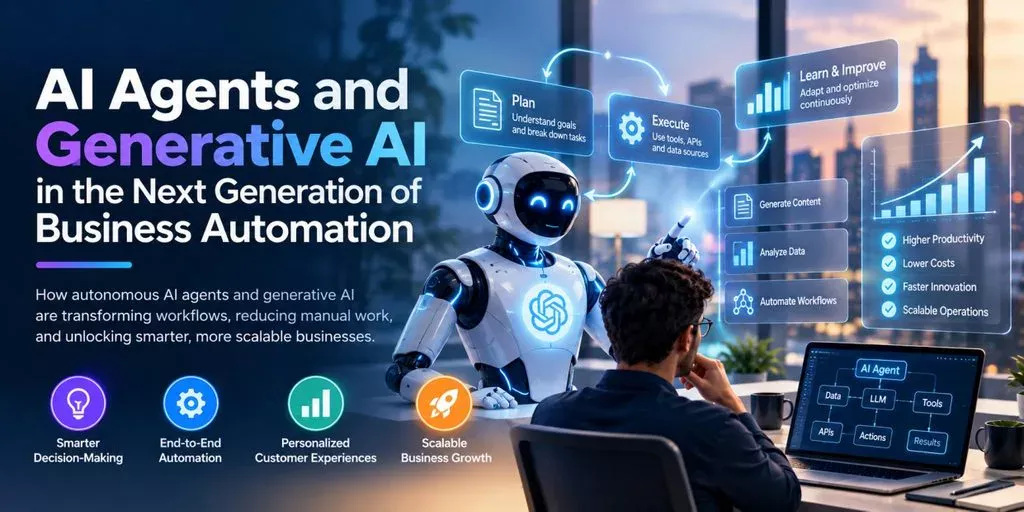
In addition to reading information, agents also have planning capabilities. Agents also have the ability to connect to tools and use those tools to perform tasks. Finally, agents have rules that define which areas/parts of the systems an agent is authorized to interact with. If both generative AI and agents are combined, they form agentic AI solutions.
A customer service representative receives a request from a customer. Generative AI understands the request. Agents use their abilities to handle the request by accessing multiple systems.
The final outcome of the request only lands with a human employee if the human employee is needed to complete the task. Instead of being viewed as a smarter version of a tool that performs repetitive tasks for employees, agentic AI solutions are similar to having a coworker who takes care of the repetitive aspects of an employee’s job.
Where AI Workflow Automation Is Landing First
Automation of AI workflows has been successful in the early stages as it tends to follow a similar model. Many unstructured inputs are processed with a decision made based upon policy and finally an update is sent out.
These patterns exist across many different industries including: Customer service departments sorting through tickets and creating initial responses. Accounts payable departments verifying invoices against purchase orders and identifying those which appear abnormal.
Sales departments maintain up-to-date information in their CRM systems for follow-up purposes. Desks at human resources and information technology offices repeatedly answering the same 20 questions throughout the entire week.
Procurement departments reviewing multiple bids from potential vendors and following up on approval requests. It may not seem exciting to automate this type of work, but that is exactly why it provides such quick returns.
What Enterprises Usually Underestimate
Most enterprises tend to underestimate these things: The choice of which model to use seems like the most important thing to choose from.
However, many times this is the least difficult thing to decide on. The real issues arise when you have to answer all of those other questions about the model. What user can this agent represent?
What data can this agent view? How will this agent interface with a 10 year old ERP system that doesn’t have an API? How can we determine if this agent is correct, not just if it sounds correct? And how much does it cost when you need to make 6 model calls for every task you want done versus one?
This is why enterprise generative AI isn’t simply a model dropped into a chat window. Enterprise generative AI requires data pipelines, access control mechanisms, evaluation processes, logging capabilities and someone monitoring the model after deployment.
Because most of the work involved in building enterprise generative AI occurs in developing the “plumbing” around the model, many organizations hire Enterprise Generative AI Development Services to assist them in this area.
Keeping People in the Loop Without Slowing Things Down
A common concern is whether the agents are performing enough, or too much. One method to address this issue is by establishing a level system. Minimal risk operations (tagging a ticket, filing a document etc.) can be performed independently; anything that requires monetary commitment, customer obligation, or sensitive data needs to go through an agent for quick approval.
As you gain more experience and demonstrate your ability to get things done correctly over time, you may find that you can ease up on some of the previously required approvals. You earn trust through performance and not through taking a leap of faith based upon a demonstration.
A Sensible Way to Start
Most companies will continue to produce consistent results with the first phase being kept relatively modest: Choose a workflow that is currently hurting you today. Write down every single step of your workflow exactly as they are performed (even if they’re messy).
Have your agent work alongside the employees for a couple of weeks to see what changes occur. Record how much time was saved due to automation, the error rate of your agents, and how frequently your agents requested assistance. Do not expand until you have positive data.
This may appear to be a slower method; however, it prevents large rollouts from quietly disappearing without anyone noticing, as no employee trusts the new system.
Also Read : Couchbase AI Services Put Enterprises in Control of Agentic AI
Mistakes That Repeat Themselves
There are some common themes that keep appearing. The team pursues a flashy demonstration and avoids the unappealing cleanup of data. New hires receive wide access to the system from their first day of employment, as it’s easier to create the account. No one defines what constitutes success, therefore, no one knows whether the project was successful or not.
The launch of the system is viewed as the final phase of the project, however, models will evolve, policies will be revised and the workflow will need continuous attention just like every other aspect of the organization. Employees are important in this regard as well.
If employees perceive that the implementation of the agent is occurring at their expense (rather than for their benefit), the process of obtaining employee acceptance will become difficult very quickly. Typically, demonstrating how the agent eliminates mundane tasks is extremely beneficial.
Wrap Up
The trend in business automation has been towards a system capable of reading, judging and acting (rather than being based on pre-defined rules). Generative AI provides the reading capability, while agents provide the follow-through; however, the biggest impact is usually seen when these two elements are combined with the actual data and processes of a business.
Typically, it is easier to achieve positive results by starting small, defining boundaries, and making gradual improvements as opposed to attempting to automate all areas simultaneously.
If your team is interested in pursuing this type of automation, WeblineIndia has extensive experience in software development and artificial intelligence which could assist you in taking an initial idea and transforming it into a practical solution for your business.
Author
Sunil Mohan
As a Digital Marketing Specialist at WeblineIndia, I create data-driven marketing strategies and content that enhance brand visibility and audience engagement. Passionate about technology, AI, and digital innovation, I enjoy communicating ideas that help businesses and readers stay ahead in a rapidly evolving digital world.