
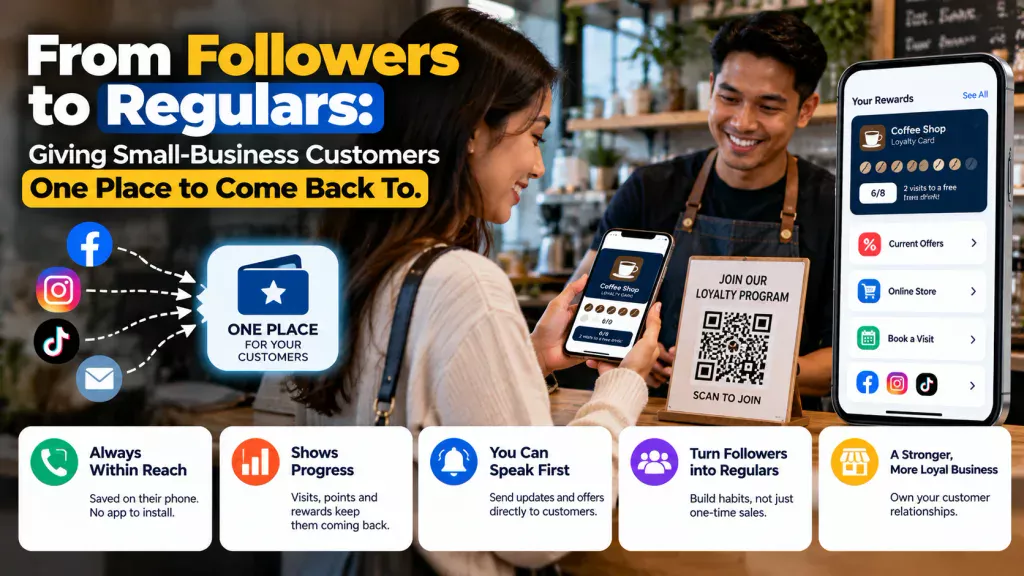
Ask a small-business owner where their customers are and the answer is usually “everywhere.” Some follow the shop on Facebook, others on Instagram or TikTok. A few joined a group chat, some signed up for an email list years ago, and many simply walk in whenever they happen to pass by. Each channel holds a slice of the audience, and none of them holds the whole relationship.
That fragmentation has a cost. A post reaches only part of the followers, and only for a few hours. A promotion announced in one place is missed by everyone who lives somewhere else. And the most valuable customers, the ones who already buy regularly, are often the least likely to be scrolling the shop’s feed. They do not need persuading to visit. They need a reason to visit a little more often.
The difference between a follower and a regular
A follower has expressed interest. A regular has formed a habit. Businesses grow when they turn the first into the second, and the tools that do that best share three qualities:
- They are always within reach. The customer should not have to search for the shop’s page or remember a login.
- They show progress. A visible count of visits, points or rewards gives people a reason to return before the next payday, not after.
- They let the business speak first. A short message sent at the right moment brings back a customer who was drifting, without paying for an ad.
One page instead of five channels
This is why more small businesses are giving their customers a single home base: a simple page that shows the customer’s loyalty card, the rewards they have earned, current offers, and links to the shop’s social accounts, booking or online store. It opens straight from a card saved in the phone’s wallet, so there is nothing to install from an app store and nothing for the customer to remember.
For the owner, a loyalty app for small business built this way does the job that a link-in-bio page, a paper stamp card and an occasional promotional blast used to do separately. Customers join by scanning a QR code at the counter. Staff record visits or purchases with a quick scan. And the business can send a message that lands on the customer’s phone, rather than hoping the algorithm shows the next post.
Where to start
The practical first step is modest. Choose one reward that suits the business: a free coffee after eight visits, a discount on the fifth haircut, a free delivery after a set number of orders. Put the QR code where customers already wait, at the counter, on receipts, in the delivery bag. Then tell every customer about it for a month. Staff mentioning the program in one friendly sentence will do more than any poster.
After that, watch three numbers: how many customers joined, how often members come back compared with everyone else, and how many have gone quiet. Those figures show quickly whether the program is building habits or just handing out discounts.
Owning the relationship
Social platforms will keep changing their rules, their reach and their prices. A customer who has saved your card on their phone is different: that connection belongs to the business, not to a platform. For a small company competing with bigger brands and bigger budgets, that may be the most valuable asset it can build, one regular at a time.