
Modern eCommerce has become a complex, vast market where the number of products available is constantly increasing, the purchase process spans multiple channels, and users expect real-time, relevant information in every interaction.
Generative AI provides one of the best solutions to this growing difficulty. Businesses in both B2B and B2C markets can utilize generative AI technology to produce contextually relevant material, provide product suggestions and recommendations, gather user insights and feedback, as well as provide automated responses across multiple channels to assist them in dealing with increased complexity while still providing customized products and services and operating efficiently.
Therefore, this article will discuss some specific areas within eCommerce, which will benefit from applying generative AI products to the real world, providing a positive return on investment for nearly every business utilizing generative AI.
Generative AI in eCommerce: Its Role and Use Cases
A subset of AI systems known as “generative AI” creates new content or outputs instead of merely analyzing preexisting data, as is the case with conventional analytics-based AI systems. eCommerce uses generative AI to offer:
- More effective product names, descriptions, and attributes.
- Personalised product recommendations.
- Marketing copy that better fits a customer’s needs.
- Conversational responses for customer service inquiries.
- Dynamic pricing models based upon real-time data.
- Real-time business insights.
McKinsey estimates Generative AI will deliver $240-$390 billion of annual value to the Retail and Consumer Goods Sectors. The majority of that value will come from Creating Personalization, Pricing Optimization and Automated Content Creation. According to Gartner, in 2026, over 80% of all Customer Interactions within Digital Commerce will be influenced by Generative AI.
Context, consumer intent, and prior brand interactions can all be taken into account by generative AI. Compared to traditional AI, which either classifies or predicts outcomes, this represents a significant shift. As a result, eCommerce platforms that use generative AI can move away from static procedures toward more flexible and responsive ways of producing results. Working with an experienced AI assisted development partner can also help businesses integrate these capabilities into existing commerce platforms, data pipelines, and operational workflows.
For both types of business, B2B and B2C, AI enables more engagement with customers, more automated manual tasks, and an increased ability for them to grow without increasing their operational costs at the same rate. A study by BCG shows that companies using AI on a large scale in commercial operations increase productivity by 20% and make faster decisions than sales and merchandising teams not using AI.
Personalizing Customer Experiences at Scale
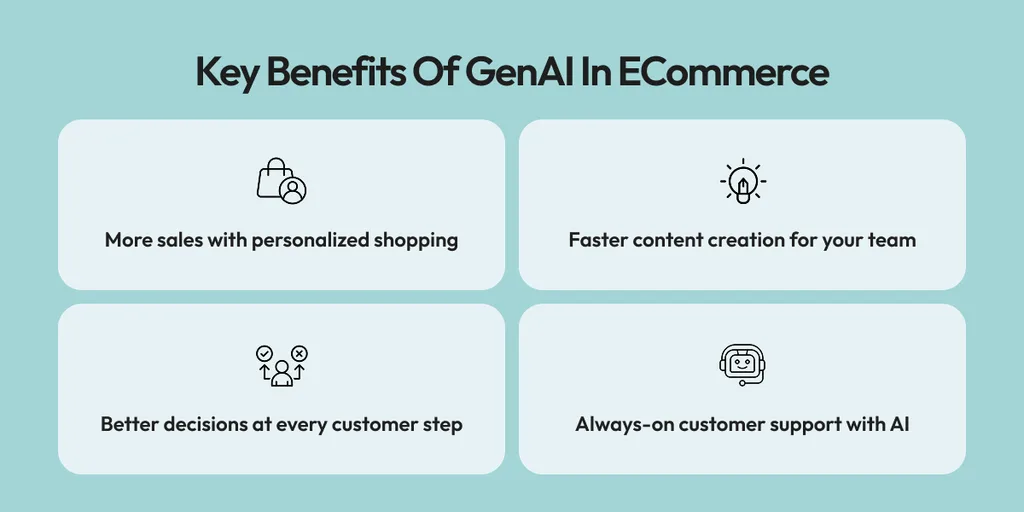
Personalization is now expected to be a fundamental part of a customer’s interaction with a business, not just as a competitive advantage to win over customers from another brand or retailer. Consumers use many different types of digital solutions every day and are quick to identify when they have a generic or non-personal experience.
Generative AI allows personalization to be achieved at a level that is not possible through any other type of method. By analyzing buying behavior, purchase history, session context, and user behavior, Generative AI will provide a unique set of products and services based on each customer’s interaction, as opposed to providing generic segments.
In B2C eCommerce, personalization typically manifests as dynamic recommendations of products, as well as the dynamic nature of the landing page and promotion aspects, and can create a significant change in what a returning sportswear customer sees versus a first-time casual shopper.
In B2B Companies, personalization represents a much more advanced workflow. Most customers purchase with the understanding that they are purchasing under a contractual agreement, set approved assortments, and that they may have to seek approval from other procurement processes. Generative AI can be applied to create customer-specific catalogs, show the most ordered products, and assist in reducing the need for manual data entry and searches, thus reducing the time between orders.
The positive results of effective personalization can be quantified. When experiences are tailored to meet the needs of the buyer, this leads to a better overall experience for the customer, an increase in engagement and conversion rates, a stronger perception of the relationship, and also lessens the workload of adding items to merchandising and creating marketing campaigns.
Enhancing Product Descriptions and Catalog Management
The process of managing a large product catalog is a resource-heavy task for any eCommerce business, and manually writing, editing, and translating product content for every item becomes increasingly challenging as the number of items continues to increase.
With generative AI, you can automate the creation of content (product descriptions, product specifications, and other related materials) from your structured data. Rather than having to write descriptions for thousands of SKUs (stock keeping units), your team can set up attributes for each SKU and provide brand guidelines for your AI to generate content that will be consistent and SEO (search engine optimization) friendly.
This allows B2C retailers to get products to market faster and creates a consistent message across all channels. Besides, B2B suppliers have the opportunity of employing generative AI for the generation of technical descriptions, usage instructions, and documentation that will be suited for various buyer roles and industries. This, on the one hand, eliminates misunderstanding and, on the other hand, establishes trust between the buyer and the seller during the difficult process of purchasing.
Revolutionizing Visual Content and Product Presentation
Text-based content creation is not the only use for generative AI. Applications of generative AI can be found in a number of industries, including eCommerce, where it is used to create digital assets that support product display, such as images, videos, and text.
Compared to traditional photography, generative graphics enable the creation of virtual product displays, customized product variations, and lifelike visual representations of products at no cost and in significantly less time. For example, furniture manufacturers can use generative visuals to create realistic room visualizations so that consumers can picture their products in actual settings, and the fashion retail sector can use generative graphics to make outfit mixing available in various colors and styles.
Visual generation also helps B2B companies to develop more complex visual representations for use in highly technical applications, such as layout simulations and configuration previews, as well as digital twins, which allow B2B companies to conduct better customer evaluations before making any purchase decision.
Using generative visuals with behavioural data gives businesses a clearer picture of their customers’ intent and, thus, leads to greater customer engagement and increased confidence in buying decisions.
Optimizing Marketing Campaigns With Generative AI
Marketing professionals feel the pressure to generate content that will meet the needs of multiple channels and provide value to the marketer. The advent of generative AI has helped make it possible for marketers to automate the production of content through the ability to create customized copy, images, and messaging for each unique audience segment.
The application of generative AI in B2C marketing has created the opportunity for marketers to create many different variations of their advertising messages and test them in real-time to see which performs best, resulting in a higher return on investment for the money invested in advertising.
Marketers in the B2B sector have taken full advantage of generative AI and developed a range of different educational resources, for example, account-based communication, targeting specific industries through campaigns, and delivering the appropriate content throughout the decision-making process of the customers and the corresponding sales funnel stages.
Elevating Customer Support Through Conversational AI
As customer support is essential to an eCommerce company’s ability to meet its objectives, learning how to effectively scale the department is challenging. Conversational assistants utilizing generative artificial intelligence are designed to answer common questions, provide assistance through automated processes and deliver contextual support.
In the B2C space, AI-enabled chatbots can be used for 24/7 order tracking and returns, and also answer basic product inquiries. In the B2B sector, conversational artificial intelligence assists with the onboarding of new customers, answers questions about technical support, and supports contract management processes so that human agents can devote their time to more complex inquiries.
The implementation of these technologies leads to a decrease in support costs, an improvement in response rates, and an ultimately increased level of customer satisfaction. Well-designed systems come with escalation and governance mechanisms built in to make sure that problems are escalated and solved in a right manner.
Predictive Insights and Inventory Management
AI predictive analytics is a great application of Generative AI because many do not realise how useful these technologies can be in their day-to-day business operations. By analysing past sales data and comparing it to current “market signals” such as current sales trends, social media, competitors’ pricing, etc., AI can produce forecasts to assist with forecasting and managing inventory.
For example, when using the insights of these AI forecasts to support both consumer and retailer businesses, B2C retailers will analyze the insights of these seasonal and other market trends so that they can optimise their stock levels against what is expected to sell.
For B2B distributors, using the AI insights allows distributors to forecast what will be required based on demand from their clients, provide for less overstocking and enable timely delivery to their customers.
Thus, using AI forecasting combined with supply chain workflows allows businesses to make quicker decisions and create a more resilient operation for their business.
Streamlining Pricing and Promotions
Pricing continues to be a complex challenge within eCommerce. Generative AI will provide a solution to dynamic pricing. It will allow retailers to analyze competitors’ activities, customer behaviors and market conditions for real-time data.
B2C businesses can utilize generative AI for creating targeted promotions that are tailored to their customers’ preferences and for creating personalized offers based on the products consumers have viewed, and thus, increasing their conversion rates while preserving the company’s margins. Generative AI will also assist B2B eCommerce with volume-based pricing through contract negotiations and optimizations of discounts.
Using generative AI allows all retailers to create a pricing strategy that continuously adapts and evolves while allowing them to provide transparency to their customers.
Creating Conversational Commerce Experiences
Consumers interact through conversational interfaces with businesses in conversational commerce, i.e., they continue their business talks while speaking to customers in a natural, back-and-forth manner rather than still maintaining a pervasive barrier and keeping the business agents icy cold. Generative AI powers chat-based and voice-based experiences that enable consumers to independently discover new products, receive recommendations, and make informed decisions.
B2C use case examples would include using conversational assistants to help the consumer locate products, create product comparison charts, and make final purchases. In B2B implementation, AI will actively assist businesses with generating quotes, guiding configuration and guiding the procurement process, thereby streamlining complex B2B purchases.
Overall, these AI-enabled experiences improve sales cycle length and consumer satisfaction by making the interaction more aligned with the user’s needs.
Implementation Challenges and Risks of Generative AI in eCommerce
Although the pros are obvious, the generative AI embrace in eCommerce offers some hurdles that companies need to deal with at the very beginning. The neglect of these risks, in most cases, results in systems with low performance, increased operational expenses, or mistrust among the customers.
Data Quality and Fragmentation Risks
Data quality is one of the most frequent difficulties. Generative AI applications are reliant on structured, trustworthy, and current data. In a number of companies, product data, customer databases, and historical transactions are still scattered across different systems. In the absence of data management protocols, the outputs of AI may not only be inconsistent but also inaccurate.
Hallucinations and Factual Accuracy Issues
The other major challenge is the possibility of hallucinations and errors in facts. Even though generative models can very well create content that sounds fluent, they can also very well produce incorrect specs, pricing info, or policy outlines, unless some controls are put up. This situation is very delicate in the case of B2B commerce, where the wrongs can ripple on contracts, compliance, and operational decisions.
Cost Management and Infrastructure Complexity
Further, cost management needs to be accurately planned. The running of large language models comes with huge demands for computational power and, if not monitored, the cost of the infrastructure can easily run out of control in no time. Thus, companies will have to set limits on usage, optimize cache, and have fallback measures in place to ensure that the costs remain within predictable limits.
Legal, Regulatory, and Transparency Considerations
In addition, generative AI usage-related legal and regulatory factors are assuming more and more importance. The rules on ownership of intellectual property, data protection, and the need for transparency differ from one location to another, and from one industry to another. Organizations must make sure that their generative AI systems not only meet the standards set by the law but also make it clear to the users when AI is involved in the communication.
Building a Long-Term Generative AI Strategy for eCommerce
The use of Generative AI is not an instant solution but rather a complete and slow transformation of the workflow at the entire commerce operation level. The communication and agreement among the technical and business stakeholders are the key to the above-mentioned success in the long term along with learning and iteration that are always going on.
In order to guarantee relevance, accuracy, and scalability, organizations that choose to build a generative AI model rather than exclusively rely on off-the-shelf solutions must be ready to invest in data readiness, domain expertise, and ongoing model tuning.
Data infrastructure investment, team building, and governance framework reassessment are just a few of the regular activities that an organization considering AI as a core competency would engage in.
Whenever there are shifts in customer demands or business environment, the generative AI systems will have to adjust their operations accordingly. The companies that have envisioned flexibility as part of their strategy will always be part of the digital commerce loop that is constantly changing.
The Road Ahead
Generative AI is getting more and more popular in retail and digital commerce, however its long-term influence will be determined by cautious adoption. The future of the e-commerce landscape will probably be characterized by the presence of smart storefronts, AI-supported markets, and supply chains that are becoming more and more self-governing.
Getting for a successful implementation requires a perfect coordination between technology, data maturity and operational processes. Not every case of application requires complete autonomy, and the enterprises need to strike a balance between innovative ideas and rules plus cost controls.
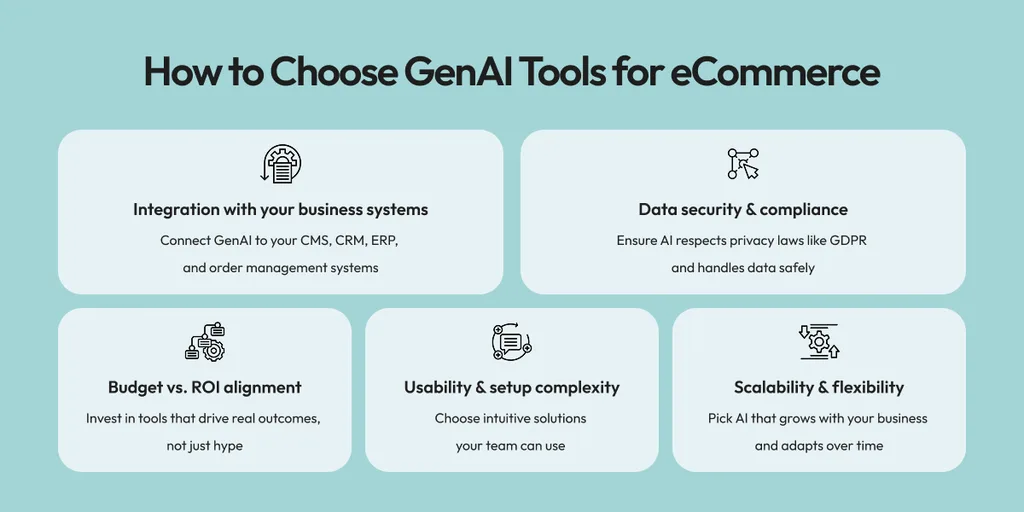
The following framework presents main points to consider while choosing generative AI tools for e-commerce environments.