
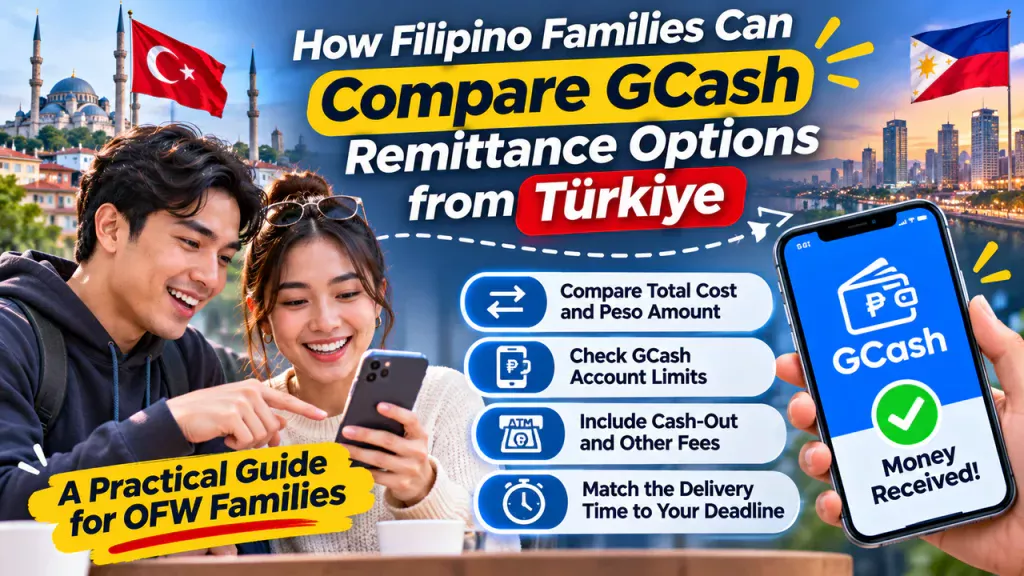
For Filipino families receiving support from a relative in Türkiye, a useful remittance comparison begins with two figures: the total Turkish lira the sender will spend and the Philippine pesos that will reach the family’s GCash wallet. The advertised transfer fee tells only part of that story.
The recipient has a role in choosing the service too. They know when a school payment is due, whether a bill can be paid digitally and whether some money will need to be withdrawn as cash. Sharing those details before the sender requests a quote makes it easier to compare options that meet the family’s needs.
Confirm the sending country and payout method
Start by selecting Türkiye as the sending country and the Philippines as the destination. If the sender holds Turkish lira, check that the quote uses TRY. Then select GCash as the receiving method. A service that sends to Philippine bank accounts does not necessarily offer the same terms for mobile wallets.
TransferGo’s page for people who want to send money to the Philippines be a starting point for reviewing its transfer options. The company says fees depend on the amount, payment method, and payout method, with the fee and exchange rate shown before confirmation. Check the options available for the sender’s account and chosen route when requesting the quote.
Compare the pesos delivered for the same lira budget
Use a fixed total budget when comparing quotes. If the sender can spend TRY 5,000, include the transfer fee within that amount. Comparing TRY 5,000 plus a fee with TRY 5,000 including a fee gives the two services different amounts to work with.
The example below uses invented exchange rates and fees to show the calculation. These are not current prices or quotes from TransferGo or any other provider. Both options assume the same delivery terms and no additional deductions.
| For a TRY 5,000 total budget | Illustrative option A | Illustrative option B |
| Fee included in the budget | TRY 0 | TRY 50 |
| Amount converted | TRY 5,000 | TRY 4,950 |
| Pesos per Turkish lira | PHP 1.25 | PHP 1.28 |
| Amount credited to the wallet | PHP 6,250 | PHP 6,336 |
Option B delivers PHP 86 more because its exchange rate offsets the TRY 50 fee. Looking only at the fee would miss that difference. For real quotes, compare the final peso amount at roughly the same time, since exchange rates can change.
Ask whether the bank or card used to fund the transfer charges separately. Also check whether a promotional rate applies only to the first payment. A family arranging monthly support needs to understand the terms of repeat transfers as well as the introductory offer.
Check the receiving wallet before the sender pays
The recipient should have a Fully Verified GCash account and provide the name and mobile number registered to it. TransferGo’s guide to receiving money in GCash from abroad explains how supported remittance services can deliver funds to a GCash wallet in Philippine pesos.
Confirm whether the selected service credits the wallet directly or requires the recipient to claim the remittance using a reference number. Follow the instructions for that particular transfer. A process described for one remittance partner may differ from another’s.
Before sending, review the official GCash wallet and transaction limits. The maximum balance and the monthly incoming allowance are separate limits, and they depend on the customer’s profile. A wallet can have space for more money while its incoming allowance for the month is nearly used.
Check the remaining allowance in the app and account for other expected payments. The remittance provider may also apply its own transaction limit. Resolve any limit or verification issue before paying for a transfer the wallet cannot receive.
Include the cost of accessing the money
Decide how the family will use the funds once they arrive. If the intended biller or merchant accepts GCash, check the payment options and any applicable fee. If the family needs physical cash, include the cost of cashing out when assessing how much support will actually be available.
GCash’s cash-out guidance describes fees at partner outlets, with charges depending on the outlet type. Confirm the amount with the chosen outlet before withdrawing. A transfer that looks sufficient at the wallet stage may leave the family short of a cash payment after withdrawal costs.
Match the delivery estimate to the family’s deadline
Agree on when the money must be usable in the Philippines. Compare the delivery estimate for the actual route and payment method. Allow time for any identity checks, bank processing, or holidays that could affect the transfer. A general promise of fast delivery is less useful than the estimate attached to the payment being arranged.
The sender should retain the confirmation and reference number, while the recipient checks the amount credited in GCash. Keep a simple record of the lira paid, pesos received, and arrival date. If a payment is delayed, use its status and reference when contacting the provider before arranging another payment.
Before confirming the next transfer, the family can run through five questions:
- Is GCash available for this sending route and payment method?
- What is the total lira cost, including known funding charges?
- How many pesos should reach the wallet?
- Can the recipient’s verified account accept the amount?
- Will the money be available in the form needed by the due date?
Check out a fresh quote each time. Keeping the sender’s budget and the recipient’s expenses in the same conversation helps the family choose a transfer that works for both sides.