Urban Gardening Is Possible Even in Small Spaces
Living in a small apartment, condominium, townhouse, or urban home does not necessarily mean giving up the idea of growing your own food.
You do not need a large backyard or a traditional garden plot to grow vegetables and herbs. A small balcony, rooftop, windowsill, patio, or other available space can potentially become a productive mini garden.
One technology designed specifically for this challenge is Enriched Potting Preparation (EPP).
The EPP technology provides a relatively simple and affordable way to grow vegetables, herbs, and ornamental plants at home while making use of discarded non-biodegradable plastic bottles as plant containers. According to the source material, it was developed to eliminate the need for adequate conventional space for crop production and can help urban families produce pesticide-free vegetables and grow useful herbs at home.
For a generation increasingly interested in sustainability, practical DIY projects, and growing food at home, EPP offers an interesting approach to small-space urban gardening.
What Is EPP Technology?
Enriched Potting Preparation (EPP) is an urban gardening technology built around three interconnected components:
- A container
- A potting medium
- Compost Soil Extract (CSE) fertilizer
Together, these components are designed to provide plants with the air, water, and nutrients they need to grow in a compact container system.
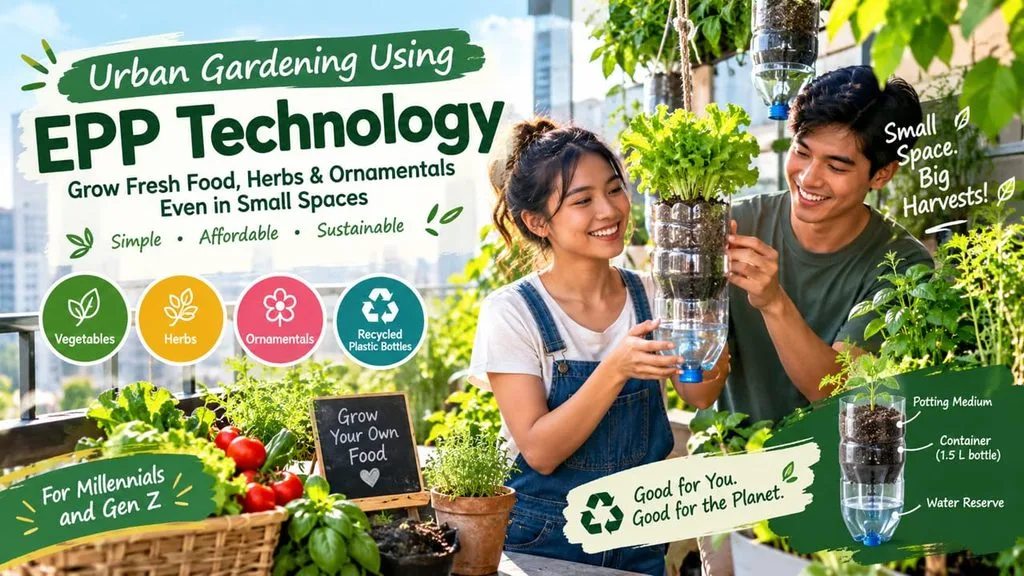
The system uses a 1.5-liter plastic soft drink bottle that is cut in half. The upper portion holds the potting medium and plant, while the lower portion functions as a reservoir that collects excess water for potential reuse by the plant. Small holes are made in the bottle to provide aeration and drainage.
In simple terms, EPP turns an ordinary discarded plastic bottle into a compact growing container.
That makes the concept particularly relevant to urban households where space is limited.
Why EPP Technology Is Interesting for Millennials and Gen Z
Urban gardening is not only about having something green around the house. It can connect several practical goals:
- Growing vegetables for household consumption
- Having herbs available for cooking
- Adding ornamental plants to small spaces
- Reusing discarded plastic bottles
- Reducing dependence on purchased vegetables for some household needs
- Creating a potential small-scale income opportunity
The EPP system was specifically designed to work in areas where conventional gardening space may be unavailable or insufficient. The source also notes that EPP containers can be hung or placed standing, making them movable and easier to transport during heavy rain or excessive heat.
For people living in dense urban environments, that flexibility can be an important advantage.
How EPP Technology Works
1. The Recycled Bottle Container
The EPP container uses a 1.5-liter plastic soft drink bottle.
The bottle is cut into two sections:
- The top half, including the bottle cap, becomes the vessel for the potting medium.
- The bottom half acts as a water collection and reserve area.
The container also has small holes on the sides for aeration and drainage. The source material states that the positioning of these holes was scientifically studied and determined.
This creates a simple system that combines a growing container with a small water reserve.
2. The Potting Medium
The potting medium is not simply ordinary garden soil.
According to the EPP material, it consists of:
- Fertile topsoil
- Well-decomposed coconut coir dust
- Compost
The material is described as porous and nutrient-rich and as being free from harmful elements such as lead, cadmium, and mercury.
The combination is intended to provide an appropriate growing environment for the plant’s roots.
For small-space gardening, the growing medium is especially important because the plant cannot rely on a large volume of surrounding soil to supply nutrients and support root growth.
3. Compost Soil Extract as Fertilizer
The third component is Compost Soil Extract (CSE).
The source describes CSE as an organic-based fertilizer extracted from a mixture of compost and fertile topsoil enriched with dolomitic lime and phosphate rock.
It is applied in diluted form during watering and provides nutrients intended to sustain several cropping cycles.
The source specifically states that leafy vegetables such as lettuce, pechay, and mustard can be grown for as many as seven cycles in a year under the EPP system.
How Much Water Does an EPP Garden Need?
One of the notable features of EPP is its relatively low maintenance requirement.
The source specifies:
- Seedlings: Water approximately once a week
- Mature plants: Water approximately two or three times a week
The plants can also absorb excess water stored in the lower portion of the bottle.
However, the actual water requirement will still depend on factors such as the plant, temperature, sunlight exposure, and growing conditions.
The EPP material also provides a specific procedure for replenishing the water reserve: when the water in the bottom portion of the bottle is nearly empty, water the plant by dipping it into a pail of water or sprinkling water until the bottom section is filled.
Step-by-Step: How to Transplant Seedlings Into an EPP Container
If you want to start an EPP garden, the source provides a specific transplanting procedure.
Step 1: Prepare the potting medium
Place approximately 750 cubic centimeters of potting medium into the inverted top portion of the bottle.
Step 2: Transplant the seedling
Carefully transplant the seedling into the potting medium.
Spray water over the seedling to help establish good contact between its roots and the soil.
Step 3: Protect the newly transplanted seedling
Use the bottom half of the bottle to cover the newly transplanted seedling.
This provides protection against:
- Pests
- Strong winds
- Rain
Step 4: Fully moisten the potting medium
Dip the EPP vessel into water so that the potting medium becomes thoroughly moist.
Step 5: Drain excess water
Allow excess water to drain and air to enter the growing medium.
Afterward, the vessel can be hung.
Step 6: Remove the protective cover as the seedling grows
Once the seedling has grown, remove the cover and insert the vessel into the bottom portion of the bottle.
Then water the plant.
How Much Sunlight Do EPP Plants Need?
The EPP material recommends placing plants in partial shade or full sunlight depending on the requirements of the particular plant.
As a general guideline, plants should receive at least two hours of full sunlight.
This is important because not every crop has the same light requirements.
Before deciding where to place your recycled-bottle containers, consider whether the location receives enough sunlight for the specific plant you’re growing.
A balcony that receives several hours of direct sunlight may be suitable for certain vegetables, while a more shaded area may be better for plants that do not require as much direct exposure.
How to Control Pests Without Using Pesticides
One of the distinctive instructions in the EPP source is a physical method of pest control.
For pest control, the material recommends submerging the whole plant in a pail of clean water for 10–20 minutes and specifically states not to use pesticide.
This is part of the source’s approach to producing pesticide-free crops.
If you are building an EPP garden, pest management should therefore be treated as part of regular plant maintenance rather than something to deal with only after severe infestation occurs.
How to Use Compost Soil Extract (CSE)
The EPP source provides a straightforward application method.
Step 1: Dilute the CSE
Shake the CSE before use.
Dilute 5 tablespoons of CSE in 1 liter of water. The source notes that the CSE bottle cap can be used as a substitute for a tablespoon.
Step 2: Apply the diluted solution
Use approximately 100 mL, or one small glass, of the diluted solution to water the plant.
Step 3: Fertilize weekly
The source recommends fertilizing plants once a week.
Following a consistent schedule can make it easier to manage a small urban garden, particularly if you have several containers growing different crops.
What Plants Can You Grow Using EPP Technology?
One of the biggest advantages of the EPP approach is the variety of plants identified in the source material.
Vegetables
The listed vegetables include:
- Lettuce
- Pechay
- Mustard
- Tomato
- Eggplant
- Ampalaya
- Okra
- Ginger
- Beans
- Kangkong
- Camote tops
- Saluyot
- Spring onion
- Hot pepper
- Sweet pepper
- Chinese celery
- Cucumber
- Spinach
This provides plenty of possibilities for someone who wants to build a compact edible garden.
For beginners, leafy vegetables and herbs can be an accessible starting point because they can provide useful harvests without requiring the same type of growing space as a conventional field crop.
Herbs
The EPP material lists the following herbs and useful plants:
- Basil
- Mint
- Parsley
- Sage
- Rosemary
- Thyme
- Wansoy or coriander
- Kaffir lime
- Tarragon
- Stevia
- Gotu kola
- Oregano
- Gynura
For Millennials and Gen Z who enjoy cooking, herbs can be particularly practical.
Instead of dedicating an entire garden to food crops, you can create a compact herb collection that puts commonly used seasonings within easy reach.
Ornamental Plants
EPP isn’t limited to edible crops.
The listed ornamentals include:
- Euphorbia
- Daisy
- Dracaena Florida Beauty
- Impatiens
- Cactus
This makes the system useful for people who want to combine food production with home decoration.
You could, for example, dedicate one area to vegetables and herbs while using another set of containers for ornamental plants.
The Sustainability Side of EPP Gardening
The environmental component of EPP is one of its most interesting features.
Instead of immediately discarding non-biodegradable plastic soft drink bottles, the technology repurposes them as plant containers.
This gives the bottle a second function: from disposable packaging to a container for growing plants.
The source states that EPP contributes to community waste-management programs and can help reduce the volume of non-biodegradable plastic entering urban landfills.
For environmentally conscious younger generations, this makes EPP more than just a gardening technique.
It becomes an example of how waste reduction and food production can be combined in a small urban space.
Can EPP Gardening Help Save Money?
Potentially, yes.
The source explains that families can produce vegetables for household consumption, including vegetables that may be expensive in the market. It also says that excess harvests can be sold to neighbors or further processed to create additional income.
This creates two possible benefits:
Household use:
Grow some of the vegetables and herbs your household regularly consumes.
Small-scale selling:
If production exceeds household needs, surplus harvests could potentially be sold within the local community.
However, it is important to distinguish between the technology’s potential and actual profitability. Your results will depend on factors such as crop selection, production volume, labor, input costs, selling price, demand, and local market conditions.
EPP as a Small Agribusiness Opportunity
The source goes beyond household gardening and describes EPP production as a potential business opportunity.
A feasibility study cited in the material found that establishing an EPP production business could be viable.
The study used a 750-square-meter production area and estimated an initial investment requirement of ₱2.5 million for a six-month pre-operating period covering fixed-asset acquisitions, startup costs, and working capital.
The reported projections included:
- Investment recovery: 3.98 years
- Net Present Value over five years: ₱8,090,480
- Internal Rate of Return: 43.36%
- Projected Year 1 sales: ₱1.8 million
- Projected Year 5 sales: ₱10 million
- Projected Year 5 gross profit: ₱6 million
- Projected Year 5 net income: ₱1.5 million
These figures come from a feasibility study cited by the 2011 PCARRD material, so they should not be interpreted as current 2026 investment requirements, sales forecasts, or guaranteed returns. A modern business plan would need updated costs, selling prices, demand estimates, labor costs, and financial assumptions.
Nevertheless, the study demonstrates that EPP was considered not only a household gardening method but also a potential commercial enterprise.
How Much Did EPP Technology Cost?
The original PCARRD material lists the following historical prices:
| EPP Product | Price Listed in the 2011 Source |
|---|---|
| 1 EPP with plastic bottle + potting medium | ₱20 |
| 1 CSE, 320 mL | ₱20 |
| 1 CSE, 500 mL | ₱30 |
| 1 packet potting medium, 750 cm³ | ₱10 |
| EPP Triplet: 3 EPPs + 1 bottle CSE (320 mL) | ₱80 |
These are historical source prices from 2011, not current retail prices.
If you are considering EPP as a present-day gardening or business project, current prices for bottles, soil components, compost, containers, labor, seeds, seedlings, and fertilizer should be calculated separately.
Who Can Use EPP Technology?
The original material identifies several groups that have used EPP technology:
- Local government units
- Private individuals
- Households
- Small-scale entrepreneurs
- Users from urban and suburban areas
That broad user base reflects the flexibility of the system.
You don’t have to think of EPP as exclusively a commercial farming system. It can also function as a household gardening approach.
A Practical EPP Garden for a Small Urban Home
If you are a beginner, you don’t need to immediately build dozens of containers.
Start small.
A simple setup could consist of:
Vegetable section
Grow a few leafy vegetables such as lettuce, pechay, mustard, or kangkong.
Herb section
Add basil, mint, oregano, rosemary, or wansoy.
Ornamental section
Use cactus, daisy, or other listed ornamentals to add visual appeal.
Recycled-container section
Prepare clean discarded 1.5-liter plastic bottles and convert them into EPP-style containers.
The goal is to create a garden that fits naturally into the space you already have rather than trying to recreate a traditional farm in an urban environment.
Tips for Starting an EPP Garden
Start with crops you actually eat
Growing a plant simply because it looks interesting can be fun, but edible gardening becomes more useful when you choose crops that your household regularly consumes.
If you frequently use spring onions, basil, kangkong, pechay, or peppers, those may be practical choices.
Use your available vertical space
Because EPP containers can be hung or placed standing, vertical arrangements may help maximize limited space.
A balcony wall, railing area, or other appropriate location could potentially accommodate containers without requiring additional floor area.
Monitor sunlight before arranging everything
Don’t permanently arrange dozens of containers before checking how sunlight moves across your space.
The source recommends at least two hours of full sunlight as a general guideline, while also emphasizing that sunlight requirements vary by plant.
Create a watering routine
EPP is designed for relatively low maintenance, but plants still need regular attention.
A simple weekly routine can include:
- Checking water reserves
- Inspecting leaves for pests
- Checking moisture
- Applying diluted CSE according to the prescribed schedule
- Removing weeds when necessary
- Moving containers when weather conditions require it
The source specifically notes that weeds only need to be removed when necessary.
Take advantage of mobility
One benefit of container gardening is that plants can be moved.
The EPP material specifically notes that containers are easy to transport during heavy rains or excessive heat.
This can be especially useful in Philippine urban environments where weather conditions can change quickly.
EPP Gardening vs. Traditional Gardening
The biggest difference is the amount of space involved.
Traditional gardening generally depends on a dedicated area of soil, while EPP uses compact containers that can be hung or placed in small spaces.
| Feature | Traditional Garden | EPP Urban Garden |
|---|---|---|
| Space requirement | Usually requires dedicated ground space | Designed for limited spaces |
| Container | Often unnecessary | Recycled 1.5-L plastic bottle |
| Growing medium | Garden soil or prepared soil | Topsoil, coconut coir dust, and compost |
| Water management | Depends on garden setup | Bottom section can reserve excess water |
| Mobility | Limited | Containers can be moved |
| Suitable for urban homes | Depends on available space | Specifically designed for space-limited settings |
| Waste reuse | Not inherent to the system | Uses discarded plastic bottles |
| Fertilization | Depends on gardening method | Uses diluted Compost Soil Extract |
The advantage of EPP is therefore not that it replaces every form of gardening, but that it offers a compact system specifically suited to space-limited environments.
Why Urban Gardening Matters for the Next Generation
For Millennials and Gen Z, urban gardening can represent more than a hobby.
It can combine several contemporary priorities:
Food awareness:
Growing even a portion of your own vegetables can make you more aware of where food comes from.
Sustainability:
Reusing discarded plastic containers gives waste another purpose.
Small-space living:
EPP demonstrates that food production doesn’t necessarily require a traditional backyard.
Practical skills:
Growing plants teaches planning, observation, resource management, and consistency.
Potential entrepreneurship:
The original EPP material identifies small-scale entrepreneurship and EPP production as potential opportunities.
The bigger idea is simple: you can start producing something useful even when you don’t have a large amount of land.
Frequently Asked Questions About EPP Technology
What does EPP stand for in gardening?
EPP stands for Enriched Potting Preparation. It is a technology designed for growing vegetables, herbs, and ornamental plants in compact containers, particularly where conventional gardening space is limited.
What container does EPP technology use?
The source specifies a 1.5-liter plastic soft drink bottle, cut in half and modified with holes for aeration and drainage.
What is the EPP potting medium made of?
It consists of fertile topsoil, well-decomposed coconut coir dust, and compost.
How often should EPP plants be watered?
The source recommends watering seedlings once a week and mature plants two or three times a week, with plants also able to absorb water retained in the lower portion of the bottle.
How often should CSE fertilizer be applied?
The source recommends fertilizing once a week using diluted CSE.
How much CSE should be diluted in water?
The specified mixture is 5 tablespoons of CSE per 1 liter of water.
How much diluted CSE should be used per plant?
The source specifies approximately 100 mL, or one small glass, of the diluted solution when watering the plant.
Can EPP be used for vegetables?
Yes. The source lists numerous vegetables, including lettuce, pechay, mustard, tomato, eggplant, ampalaya, okra, beans, kangkong, peppers, cucumber, and spinach.
Can EPP be used for herbs?
Yes. Listed herbs include basil, mint, parsley, sage, rosemary, thyme, wansoy, oregano, and others.
Can EPP be used for ornamental plants?
Yes. The source lists ornamentals including Euphorbia, daisy, Dracaena Florida Beauty, impatiens, and cactus.
Is EPP suitable for people without a backyard?
That is one of its intended applications. The technology was designed to eliminate the need for adequate conventional space for crop production and can be used in urban and suburban settings.
Can EPP become a business?
The source cites a feasibility study that found establishing an EPP production business viable under its study assumptions. However, the financial figures are from the original study and should be updated before making a present-day investment decision.
Final Takeaway: You Don’t Need a Big Backyard to Start Growing
Urban living often comes with one major gardening problem: lack of space.
EPP technology approaches that problem by combining a recycled plastic bottle container, a nutrient-rich organic potting medium, and Compost Soil Extract fertilizer into a compact growing system.
It can be used for vegetables, herbs, and ornamentals, while the containers can be hung or moved as necessary. The approach also incorporates the reuse of discarded plastic bottles, giving urban gardening an additional waste-reduction component.
For someone living in a small urban home, the idea is surprisingly practical: turn a little space into something productive.
You don’t need to start with a full urban farm. A few containers, some suitable plants, consistent care, and an understanding of your available sunlight can be enough to begin experimenting with small-space gardening.
And if your garden eventually produces more than your household can consume, the surplus can potentially become the starting point for a small neighborhood-based gardening business.
The original EPP material ultimately presents urban gardening not merely as a way to grow plants, but as a way to combine food production, environmental responsibility, household consumption, and potential livelihood opportunities in limited urban spaces.
Source: Philippine Council for Agriculture, Forestry and Natural Resources Research and Development (PCARRD), Department of Science and Technology (DOST), Urban Gardening Using EPP Technology, PCARRD Information Bulletin No. 332/2011. The material cites work by Deblois, Dy, Estomo, and Rabor of the University of the Philippines Diliman (2010).