
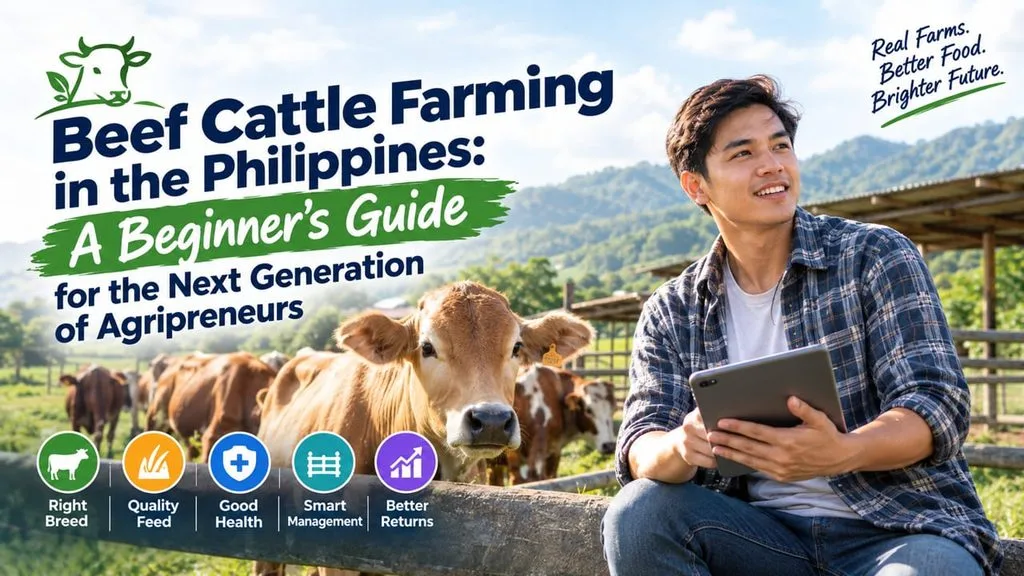
Agriculture is changing—and the next generation of Filipino entrepreneurs has an opportunity to be part of that change.
For Millennials and Gen Z, farming doesn’t necessarily mean following the same methods used decades ago. Agriculture can be a business built around technology, data, marketing, sustainability, and smart resource management.
One area worth exploring is beef cattle farming in the Philippines.
At first glance, cattle farming may look simple: buy cattle, feed them, let them grow, and sell them.
In reality, profitable cattle production is a much bigger system.
Breed selection, breeding, nutrition, pasture management, animal health, facilities, recordkeeping, labor, and marketing all affect the performance of a cattle enterprise.
The Philippine Council for Agriculture, Forestry and Natural Resources Research and Development (PCARRD-DOST) publication The Philippines Recommends for Beef Cattle Production provides technical guidance covering these areas, including breeds, breeding systems, nutrition, herd management, facilities, marketing, economics, and production concerns. The publication is a 2008 reprint of an earlier technical reference, so its historical industry data should not be treated as today’s market statistics.
Its most useful lesson for today’s aspiring agripreneur is straightforward:
Successful cattle farming starts with good management—not simply owning cattle.
Why Consider Cattle Farming as an Agribusiness?
The Philippine cattle sector has historically faced challenges in meeting domestic demand for cattle and beef. The PCARRD publication discusses declining local production and the country’s dependence on imported cattle and beef products.
It also highlights resources that can support cattle production, including pasture, forage, agricultural residues, labor, and locally relevant livestock technologies.
For an entrepreneur, this creates an interesting business opportunity.
Instead of looking at cattle as simply livestock, think of them as part of a production chain:
Land → forage → cattle → weight gain → market animal → revenue
The objective is to manage each part of that chain efficiently.
A farm with available land but poor pasture management may have unused potential.
A farm with cattle but inadequate feed may struggle with growth.
A farm that produces good animals but doesn’t understand its market may struggle to achieve attractive returns.
That’s why cattle farming should be approached as a complete agribusiness system.
1. Choose Your Cattle Business Model First
Before buying your first animal, decide what you actually want the farm to do.
Not every cattle operation makes money in the same way.
The PCARRD recommendations discuss several production approaches, including cow-calf production, breeding, growing, and fattening.
Cow-Calf Production
A cow-calf operation focuses on producing calves from breeding females.
The production cycle generally follows:
Breeding → pregnancy → calving → calf management → weaning → sale or further production
The long-term value of this model comes from maintaining productive breeding females that can consistently produce healthy calves.
Reproductive efficiency is therefore a major consideration.
Breeding Operations
A breeder farm focuses on producing animals suitable for breeding.
This requires careful selection rather than simply choosing the biggest or most attractive animal.
Characteristics relevant to a breeding program may include growth, reproductive performance, adaptability, health, and other traits related to the farm’s objectives.
Growing and Fattening
Growing and fattening operations focus on increasing the weight and market condition of cattle.
This model can look straightforward from the outside, but profitability depends heavily on the relationship between:
Animal purchase price + feeding costs + operating expenses + sale price
An animal gaining weight does not automatically mean the farmer is making money.
If the cost of producing that additional weight is too high, the business can still lose money.
2. Choose Cattle Breeds Based on Your Farm
One of the first major decisions in cattle production is breed selection.
But there is no universal “best cattle breed” for every Filipino farmer.
A breed needs to fit the production environment and business objective.
When choosing cattle, consider factors such as:
- Growth potential
- Reproductive performance
- Adaptability
- Feed availability
- Management requirements
- Health considerations
- Availability of breeding stock
- Market requirements
- Your production goals
A young entrepreneur may be tempted to choose a breed simply because it is popular or visually impressive.
That’s not enough.
The better question is:
Does this animal fit the system I can realistically manage?
A productive breed under excellent nutrition and management may perform very differently when placed in a farm with limited feed, poor facilities, or inadequate management.
In other words, breed selection and farm resources need to match.
3. Crossbreeding Can Combine Useful Traits
Crossbreeding is another strategy discussed in the PCARRD recommendations.
The basic idea is to combine characteristics from different breeds to produce animals that better meet a particular production objective.
But crossbreeding should have a purpose.
For example, a farmer may want to improve characteristics related to growth, reproduction, adaptability, or other economically important traits.
The important point is that crossbreeding should be part of a planned breeding strategy.
Don’t cross two breeds simply because the resulting calf looks interesting.
Start with a question:
What trait am I trying to improve?
Then choose the breeding approach accordingly.
4. Reproduction Determines the Future of a Breeding Herd
For a breeding operation, reproduction is one of the most important parts of the business.
A cow that produces calves efficiently contributes to future herd growth and revenue.
A cow that repeatedly fails to become pregnant, takes too long between calves, or produces poor-performing offspring can become an economic burden.
The PCARRD publication covers reproductive management topics including breeding age, mating systems, estrus, estrus synchronization, and reproductive technologies.
Understanding Estrus
Estrus, commonly referred to as heat, is the period when a female is receptive to mating.
Correctly identifying this period is important for successful breeding.
Poor heat detection can lead to missed breeding opportunities, which can extend the time between pregnancies and calves.
That creates a business consequence:
Missed reproductive opportunities can become lost production.
Artificial Insemination and Other Technologies
Cattle production can also incorporate reproductive technologies such as artificial insemination, estrus synchronization, and embryo transfer.
However, advanced technology should not be viewed as a substitute for basic management.
Good nutrition, animal health, proper records, and sound breeding decisions remain fundamental.
5. Feed May Make or Break Your Cattle Business
If you’re considering starting a cattle farm, don’t ask only:
“How much does a cow cost?”
Ask:
“How much will it cost me to feed this animal throughout the production cycle?”
Nutrition is central to cattle production because animals need nutrients for maintenance, growth, reproduction, and production.
The PCARRD guide discusses nutrient requirements, feed resources, feeding systems, ration formulation, feed additives, and other aspects of cattle nutrition.
For a business owner, the takeaway is simple:
Feed needs to be planned before cattle arrive on the farm.
6. Use Local Feed Resources Strategically
One potential advantage of cattle production in an agricultural country like the Philippines is the availability of forage and crop residues.
Agricultural by-products that might otherwise have limited value can potentially become components of livestock feeding systems when appropriately handled and nutritionally suitable.
This creates an opportunity for integrated agriculture.
For example:
Crop production → agricultural residues → livestock feed → animal production
That can create additional value from existing farm resources.
However, available does not necessarily mean nutritionally adequate.
Feed resources need to be evaluated and incorporated into a balanced feeding program appropriate for the animals being raised.
7. Pasture Management Is a Business Decision
Grazing cattle is not simply a matter of opening a gate and allowing animals onto a field.
Pasture needs to support the number of animals using it.
The PCARRD recommendations discuss stocking management and stocking rate as important elements of pasture utilization.
The fundamental issue is balance.
Too many cattle on inadequate pasture can place pressure on forage resources and land.
Too few animals can leave available forage underutilized.
Young agripreneurs should therefore think in terms of carrying capacity and forage availability, not just land size.
Before increasing herd numbers, ask:
- How much forage is available?
- How quickly does the pasture recover?
- What happens during periods of limited rainfall?
- Do I have supplemental feed?
- Can the land support additional animals?
- Will increasing the herd damage the pasture?
These questions can prevent a common expansion mistake:
Buying more animals before securing enough feed.
8. Manage Different Cattle Groups Differently
A cattle herd is not one giant homogeneous group.
The PCARRD recommendations discuss management of different categories of cattle, including breeding females, calves, growers, fatteners, and bulls.
Each group has different needs.
Breeding Females
The focus is reproductive performance, nutrition, pregnancy, calving, calf production, and overall health.
Calves
Calves require appropriate nutrition, health management, and attention to growth and development.
Growing and Fattening Cattle
The focus shifts toward efficient growth, feeding, and achieving appropriate market condition.
Breeding Bulls
A bull can influence many offspring, making breeding-bull selection and management particularly important.
This is another reason records matter.
9. Animal Health Is Also Financial Management
Disease and poor animal health can affect the entire economics of a cattle farm.
A sick animal may:
- Grow more slowly
- Require additional treatment
- Consume feed without producing expected gains
- Affect reproductive performance
- Require additional labor
- Die
That means preventive animal health isn’t simply about protecting animals.
It is also about protecting the business.
Farmers should establish appropriate health-management practices and seek professional veterinary guidance when animals show signs of illness or when specialized procedures are required.
10. Build Functional Facilities, Not Just Attractive Ones
Social media has made it easier than ever to showcase farms.
But a farm that looks great in photos isn’t necessarily a productive farm.
Cattle facilities should be designed around actual management requirements.
Depending on the production system, facilities may need to support:
- Feeding
- Watering
- Handling
- Restraint
- Breeding
- Animal separation
- Health management
- Cleaning
- Safe movement of animals
For a startup operation, expensive construction should not automatically be the priority.
Ask:
Will this investment improve animal management, labor efficiency, safety, productivity, or risk management?
If the answer is no, it deserves another look.
11. Keep Digital Records From Day One
This is one area where younger farmers have an advantage.
You don’t need a complicated livestock-management platform to start collecting useful data.
A spreadsheet or basic digital record can track:
- Animal identification
- Birth dates
- Breed
- Parentage
- Breeding dates
- Calving
- Weaning
- Weight
- Health treatments
- Feed expenses
- Purchases
- Sales
- Deaths
Why does this matter?
Because your farm should be managed using evidence rather than memory.
Suppose you think a particular cow is one of your best performers.
Your records can confirm—or challenge—that assumption.
Maybe she produces calves consistently.
Maybe another cow actually performs better.
Maybe one animal consumes significant resources without producing satisfactory results.
Records turn those observations into measurable decisions.
For Gen Z and Millennials, this is where agriculture can start to feel surprisingly familiar.
A cattle farm can have a dashboard just like a modern business.
12. Know Your Cattle Farm Numbers
Before expanding, calculate the economics of your operation.
A basic cattle enterprise budget can include:
Revenue
Number of animals sold × selling price
Costs
- Purchase of animals
- Feed
- Pasture development
- Labor
- Veterinary expenses
- Breeding costs
- Facilities
- Equipment
- Transportation
- Utilities
- Other operating expenses
- Losses associated with mortality
Result
Revenue − total costs = net return
The actual numbers will depend on your farm, production system, location, animal prices, feed costs, and market conditions.
The PCARRD publication provides economic considerations for cattle production, but because its publication history dates back decades, historical cost and industry figures should not be treated as current Philippine market prices.
For a modern business plan, current local prices need to be researched separately.
13. Marketing Should Start Before the Cattle Are Ready
One mistake new farmers make is thinking about selling only when the animals are ready for market.
Marketing should influence production decisions from the beginning.
Different buyers may have different requirements.
Depending on the business model, a farmer may sell:
- Calves
- Growing cattle
- Fattened cattle
- Breeding animals
- Other livestock products
Knowing your target buyer helps determine what kind of cattle you should produce.
Ask:
Who will buy my cattle, what characteristics do they value, and what are they willing to pay for?
That question can influence breed selection, feeding, production timeline, and investment.
14. Social Media Can Become Part of the Farm
Young entrepreneurs don’t have to market agricultural businesses using only traditional methods.
A cattle farm can use digital platforms to build visibility, document production, educate customers, communicate with potential buyers, and develop a recognizable farm identity.
Content could include:
- Calf development
- Pasture management
- Feeding practices
- Farm improvements
- Behind-the-scenes operations
- Educational cattle content
- Production milestones
- Agribusiness lessons
The goal isn’t to turn the farm into an influencer account.
It’s to make the business easier to discover and understand.
A well-managed digital presence can become another business asset.
15. Technology Should Solve Problems
Technology can help cattle farmers with:
- Recordkeeping
- Expense tracking
- Weight monitoring
- Communication
- Marketing
- Breeding calendars
- Inventory
- Farm documentation
- Access to technical information
More advanced operations can explore specialized livestock-management technologies and reproductive tools.
But there is an important rule:
Don’t buy technology simply because it looks impressive.
Identify the problem first.
Then find the tool that solves it.
A digital system that produces more data than you can use may be less valuable than a simple spreadsheet that you actually maintain.
16. Don’t Treat Cattle Farming Like Passive Income
Cattle farming is sometimes promoted online as an easy agricultural investment.
The reality is very different.
Animals require ongoing management.
Farmers have to deal with:
- Feed requirements
- Weather
- Pasture conditions
- Reproduction
- Animal health
- Labor
- Market fluctuations
- Infrastructure
- Capital requirements
- Biological production timelines
There are no guarantees.
Anyone entering the industry should understand that cattle farming is an operating business—not a passive investment where you simply buy animals and wait for your money to multiply.
17. Start Small, Learn Fast, Then Scale
For a first-time cattle entrepreneur, starting at a manageable scale can provide an opportunity to learn without exposing too much capital.
The goal isn’t simply to own cattle.
The goal is to understand the production system.
Start by learning:
- How your cattle perform
- How much feed they consume
- How quickly they gain weight
- How your pasture performs
- What health problems occur
- How reproduction performs
- What buyers want
- What your actual costs are
Then use that information to decide whether expansion makes sense.
Scale what works. Don’t simply scale what looks exciting.
The Cattle Farm of the Future May Look Very Different
The future of Philippine cattle production doesn’t necessarily belong only to large farms.
Small and medium-scale farmers can also benefit from better management, improved breeding decisions, appropriate feeding systems, digital records, market information, and stronger connections with buyers and technical experts.
This is where the next generation can contribute.
Millennials and Gen Z bring familiarity with technology, online communities, digital marketing, data, entrepreneurship, and new business models.
Those skills can complement agricultural knowledge.
Imagine a cattle enterprise where the farmer:
- Tracks every animal digitally
- Monitors growth
- Records breeding performance
- Calculates feed costs
- Documents pasture productivity
- Builds relationships with buyers online
- Uses data to select replacement animals
- Markets the farm through social media
- Makes expansion decisions using actual financial results
That’s not “old-school farming.”
That’s data-driven agribusiness.
A Beginner’s Checklist for Starting a Cattle Business
Before purchasing cattle, work through this checklist.
Business
- What type of cattle operation will I run?
- Who is my target market?
- What is my expected production cycle?
- How much capital can the business realistically support?
Land and Resources
- Do I have sufficient land?
- Is there adequate water?
- Is there enough forage?
- What feed resources are available?
- What happens during periods of limited forage?
Animals
- Which breed or breeding combination fits the system?
- Where will I source healthy animals?
- What characteristics am I selecting for?
Management
- How will I manage breeding?
- How will I monitor animal health?
- How will animals be grouped?
- What facilities are required?
Financial
- What will each animal cost?
- What will feed cost?
- What other operating expenses will I have?
- What is my expected selling price?
- What happens if prices change?
Records
- How will I identify every animal?
- Where will I record breeding information?
- How will I track weights?
- How will I record expenses and sales?
Marketing
- Who will buy my cattle?
- What do they require?
- When should I sell?
- How will I reach potential buyers?
If you can’t answer these questions yet, you’re probably not ready to buy cattle.
And that’s okay.
Planning is part of farming.
Frequently Asked Questions About Beef Cattle Farming in the Philippines
Is cattle farming profitable in the Philippines?
It can be, but profitability depends on factors such as cattle purchase prices, feed costs, animal performance, reproduction, mortality, operating expenses, and selling prices. The PCARRD publication provides historical guidance on cattle production economics, but current profitability should be calculated using up-to-date local prices and farm-specific costs.
What is the best cattle breed for farming in the Philippines?
There is no single breed that is best for every farm. Breed selection should consider the farm’s environment, available feed, management system, production objective, adaptability, reproductive performance, growth potential, and market requirements.
How much land is needed for cattle farming?
The required land area depends on the production system, pasture productivity, stocking rate, feed resources, and whether supplemental feed is provided. Land size alone does not determine how many cattle a farm can sustainably support.
Is cattle farming suitable for beginners?
Yes, but beginners should approach it as a serious business. Learning animal management, nutrition, reproduction, health, pasture management, marketing, and farm economics is essential before expanding.
What do cattle eat?
Cattle can consume forage and other appropriate feed resources. The specific feeding program depends on the animals’ production stage, available forage, nutritional requirements, and production objective. Agricultural residues may also be useful as feed resources when properly evaluated and managed.
Is breeding or cattle fattening better?
Neither is automatically better. Breeding and fattening involve different production cycles, risks, capital requirements, management needs, and sources of income. The better model depends on the farmer’s resources and business objectives.
How important is recordkeeping in cattle farming?
Very important. Records allow farmers to monitor animal performance, reproduction, health, costs, sales, and other indicators. They help replace guesswork with measurable information.
Can technology be used in cattle farming?
Yes. Technology can support recordkeeping, financial management, animal monitoring, breeding management, communication, marketing, and access to technical information. The most useful technology is technology that addresses a specific farm-management need.
What is the biggest mistake new cattle farmers make?
One common mistake is buying animals before developing a complete production plan. Feed availability, pasture capacity, animal health, facilities, financing, management, and market access should be considered before increasing herd size.
Final Takeaway: Build the Business Before You Build the Herd
Beef cattle farming can be an interesting opportunity for the next generation of Filipino agripreneurs.
But the opportunity isn’t simply in owning cattle.
It is in managing the entire system efficiently.
Genetics determine potential.
Nutrition supports growth and reproduction.
Pasture provides feed.
Animal health protects productivity.
Facilities support efficient management.
Records provide information.
Marketing generates revenue.
And financial management determines whether the whole operation makes business sense.
The biggest lesson for a young farmer is therefore simple:
Don’t start with the question, “How many cows can I buy?”
Start with:
“What cattle business can I build with the resources, knowledge, market, and capital I have?”
Once you can answer that question, the cattle become part of the plan—not the plan itself.
And that shift—from simply raising animals to deliberately building an agribusiness—is where the next generation of Philippine cattle entrepreneurs can create real value.