
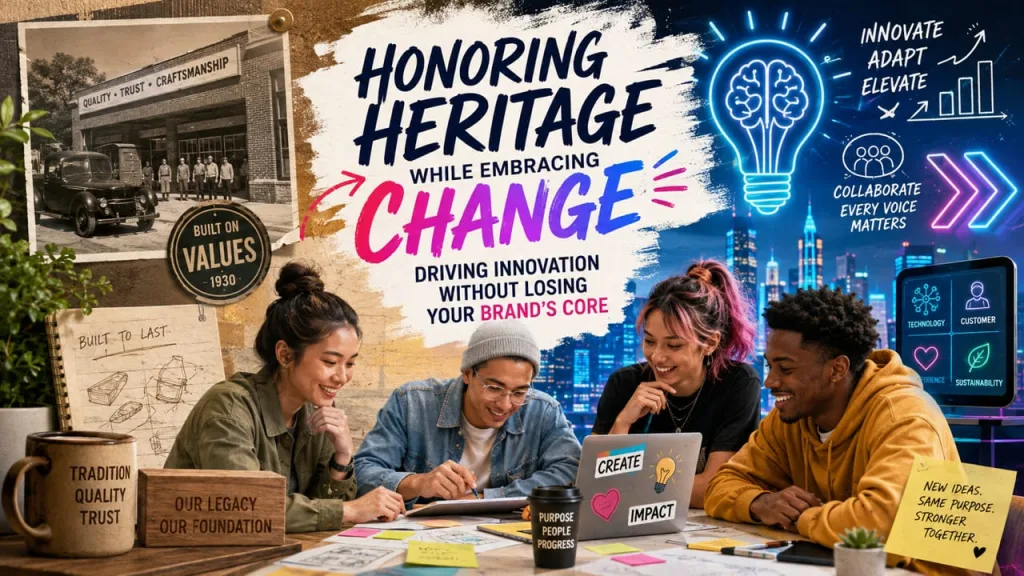
At first glance, legacy and innovation can seem like conflicting ideas. Innovation is about disruption, experimentation, and forward motion, while legacy represents tradition, stability, and history.
But they don’t have to be opposites. Many of the world’s most forward-thinking companies have deep roots and strong traditions. How? They evolve without rejecting the brand identity and values that built those reputations in the first place.
The market is in constant flux and innovation is a necessity. With thoughtful planning, you can modernize, adapt, and stay competitive while keeping your heritage intact.
Define and Protect Core Brand Values
Every strong brand rests on a set of foundational principles, whether it’s craftsmanship, customer service, sustainability, or quality. These values should act as your guiding principles when adopting new strategies or technologies.
Make them visible throughout your onboarding and training, internal messaging, and mission statement. Everyone then understands the legacy they’re helping to uphold while driving change.
Build a Clear Innovation Roadmap
Innovation without focus often creates more confusion than progress. Instead of experimenting blindly, build a roadmap that connects new initiatives to long-term goals.
Identify the areas that are most in need of change, whether it’s product development, digital transformation, or customer experience, and align those efforts with measurable outcomes. For example, a heritage retailer may decide to digitize customer service channels while delivering the personalized touch that made it successful from the start.
Nurture a Growth-Oriented Culture
True innovation thrives in a workplace that encourages curiosity, experimentation, and even failure. Empower employees to try new things, take risks, and share lessons learned.
Celebrate contributions by connecting employee achievements to your mission and rewarding progress. Share stories of how individual ideas have contributed to growth or reinforced legacy values. This demonstrates that innovation strengthens, rather than erases, your company legacy.
Blend the Old with the New
Your heritage is not an obstacle to progress. It’s your differentiator. Find ways to modernize while honoring your roots. For example, a class product line can be refreshed with updated features or traditions that can be reimagined for new audiences.
The gaming industry illustrates this balance well, revamping nostalgic titles with modern graphics to delight both longtime fans and new customers. Your history can also be used as a storytelling asset in marketing campaigns, highlighting milestones alongside current breakthroughs.
Use Technology with Purpose
Technology and innovation go hand in hand, but technology for technology’s sake rarely drives meaningful progress.
Instead of chasing every new trend, evaluate tools through the lens of your mission and values. A company that has always prioritized craftsmanship, for example, may invest in AI-powered quality control to enhance precision without losing the human touch at the core of the products.
Encourage Collaboration Across the Organization
Change is rarely successful when it’s siloed. Encourage ideas and input from all levels of your company to foster broader, stronger innovations. Pair seasoned employees who carry institutional knowledge with fresh talent that brings new perspectives.
Leaders play an important role here. They have to understand the company’s legacy and its future potential, acting as a connection between the past and present.
Communicate Openly and Clearly
Disruption can be unsettling if stakeholders aren’t prepared. Be transparent about upcoming challenges, explaining the reasoning and inviting dialogue. Employees, customers, partners, and investors should all feel engaged in the journey.
Leverage research tools like social listening, surveys, or focus groups to gauge reactions and refine your strategies based on real-world insights.
Take Smart, Measured Risks
Risk is inherent in innovation. The key is managing it thoughtfully. Pilot programs are a great way to test unproven ideas on a smaller scale. By gathering feedback and refining approaches, you can reduce the risk of setbacks while still pushing boundaries.
For example, a hospital may roll out a small telehealth pilot program before making it a core offering, testing virtual visits with select patients. This allows them to minimize risk while gathering insights to refine technology, workflows, and marketing messages.
Over time, these small wins build confidence and momentum for larger initiatives. Calculated risk-taking signals agility while maintaining alignment with your brand identity and values.
Stay True to Mission and Purpose
Every innovation should reinforce, not replace, your mission and purpose. Staying anchored ensures that change enhances your brand’s promise instead of confusing it.
Ask yourself: “Does this initiative reflect who we are at our core?” If not, it may be time to refine or redirect. When innovation strengthens purpose, it not only succeeds in the short term but builds long-term resilience.
For example, a healthcare brand may emphasize individual care and patient-first values, despite growth and investments in consumer health innovations or advanced biotechnology. The brand and marketing messaging can tie new products and campaigns back to that core promise by rooting innovation in purpose.
Measure and Adjust
Like any business initiative, innovation requires measurement. Establish clear KPIs to track success and evaluate whether changes align with legacy values.
Stay flexible. Some innovations may have a lot of promise but ultimately fall flat. Customers could feel alienated if initiatives stray too far from tradition. The ability to pivot based on feedback ensures innovation remains customer-centered and mission-driven.
LEGO: A Case Study in Balancing Tradition and Innovation
LEGO’s journey illustrates how legacy and innovation can coexist. Starting in the 1930s as a wooden toy maker, LEGO evolved into a global symbol of creativity and play. Despite decades of technological change, the company has never strayed from its core mission of inspiring imagination.
With modern product lines like LEGO Mindstorms and LEGO Boost, the brand incorporates robotics, coding, and STEM education into its iconic brick system. Partnerships with global franchises such as Star Wars and Harry Potter appeal to both nostalgic adults and new generations.
Marketing campaigns like “Rebuild the World” highlight LEGO’s creative spirit while reinforcing social and global impact. By continuously blending tradition with innovation, LEGO has built a timeless yet modern identity that resonates worldwide.
Moving Forward Without Letting Go
Balancing innovation with legacy is challenging, but it’s achievable. By anchoring change in your brand’s core values, embracing collaboration, and taking calculated risks, you can evolve while still honoring the history that defines your business.
Author Bio
Author: David Maricich

David Maricich, President & Chief Creative Officer of Maricich Health, has spent more than 20 years leading healthcare innovation, branding, marketing, and communications initiatives for hospitals, health systems, and Fortune 500 healthcare companies across the U.S. and internationally. He has led growth, advocacy, and change-management campaigns while helping organizations improve public health outcomes through strategic, creative communications.