
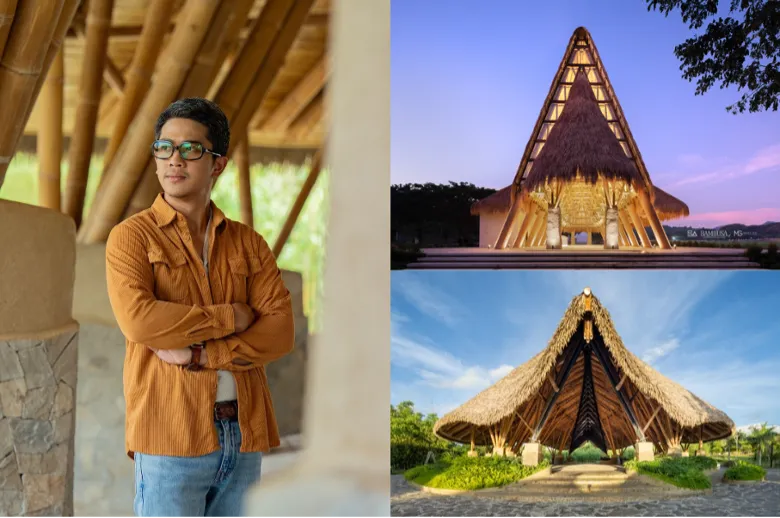
MANILA, Philippines — Can a material historically dismissed as “poor man’s timber” be used to house royalty and VIPs on an international stage? Architect Christian Salandanan, co-founder of Sangay Architects, has proven that it can.
Architect Salandanan, the mastermind behind some of Luzon’s most iconic modern bamboo developments—including the prestigious MLR Polo Pavilion built for the 2019 Southeast Asian Games and the massive Kawayan Eco Park, the largest bamboo structure in Luzon to date—is set to speak at the Mindanao Bamboost Forum: The South Cotabato Experience on August 7, 2026, at The Farm in South Cotabato.
The regional Bamboost forum is a direct expansion of the annual Bamboost series initiated by Base Bahay Foundation (BASE). Designed to build on the momentum of the 2025 Bamboost Forum held in Manila, where BASE and the Association of Structural Engineers of the Philippines (ASEP) unveiled the historic Philippine Guidelines on Bamboo Design and Construction, the South Cotabato forum aims to localize these standards, making them accessible to Mindanao-based architects, interior designers, engineers, developers, and contractors.
From Top Board-Topper to Bamboo Pioneer
An alumnus of the University of Santo Tomas (UST), where he graduated Cum Laude, Salandanan solidified his academic excellence by ranking 5th in the June 2015 Architect Licensure Examination. His early career research in 2012 focused heavily on alternative materials and structural innovation, earning him prestigious local and international accolades. He won 3rd Place at the World Bamboo Design Competition 2014 in South Korea, received the National Commission for Culture and the Arts (NCCA) Ani ng Dangal Award, and earned a Prizewinner distinction at the Archiworld Academy Awards 2015 in Munich, Germany.
Salandanan’s professional philosophy was deeply shaped by working closely for eight months with the late National Artist for Architecture, Francisco “Bobby” Mañosa, whose masterworks celebrated indigenous materials like coconut, capiz, and bamboo.
“That inspired me to ask: why not promote what is ours instead of simply copying Western materials and design?” Salandanan reflects. “Modernization is not about creating box-like, soulless buildings with no character.”
Elevating Bamboo to Grandeur
Salandanan’s signature projects demonstrate that bamboo is highly scalable and structurally viable for massive, high-end civic developments. When commissioned to build the MLR Polo Pavilion for the 2019 Southeast Asian Games, he faced the unique challenge of designing a structure that would host international royalty, kings, and sultans using a material traditionally associated with temporary beach cottages.
To shatter this stereotype, he focused on a grand sensory experience: designing a low-roof entrance to welcome guests warmly before revealing a dramatic, soaring high ceiling lit by indirect lighting. For the massive Kawayan Eco Park, he assembled a global collaborative team of Indonesian and UK specialists to demonstrate how local materials can be approached with world-class ambition.
“Many people still see bamboo as a ‘low man’s timber’ or a poor material, but through good design, we believe its value can be elevated,” Salandanan explains. “The problem is not the material itself. The real question is how you use it, how you design around it, and how you combine it with other materials to create a strong composition and design character.”
At the forum, Architect Salandanan will lead “Bamboo Architecture,” where he will showcase the flexibility of bamboo in building high-end structures.
“It is the experience of staying inside a bamboo structure. That is something you cannot get from concrete or steel. Bamboo gives a certain warmth… its flexibility—its ability to ‘dance’ during earthquakes—is one quality many people do not realize,” Salandanan adds.
Merging High-End Design with Local Hands
A vital element of Sangay Architects’ practice is ensuring that structural modernization directly benefits grassroots communities. During the construction of the MLR Polo Pavilion, the firm employed between 25 to 50 local farmers, suppliers, and craftspeople to produce custom light fixtures, intricate woven details, and bamboo lashings.
“During the first light test of the MLR Polo Pavilion, the local workers stood in front of the structure with pride,” says Salandanan. “That was one of the most satisfying moments of my career: seeing the people who worked on it take pride in what they created and in the skills they learned.”
Empowering Builders Through the Bamboo Academy
Through his presentation, Salandanan will challenge developers and engineers to look beyond round poles and explore high-performance products like cross-laminated bamboo, timber-like profiles, and structural wallboards. Having served as a consultant for BASE starting in 2014, Salandanan highlights the immense value of BASE’s open-source scientific testing, guidelines, and workforce training programs in standardizing the industry.
This commitment to sharing knowledge is a vision shared by BASE General Manager Engr. Luis Felipe Lopez, who believes regional educational forums are crucial to moving bamboo into the construction mainstream.
“At BASE, we believe the future of construction will be shaped by technologies that are both high-performing and regenerative. Bringing the Bamboost Forum to South Cotabato is part of that vision—connecting engineering, design, and local expertise to transform bamboo from an underutilized resource into a trusted construction material. Together with visionary architects like Architect Christian Salandanan and partners across the region, we are helping build the skills, confidence, and ecosystem needed to make bamboo a mainstream solution for resilient, low-carbon development.”
Salandanan agrees that these unified efforts are paving the way for a more sustainable building sector.
“That is the ultimate goal: to make bamboo not just an alternative, but an equal option among building materials,” Salandanan says. “There are no boundaries and limits for bamboo architecture. There is so much potential in it. If there is one thing I want people to remember, it is to question the current bamboo industry and keep pushing the boundaries.”
For Mindanao Bamboost Forum registration inquiries and more details, visit BASE social media accounts.