
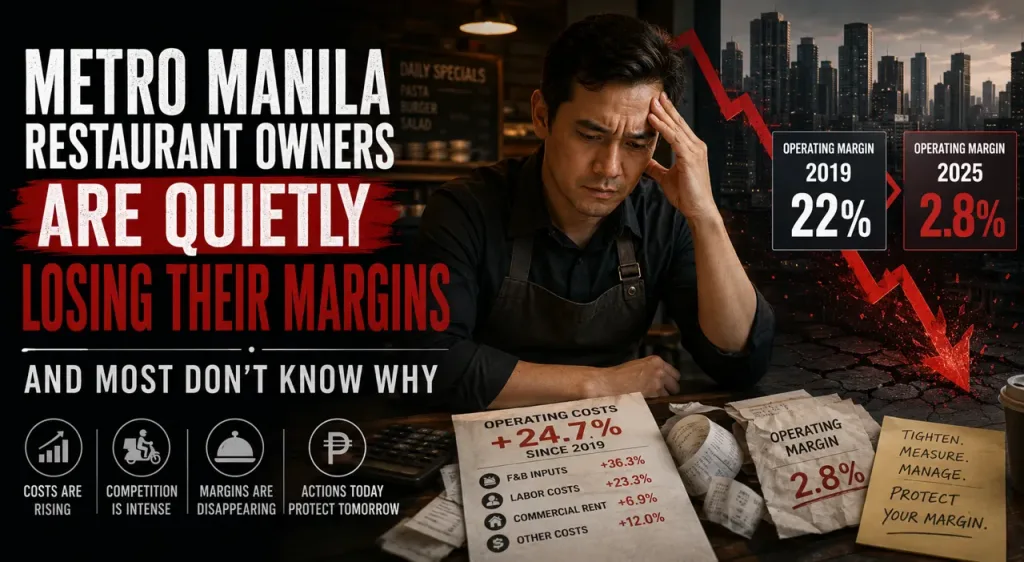
A well-run Metro Manila restaurant in 2019 could expect to keep around 22% of every peso it earned after operating costs. That’s a healthy cushion, enough to absorb a slow month, reinvest in the business, and still reward the owner for their risk.
Today, that same restaurant could be keeping as little as 2.8% without a single bad business decision.
Not because the place is empty. Not because the food got worse. But because total operating costs have risen by an estimated 24.7% while competitive pressure has made it nearly impossible to raise prices fast enough to keep up.
This is margin compression. And according to data analyzed by CloudCFO, it has already quietly pushed the average Metro Manila restaurant’s operating margin from 22% in 2019 down to as little as 2.8% today, nearly wiping out six years of hard-won recovery from the pandemic.
The F&B Industry Recovered But the Competition Looks Very Different Now
On the surface, Metro Manila’s F&B scene looks stronger than ever. Foodservice outlets nationwide reached 96,650 in 2024, surpassing pre-pandemic levels for the first time. The DTI’s 2023 MSME statistics show over 36,793 accommodation and food service establishments in NCR alone — making it the second-largest industry in the region.
But the headline numbers hide a more important story: the recovery has not been equal, and independent operators are on the wrong side of the split.
1. Chains Are Winning the Recovery
Between 2020 and 2024, chained foodservice outlets grew their market share from 68% to 72%. Independent operators fell from 32% to 28% over the same period.
Looking at sales performance between 2019 and 2023, chained limited-service restaurants grew at a compound annual rate of 3.4%. Independent restaurants in the same segment declined at -7.8% annually. For independent cafés and bars, the drop was even steeper at -10.9% CAGR, compared to essentially flat growth for their chained counterparts.
The competitive field has not just recovered. It has structurally tilted against independent operators.
2. Delivery Platforms Are Both a Lifeline and a Cost Burden
GrabFood and Foodpanda have transformed how Metro Manila consumers access food. The Philippine digital food delivery market reached approximately USD 3.86 billion in 2024, with 12.3% annual growth projected through 2034.
But these platforms come at a price. GrabFood charges commissions of 10–25% per transaction. Foodpanda charges 25–30% plus a 2% gateway fee for digital payments. For a restaurant where delivery accounts for 30% of sales, those commissions alone can reduce overall margins by 3 to 9 percentage points — before any other cost pressures are considered.
3. New Competitors Have Entered the Market
Cloud kitchens, a delivery-only operation with no dine-in setup, operate with significantly lower rent and labor costs. They can compete aggressively on price while targeting the same delivery demand as traditional restaurants. Combined with the continued expansion of major QSR chains, independent restaurants are now competing against businesses built to operate at structurally lower cost bases.
Costs Have Also Changed Across the Board
Even if the competitive landscape had stayed exactly the same, Metro Manila F&B operators would still be facing a profit squeeze. Every major cost category has increased since 2019.
1. Food and Beverage Inputs: +36.3%
This is the biggest driver. Using PSA Consumer Price Index data and a weighted estimate based on a typical F&B menu mix, food and beverage input costs have risen by an estimated 36.3% between 2019 and 2025. The sharpest jump came in 2022, when global commodity prices surged due to supply chain disruptions and the Russia-Ukraine conflict, pushing food inflation to nearly 12% in a single year. Prices have eased since then — but they have not come back down.
2. Labor Costs: +23.3%
The NCR daily minimum wage rose from ₱537 in 2019 to ₱695 effective July 2025 — the largest single increase in NCR history. When mandatory employer contributions like SSS, PhilHealth, and Pag-IBIG are factored in, the total daily employer cost per minimum-wage worker has risen from approximately ₱602 to ₱742. That figure does not account for above-minimum roles such as experienced chefs and bar managers, where salary expectations have likely risen even faster.
3. Commercial Rent: +6.9%
The pandemic dip in rental rates was brief. From 2022 onward, rents climbed back — and by 2024, they had not only returned to pre-pandemic levels but exceeded them in many locations. CBRE data shows that nearly half of lease renewals in 2024 closed at higher rates, with an average uplift of approximately 14%. And unlike food costs, rent does not flex with sales volume. It is owed whether the dining room is full or empty.
4. Other Operating Costs: +12%
Utilities, packaging materials, cleaning supplies, equipment maintenance, and administrative expenses collectively account for around 10% of revenue for a typical F&B establishment. Higher electricity rates and the increased cost of delivery packaging have been the primary drivers of this category’s rise since 2019.
What the Numbers Actually Show: 2019 vs. 2025
To understand the real impact, consider a simplified Profit and Loss comparison for a typical Metro Manila restaurant, indexed to ₱100 in revenue.
| P&L Line Item | 2019 (₱) | 2019 (% of Revenue) | Cost Increase | 2025 (₱) | 2025 (% of Revenue) | Change |
| Revenue | 100 | 100% | — | 100 | 100% | — |
| F&B Cost | 32 | 32% | +36.3% | 43.6 | 44% | +12pp |
| Labor Cost | 24 | 24% | +23.3% | 29.6 | 30% | +6pp |
| Rental | 12 | 12% | +6.9% | 12.8 | 13% | +1pp |
| Other Costs | 10 | 10% | +12.0% | 11.2 | 11% | +1pp |
| Total Costs | 78 | 78% | +24.7% | 97.2 | 97% | +19pp |
| EBITDA | 22 | 22% | 2.8 | 3% | −19pp |
Source: PSA CPI data, NWPC, Colliers, JLL, CBRE, CloudCFO analysis.
The math is straightforward and uncomfortable. Revenue stays flat. Costs rise by 24.7%. And the profit margin that was once 22% shrinks to just 2.8%.
To hold the original 22% margin, an establishment would need to raise prices by roughly 25%. In practice, most operators cannot do that — not in a market where delivery platforms, cloud kitchens, and QSR chains are all competing for the same customer at lower price points. The result for most businesses is somewhere in the middle: partial price increases combined with gradual margin erosion that often goes unnoticed until the numbers stop making sense.
How to Protect Your Restaurant’s Margins
The macroeconomic forces aren’t going away. But there are concrete steps that can protect what’s left of the margin.
1. Tighten Inventory Management
With food and beverage costs now the single largest expense — and having risen by over 36% since 2019 — inventory management is no longer just a back-of-house task. It is the most direct lever operators have over their profitability.
Assign clear ownership: head chef for kitchen inventory, bar manager for beverages. Conduct monthly physical counts aligned with your financial reporting cycle. Use actual inventory values in your reports, not just theoretical food cost percentages — the gap between the two is where waste, over-portioning, and shrinkage hide. Track spoilage as a dedicated line item in your P&L. What gets measured gets managed.
2. Keep Your Menu Costing Current
Supplier prices drift over time, and menu cost cards that were accurate in 2023 may no longer reflect reality today. Conduct quarterly reviews of purchase prices against market rates and renegotiate where possible. Update cost cards immediately when ingredient prices change — not at the end of the quarter. Also ensure that both your selling prices and purchase costs are compared on a VAT-exclusive basis. Mixing VAT-inclusive and exclusive figures is a common error that distorts food cost percentages.
3. Manage the Delivery Channel as a Separate Business
Delivery is a necessary channel for most operators, but it needs its own financial lens. Track delivery revenue, commissions, packaging costs, and any dedicated labor separately so you can see whether the channel is actually contributing to profit. Many successful operators apply a 15–20% markup on delivery menu items to offset platform commissions without affecting dine-in pricing. Not every item makes sense on a delivery menu — focus on dishes that travel well and maintain strong margins after commission.
4. Demand Faster Financial Reporting
In a low-margin environment, slow reporting is a business risk. Complete monthly financial statements should be in your hands within one week of month-end. If you are waiting three to four weeks for numbers, decisions are already being made on outdated information. If you operate multiple branches, ensure you can see P&L statements per location — aggregate numbers frequently hide underperforming outlets that need attention.
5. Apply Menu Engineering
Menu engineering is the practice of analyzing each item on your menu by two dimensions: how profitable it is and how often it sells. Items that are both highly profitable and highly popular should be promoted. Items that are neither should be reconsidered. Focus price adjustments on dishes where customers are less price-sensitive — typically signature items, add-ons, and beverages. A smaller, more focused menu also tends to reduce waste, simplify inventory, and improve overall food cost efficiency.
Final Thoughts
Metro Manila’s F&B industry is not in decline. Demand is real, dining culture is strong, and new concepts continue to find audiences. But the economics of running a restaurant or bar have changed significantly since 2019 — and the change has been largely invisible because it happens gradually, one cost increase at a time, until the numbers at the end of the month no longer add up.
The 24.7% increase in total operating costs since 2019, led by a 36.3% rise in food and beverage inputs, has the potential to nearly eliminate the margins of establishments that have not proactively adjusted. Even those that have made partial adjustments are likely experiencing some degree of compression.
The businesses that will navigate this period successfully are not necessarily those with the best location or the most popular concept. They are the ones that treat financial management as a core discipline — not an afterthought. Tight inventory controls, current menu costing, channel-level P&L analysis, and timely reporting are not finance department concerns. They are survival tools.
The margin is thin. The margin for ignoring your numbers is even thinner.
This article is based on original research and analysis conducted by CloudCFO, a Philippine-based cloud accounting firm specializing in accounting, compliance, and financial services for SMEs and Growing Businesses. The full white paper, “Margin Compression in Metro Manila’s F&B Industry,” is available here.