
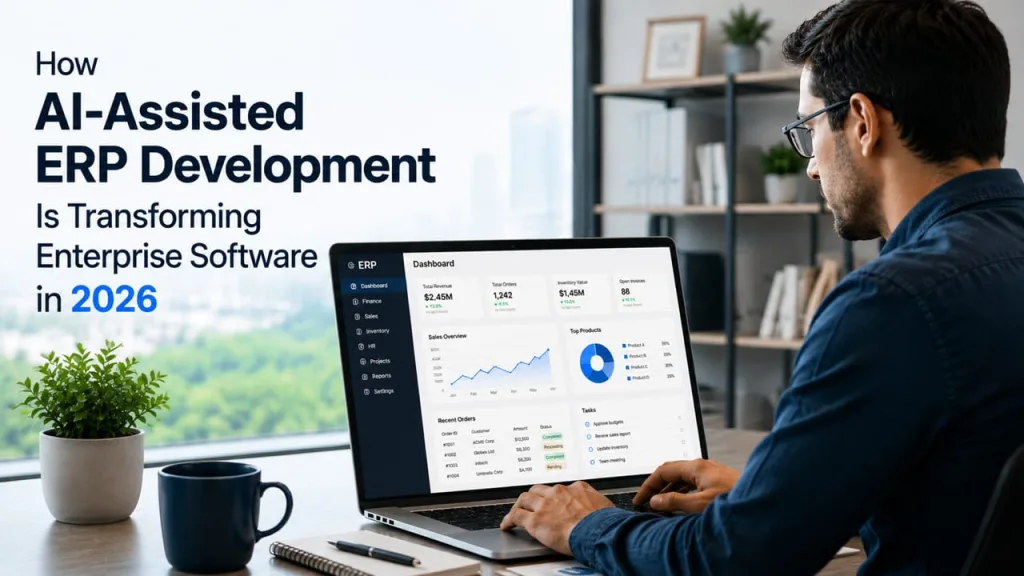
Large-scale enterprise apps (ESAs) are completely changing due to AI. Originally viewed as something to be added later on, AI is now a key component of the development, deployment, and optimization of enterprise resource planning (ERP) systems. ERP systems are being developed faster than ever before, enabled by the intelligent decision-making capabilities provided through the use of AI, ultimately changing the way businesses work and allowing them to be more efficient and agile than ever before.
The Emergence of Artificial Intelligence with Enterprise Resource Planning Software Development
Enterprise Resource Planning (ERP) systems have always played a very integral role, allowing businesses to connect their different core functions (finance, supply chain, human resources, and operations) together as one connected platform for enterprise-wide visibility down to each individual part. Traditional ERP development tends to take a lot of time, is usually very inflexible in how it is built, and is very expensive to develop overall as well. With the introduction of AI into the ERP development lifecycle through machine learning, natural language processing and predictive analytics, to ERP development its easy for both developers and companies to see how they will benefit from utilizing smarter, more wide-ranging, and more efficient software applications, especially when guided by an AI assisted development team.
Accelerating Development with Intelligent Automation
The influence of AI in the ERP development arena is greatly reflected on the potential of automating repetitive or complex tasks; specifically, how rapidly code generation tools driven from large language models (LLMs) can produce boilerplate code, configuration scripts and integration components in a fraction of the time compared to before AI, thereby shortening project timelines, reducing human error while allowing developers to concentrate on more value-add functions of design architecture/innovation.
Quality assurance (QA)/testing can also realize similar advancements through the use of AI, as it provides support for developing automatic test case generation, identifying integration defects and recommending optimization throughout the development lifecycle. As a result, ERP projects no longer endure long delays typically associated with lengthy debugging processes performed manually during the quality assurance phase (QA).
Customizing and Configuring Smartly
Today’s businesses require an ERP system to support their unique business processes and workflow. AI allows for a dynamic approach to customizing ERP systems, in which they can be set up based on business rules derived from historical data, usage patterns, and other industry benchmarks. Companies may use AI to identify the best-configured ERP modules without having to create each module from scratch; instead, they may use the recommendations produced by AI to ensure that their ERP system meets performance, compliance, and scalability goals.
Business users can leverage natural language interfaces to interact with ERP systems through conversational queries or requests. One example is a procurement manager requesting that the ERP system “generate a forecast for supplier lead times based on the last quarter.” The ERP system will provide this information without the user having to submit any type of manual query.
Improved User Experience through Personalization
Historically, ERP systems have been plagued by complexity and long learning curves but are now being transformed by AI’s provision of user-centric experiences. As an example, user interface (UI) will adapt based on user’s role, preference and usage behaviour. Similarly, dashboards display the most important metrics and business processes to reduce cognitive load and enhance user performance.
ERP systems now incorporate intelligent assistants that offer contextual support for users to assist them in navigating through a complicated application and provide real-time answers to questions related to ERP use. This reduces overall training costs and increases employee ERP use across departments.
Timely Data Insights and Forecasting
As a modern business, data fuels growth transformation for businesses today, either by providing insight for strategic opportunities or transformation for their operations. Utilizing built-in analytics enables processing large amounts of data in real-time, allowing the creation of dashboards and alerts to drive significant impacts in each company. Predictive models allow business leaders to identify areas of concern before problems arise, including cash flow variability, inventory levels, or workforce talent.
This has been a huge shift for companies from a historical or backward-looking methodology to using intelligence to provide employees with insight into what process improvements can be achieved, by allowing proactive decision-making. The finance team can analyze budgetary variances, inventory level forecasts can be identified in advance, and HR teams can analyze current employee forecasted needs.
Artificial Intelligence-Assisted ERP Development Can Improve Anomaly Detection and Risk Management
With the advent of machine learning, the ability to identify and monitor risks is beginning to be enhanced through the use of AI to support the development of Enterprise Resource Planning (ERP) software. Machine learning algorithms can analyze transactional data in real time to find fraudulent patterns of behavior, compliance violations, and even misconfigurations within systems. Automated risk alerts can help to provide timely compliance with regulations in industries that are heavily regulated and require companies to be able to demonstrate that they are following good business practices at all times, including having accurate and complete accounting records available for review in case a company receives an audit.
Using AI will also enable companies to identify vulnerabilities in their ERP software code by identifying patches or refactoring the code to correct the vulnerability before it causes significant enough damage to their ERP application.
Integration of Multiple Systems Effortlessly and Intelligent Workflow
Most organizations are using many different types of software tools, including CRM, e-commerce, and analytics; therefore, they will experience continual difficulty integrating these tools together. However, the use of AI-assisted development tools can ease the burden by automating the process of creating integration connectors, mapping data schemas/etc, and orchestrating intelligent workflows across the various systems used within an organization. By leveraging pattern recognition technology and semantic matching, AI can accomplish many tasks that previously required extensive manual mapping and middleware configuration.
Creating a unified ecosystem of applications will help ensure data integrity and create greater visibility and collaboration between departments.
Implementing ERP Solutions in the Future through Continuous Learning
Historically, upgrades have enabled application software programs to become obsolete & outdated but with the use of AI, organizations can continuously learn and grow via the use of AI-assisted ERP Solutions. These models are regularly trained (on a recurring basis) using actual day-to-day operations. As the models evolve, like the organization they serve, they will be able to enhance processes with minimum human intervention. Since this eliminates the costly & risky reversion to previous versions of your ERP software Solutions, companies can remain nimble and adaptable to a rapidly changing marketplace.
Security, Governance, and Ethical Considerations
While the potential for AI to transform things on an unprecedented scale, we have also introduced a range of new considerations regarding how we manage data privacy, fairness and transparency. Therefore, companies need to create proper governance frameworks if they want to use responsibly developed AI systems that are ethical, protect sensitive information, and provide an audit trail for automated decision-making processes. Every step of the way, companies need to build security into their AI-supported ERP systems to safeguard against unintentional access, accidental changes to models or data being exposed (leaked) through a third-party vendor.
The responsible deployment of AI will not only foster trust between an organisation and its customers, but it will also support compliance with the continuously evolving global data laws.
Wrapping Up: The Necessity of AI as a Strategy
The advantages of having an AI system in place for the production of ERP systems are evident; faster development loops, an increased level of intelligent customization, predictive analysis, and proactive measures to mitigate risk are allowing ERP systems to become much more adaptive, intelligent, and closely aligned with the business strategy.
Businesses that are willing to embrace these disruptive innovations will be able to achieve a competitive advantage in their respective markets as they build an application ecosystem that not only focuses on operational efficiencies but also enables them to have numerous opportunities for future growth, resiliency and innovation. AI continues to develop at a rapid pace; the continued integration of AI into ERP applications will remain a critical component of the digital transformation of every industry.