
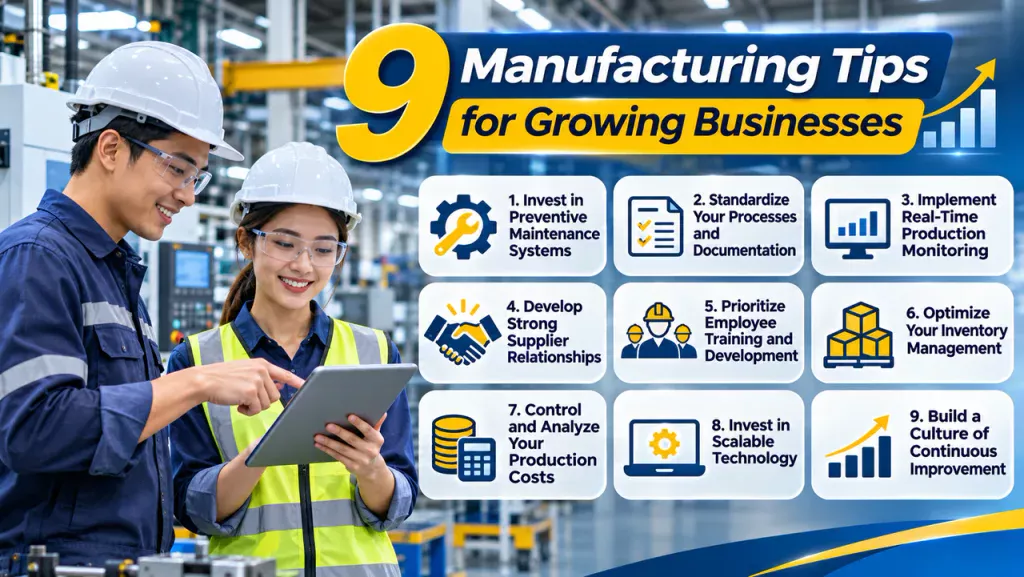
When your manufacturing operation starts to scale, the pressure intensifies immediately. You face new challenges in production efficiency, quality control, workforce management, and cost containment all at once. Many growing manufacturers struggle because they apply the same strategies that worked at smaller volumes without adapting them for greater complexity. The difference between businesses that successfully navigate this growth phase and those that stumble often comes down to how well they optimize their core processes.
1. Invest in Preventive Maintenance Systems
Downtime costs money, and unplanned equipment failures can derail your entire production schedule. As your business grows, the consequences of unexpected breakdowns become exponentially more damaging because you have more orders to fulfill and more customers depending on you. Preventive maintenance means scheduling regular inspections, cleaning, and repairs before problems occur rather than waiting for equipment to fail. This approach extends equipment lifespan, reduces emergency repair costs, and keeps production lines running smoothly. Implementing a structured maintenance calendar and tracking system helps your team stay organized and ensures nothing gets overlooked as operations expand.
2. Standardize Your Processes and Documentation
Consistency becomes increasingly difficult to maintain when you hire additional staff and increase production volumes. Without clear, documented processes, different team members may handle tasks differently, leading to quality variations and inefficiencies. Standardization means creating written procedures for every significant manufacturing task, from setup routines to quality checks to equipment operation. Documentation serves as a reference guide that reduces human error and ensures that institutional knowledge stays within your organization even when employees leave. Spending time early on to document your current best practices pays dividends as you scale because you can train new workers more effectively and maintain quality standards across expanded production.
3. Implement Real-Time Production Monitoring
Growing businesses need visibility into what is happening on their manufacturing floor at all times. Real-time monitoring systems track production output, identify bottlenecks, and alert supervisors to problems as they happen rather than surfacing issues during end-of-day reviews. Whether through simple visual boards or sophisticated software systems, monitoring helps you respond quickly to inefficiencies and make data-informed decisions about resource allocation. This visibility also supports better forecasting because you understand your actual production capacity instead of relying on estimates. For growing businesses, the investment in monitoring systems typically pays for itself through improved efficiency and reduced waste within the first year of implementation.
4. Develop Strong Supplier Relationships
As your production volumes increase, your dependence on suppliers grows correspondingly. Reliable suppliers deliver quality materials on schedule, which directly impacts your ability to meet customer deadlines and maintain product quality. Growing manufacturers should communicate with their suppliers about upcoming volume increases, changing specifications, and delivery requirements well in advance. Building collaborative relationships rather than purely transactional ones often leads to better pricing, priority treatment during supply shortages, and greater supplier flexibility. Diversifying your supplier base also reduces risk because you are not entirely dependent on one source for critical materials.
5. Prioritize Employee Training and Development
Your workforce is your most valuable asset, and growing businesses often struggle because they focus on hiring speed rather than training quality. New employees need comprehensive onboarding that goes beyond a single orientation day to actually become productive contributors. Ongoing training keeps your team updated on new equipment, processes, and quality standards, which becomes increasingly important as you introduce new technologies and products. Cross-training team members in multiple roles creates scheduling flexibility and provides backup coverage when someone is absent. For manufacturers who rely on precision production methods such as injection molding, ensuring that employees are properly trained on process parameters and tooling requirements helps maintain part consistency and reduce scrap rates as volumes climb.
6. Optimize Your Inventory Management
Growing production volumes create more complex inventory challenges because you need to balance having sufficient materials to meet demand against the costs of storing excess inventory. Implementing inventory management software helps track materials in real time and prevent both stockouts and overstocking. Understanding supplier lead times becomes critical so you can order materials with enough advance notice without accumulating unnecessary stock. Regular inventory audits ensure that your records match physical stock and catch discrepancies before they cause production problems. Efficient inventory management frees up warehouse space and capital that can be reinvested in other areas of your growing business.
7. Control and Analyze Your Production Costs
Scaling production without tracking costs carefully can erode profit margins even when revenue is rising. Regularly reviewing labor costs, material costs, and overhead against production output reveals where inefficiencies are quietly accumulating. Activity-based costing methods attribute expenses more accurately to specific products or processes, helping you make better pricing and production decisions. When you understand the true cost of each product, you can prioritize higher-margin items and identify where process improvements would have the greatest financial impact. Cost awareness at every level of your organization supports more disciplined growth.
8. Invest in Scalable Technology
Technology that works at low volumes may become a bottleneck as your business expands. Evaluating your current equipment, software, and automation tools for scalability before you need additional capacity prevents disruptive mid-growth upgrades. Many manufacturers find that targeted automation of repetitive or high-error tasks improves throughput and consistency without requiring a complete overhaul of existing operations. Cloud-based manufacturing software, for example, often scales more easily than legacy on-premise systems and supports remote visibility into operations. Planning technology investments with future capacity in mind reduces the total cost of scaling and minimizes operational disruption.
9. Build a Culture of Continuous Improvement
Operational excellence is not a destination but an ongoing discipline. Encouraging employees at every level to identify inefficiencies and suggest improvements creates a feedback loop that surfaces problems early and generates practical solutions. Formal frameworks such as lean manufacturing or Kaizen events provide structured methods for systematically reducing waste and improving process flow. Recognizing and acting on employee suggestions reinforces the value your organization places on their insight and experience. Over time, a culture that actively pursues improvement adapts more readily to growth, market changes, and new customer demands.
Conclusion
Successfully scaling a manufacturing business requires more than simply producing more volume. The nine tips covered here address the interconnected systems that must work together as your operation grows. From preventing equipment failures and standardizing processes to monitoring production in real time, building strong supplier relationships, training your workforce, managing inventory, controlling costs, investing in scalable technology, and fostering continuous improvement, each area supports the others. Growing businesses that implement these practices systematically build a stronger foundation for continued expansion and long-term profitability.