
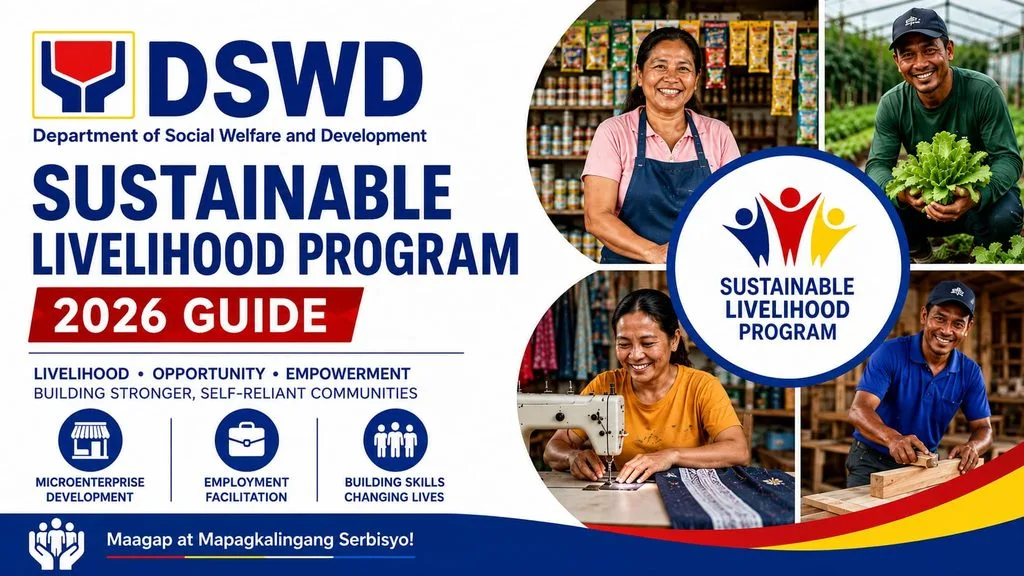
For Filipinos who need help starting a small business, strengthening an existing livelihood, acquiring job-related skills, or meeting the initial expenses of getting employed, the Department of Social Welfare and Development (DSWD) has a program specifically designed around livelihood and employment.
The Sustainable Livelihood Program (SLP) is DSWD’s capability-building program for poor, vulnerable, marginalized, and disadvantaged households and communities. Rather than functioning simply as a cash assistance program, SLP combines livelihood assistance with skills development, enterprise development, employment support, organization-building, monitoring, and partnerships intended to help participants move toward economic self-sufficiency.
The program remains active in 2026. In fact, DSWD reported in June 2026 that SLP had served 4.53 million household beneficiaries and participants nationwide as of May 2026 since the program began in 2011. Of these, 4.21 million had been served through its Microenterprise Development and Employment Facilitation interventions.
This guide explains what SLP offers in 2026, who may qualify, the types of assistance available, and how interested Filipinos can approach DSWD to be considered for the program.
What Is the DSWD Sustainable Livelihood Program?
The Sustainable Livelihood Program is designed to help eligible households and communities improve their socio-economic conditions by acquiring the assets, skills, resources, and opportunities needed to establish and maintain sustainable livelihoods.
DSWD identifies several areas that SLP interventions are intended to strengthen, including human assets through technical-vocational and life-skills training, social assets through participation in associations and community organizations, financial assets through seed capital and access to financial services, natural assets supporting livelihoods, and physical assets needed for more efficient livelihood activities.
SLP operates primarily through two tracks:
- Microenterprise Development (MD) – Pagnenegosyo
- Employment Facilitation (EF) – Pagtatrabaho
The appropriate assistance therefore depends on whether a participant intends to develop a livelihood or enterprise or pursue employment.
1. Microenterprise Development Track
The Microenterprise Development (MD) Track is intended for qualified participants who want to establish or continue a livelihood or microenterprise.
According to DSWD, the track combines financial capital, skills enhancement, and interventions involving the physical or natural assets required for livelihood activities.
The principal forms of assistance include the following.
Seed Capital Fund
The Seed Capital Fund (SCF) provides start-up capital that can be used for assets and inputs needed to start or expand a microenterprise.
DSWD identifies allowable purposes such as:
- raw materials;
- small tools;
- machinery;
- equipment;
- plants; and
- common service facilities required for a livelihood or microenterprise.
This is important because the Seed Capital Fund should not be understood as unrestricted cash that a recipient may spend for any purpose. It is livelihood assistance tied to the approved enterprise and its requirements.
How much is the DSWD Seed Capital Fund?
A current DSWD Field Office I program page lists the SCF cost parameter at a maximum of ₱15,000 per program participant, with SCF provided only once per participant.
However, applicants should not assume that every person automatically receives ₱15,000 in cash.
SLP projects can be organized and funded through associations, and actual project amounts depend on the approved livelihood intervention.
For example, in July 2026, DSWD Field Office II reported releasing ₱7.73 million in livelihood grants to 27 Sustainable Livelihood Program Associations (SLPAs) in Cagayan.
In another July 2026 implementation, four associations composed of 70 members in Echague, Isabela received a combined ₱2.1 million for community-based agricultural livelihood projects. Individual associations received ₱450,000, ₱480,000, ₱570,000, and ₱600,000, respectively.
These examples demonstrate why an association’s total project grant should not be confused with an automatic individual cash entitlement.
Skills Training Fund – Microenterprise Development
The Skills Training Fund (MD-STF) finances training that helps participants acquire the knowledge and skills required to manage their microenterprise.
According to DSWD’s SLP program information, assistance may cover:
- technical-vocational training fees;
- meals;
- lodging;
- transportation allowance;
- training supplies and materials; and
- assessment fees.
DSWD Field Office I currently lists a maximum cost parameter of ₱15,000 per program participant for this modality.
This component illustrates an important feature of SLP: the program is not limited to giving beneficiaries capital. Capability-building is integrated into the livelihood intervention.
Cash for Building Livelihood Assets Fund
The Cash for Building Livelihood Assets Fund (CBLAF) supports labor-intensive activities necessary to build, rebuild, or protect natural and physical assets needed by microenterprises.
Rather than ordinary business capital, this modality provides an allowance or stipend to qualified SLP association members who perform work on eligible livelihood-asset projects.
DSWD Field Office I states that its cost parameter is based on 100% of the applicable regional standard minimum wage, for a maximum of 11 days, including the specified pre- and post-CBLA activities.
2. Employment Facilitation Track
Not everyone interested in SLP needs to start a business.
The Employment Facilitation (EF) Track is intended for qualified participants pursuing employment.
DSWD describes this track as providing assistance for people with employment opportunities, including support for employment requirements and, where appropriate, skills-based training necessary for employment.
Its main modalities include the Employment Assistance Fund and Skills Training Fund.
Employment Assistance Fund
The Employment Assistance Fund (EAF) can help qualified participants meet certain expenses associated with entering employment.
DSWD identifies covered purposes including:
- processing employment documentary requirements;
- required medical examinations;
- basic employment tools and materials;
- transportation;
- meals; and
- board and lodging for up to the first 15 days of employment.
This assistance continues to be implemented in 2026.
For example, DSWD Field Office IV-A reported that 47 4Ps beneficiaries in Quezon Province received employment assistance in February 2026. The beneficiaries had previously been hired during a Serbisyo Fair, and the EAF helped cover pre-employment needs such as medical requirements.
Skills Training Fund – Employment Facilitation
The EF Skills Training Fund (EF-STF) supports the acquisition of technical and vocational knowledge and skills needed for employment.
Training may involve orientations, lectures, demonstrations, and similar skills-acquisition activities.
Who Is Qualified for the DSWD Sustainable Livelihood Program?
According to DSWD, SLP is intended for poor, marginalized, vulnerable, and/or disadvantaged households and communities.
Priority is given to qualified members of the Pantawid Pamilyang Pilipino Program or 4Ps.
This priority has a statutory basis. DSWD notes that Section 13 of Republic Act No. 11310, which institutionalized 4Ps, provides that qualified household-beneficiaries should receive priority in accessing SLP modalities and interventions or similar programs.
However:
You do NOT necessarily have to be a 4Ps beneficiary to be considered for SLP.
DSWD’s program information includes poor, marginalized, vulnerable, and disadvantaged households within its target beneficiaries, while DSWD’s SLP FAQ also recognizes walk-in and referred individuals.
Poor households not found in the applicable targeting database may need to undergo an SLP Means Test to determine whether they can qualify as potential participants.
Therefore, being a non-4Ps household does not by itself mean that a person is automatically disqualified.
Age Requirements
The minimum age depends on the track.
For the Microenterprise Development Track, a participant must generally be at least 16 years old. A participant of that age must have written legal consent from a parent or legal guardian. DSWD Field Office I also states that an MD participant must be a member of a Sustainable Livelihood Program Association.
For the Employment Facilitation Track, the participant must generally be at least 18 years old upon employment, consistent with legal employment standards.
DSWD’s national SLP portal additionally states that a household may enroll a maximum of two members pursuing two different tracks—one through Microenterprise Development and another through Employment Facilitation.
Is SLP Only for Individual Businesses?
No.
One important aspect of the program is the Sustainable Livelihood Program Association or SLPA.
Under the Microenterprise Development Track, participants may be organized into associations that operate livelihood enterprises collectively.
This explains why some DSWD announcements show grants worth hundreds of thousands or even millions of pesos. Those amounts can represent funding for an entire association or several associations rather than the amount given to a single beneficiary.
For example, DSWD and the Department of Agriculture distributed ₱17.7 million in livelihood assistance to 21 SLP associations in Pampanga in July 2026.
Similarly, DSWD Field Office II released ₱7.73 million to 27 SLPAs in Cagayan during July 2026.
What Businesses Can SLP Support?
DSWD does not describe SLP as a program limited to one specific type of business.
Actual projects depend on local resources, participant capacity, market opportunities, project assessment, and the approved livelihood proposal.
Recent DSWD projects demonstrate the range of enterprises supported.
In 2026, SLP-supported projects have included community-based agricultural enterprises in Isabela.
DSWD has also supported vegetable farming enterprises. In Batangas, for example, an SLPA composed of 22 members had established a vegetable farming enterprise with skills training and seed capital assistance and, in 2026, was linked with the Department of Agrarian Reform for additional farm-business training.
Other official DSWD examples include retail, food-related enterprises, agricultural activities, and community enterprises.
The key point is that approval should not be interpreted as automatic simply because an applicant proposes a common livelihood such as sari-sari retailing, food production, livestock, or farming. The proposed livelihood remains subject to DSWD’s assessment and program process.
How to Apply for DSWD Sustainable Livelihood Program in 2026
DSWD’s official SLP FAQ instructs interested applicants to visit their City/Municipal Social Welfare and Development Office (C/MSWDO) and coordinate with the designated DSWD SLP Project Development Officer (PDO) regarding scheduled SLP activities.
A practical application process therefore looks like this:
Step 1: Contact your City or Municipal Social Welfare and Development Office
Tell the office that you are interested in the DSWD Sustainable Livelihood Program.
Ask for information regarding the SLP Project Development Officer assigned to your area and the schedule of SLP activities.
Step 2: Undergo eligibility assessment
DSWD determines whether an interested household or individual meets the program’s eligibility and targeting requirements.
Being interested in starting a business does not automatically make someone an SLP beneficiary.
For poor applicants outside the applicable beneficiary databases, the SLP Means Test may be used to assess potential eligibility.
Step 3: Attend the SLP orientation
DSWD Field Office I lists attendance at SLP Orientation among the selection and documentary requirements for both MD and EF participants.
Step 4: Choose the appropriate track
Qualified participants proceed through either:
Microenterprise Development if the objective is establishing or developing a livelihood or microenterprise; or
Employment Facilitation if the objective is obtaining or entering employment.
Step 5: Complete the required capability-building activities
For MD participants, DSWD may require activities such as Microenterprise Development Training.
For EF participants, the process can involve Basic Employment Skills Training or other appropriate documentation and assessments.
Step 6: Complete the applicable program requirements
Requirements differ depending on the track and intervention.
For example, DSWD Field Office I identifies requirements including a ratified SLPA Constitution and By-laws for the MD track, while EF requirements can include the applicable needs assessment, modality application form and attachments, and EAF Fund Utilization Commitment.
Step 7: DSWD evaluates the proposed intervention
The assistance ultimately provided depends on the approved livelihood or employment intervention and the participant’s eligibility.
This is why applicants should avoid assuming that applying automatically results in receiving a fixed amount of cash.
Does DSWD Give ₱15,000 to Everyone Who Applies?
No.
This is one of the most important misconceptions to avoid.
A current DSWD Field Office I page specifies a maximum SCF cost parameter of ₱15,000 per program participant.
But this does not mean:
Apply to DSWD → automatically receive ₱15,000 cash.
SLP involves beneficiary identification, eligibility assessment, social preparation, capability building, livelihood planning, approval, implementation, and monitoring.
Additionally, many livelihood projects are implemented through SLP associations, which explains why association-level grants can be substantially larger.
Applicants should therefore rely on the assessment of the SLP Project Development Officer rather than social-media posts claiming guaranteed cash assistance.
Does SLP Need to Be Paid Back?
DSWD describes the Seed Capital Fund as a grant/start-up capital, rather than an ordinary commercial loan. Likewise, the Skills Training Fund and Employment Assistance Fund are described by DSWD as grants for their specified program purposes.
Applicants should nevertheless understand that receiving assistance comes with program responsibilities. Funds and resources are intended for their approved livelihood or employment purposes, and beneficiaries and associations are subject to program monitoring and sustainability interventions.
DSWD’s Five-Year Livelihood Sustainability Plan
A major feature of the current SLP framework is its emphasis on keeping enterprises alive after initial assistance.
DSWD’s Five-Year Livelihood Sustainability Plan contains five implementation phases:
Year 1 – Punla
Participants receive foundational preparation, knowledge, skills, and assistance for starting a microenterprise or securing employment.
Year 2 – Usbong
The focus moves toward maintaining livelihood operations and achieving positive business performance.
Year 3 – Sibol
Participants and enterprises are supported as they progress to a higher stage of development.
Year 4 – Yabong
The program aims to help participants expand into wider markets and develop relationships with more stable institutional buyers.
Year 5 – Pag-Ani
This is the culmination or graduation stage of the sustainability framework.
This five-year structure makes clear that SLP is intended to go beyond one-time distribution of livelihood capital.
The program incorporates continuing monitoring, technical assistance, capacity building, partnerships, and additional interventions aimed at helping successful SLPAs become formal and self-sufficient organizations.
SLP Is Still Active and Expanding in 2026
There is clear official evidence that the Sustainable Livelihood Program continues to operate nationwide in 2026.
On June 25, 2026, DSWD marked the program’s 15th anniversary and reported that SLP had served 4.53 million household beneficiaries and participants nationwide as of May 2026.
Implementation is also continuing at the regional level.
In Davao Region alone, DSWD reported 139,533 beneficiaries from 2017 through the first semester of 2026. During 2026, 6,557 beneficiaries in the region established microenterprises through the Seed Capital Fund under the Punla phase, according to DSWD Field Office XI.
In Central Visayas, DSWD reported that SLP had served 349,135 participants and released ₱3.996 billion in livelihood grants from 2011 through June 30, 2026. It also reported that during 2025 and 2026, 9,007 participants received product-development and diversification grants totaling ₱68.9 million.
DSWD is also working to improve market access rather than limiting assistance to business start-up. In Central Visayas, six SLPAs from Bohol and Cebu became suppliers for DSWD’s Supplementary Feeding Program, securing contracts totaling more than ₱16.6 million, according to an August 2026 DSWD report.
DSWD and DTI Partnership for Livelihood Development
SLP also involves partnerships with other government agencies and private-sector organizations.
In June 2026, DSWD and the Department of Trade and Industry held a consultative dialogue aimed at expanding livelihood and entrepreneurship opportunities for poor, vulnerable, and marginalized Filipinos.
The agencies reviewed their existing programs and the DSWD-DTI KAIBIGAN partnership while exploring ways to strengthen enterprise development and access to government support services.
This partnership approach is significant because sustainable microenterprises often require more than initial capital. They may also need product development, business registration, market connections, financial literacy, technical assistance, and access to buyers.
Frequently Asked Questions
Can I apply for DSWD livelihood assistance if I am not a 4Ps beneficiary?
Potentially, yes. SLP targets poor, vulnerable, marginalized, and disadvantaged households, although qualified 4Ps households receive priority. Non-4Ps applicants are still subject to DSWD’s eligibility assessment, and applicants outside applicable targeting databases may undergo an SLP Means Test.
How much can I get from DSWD SLP?
There is no single guaranteed amount for every applicant. DSWD Field Office I currently identifies a maximum ₱15,000 per participant cost parameter for the Seed Capital Fund, but actual SLP interventions are based on program assessment and approved projects. Association-level projects can receive substantially larger aggregate amounts.
Is DSWD SLP a loan?
The Seed Capital Fund is described by DSWD as a grant/start-up capital, not as an ordinary commercial loan. Other modalities, including Skills Training and Employment Assistance, are likewise described as grants for specific eligible purposes.
Can I apply for a sari-sari store?
SLP supports microenterprise development, but DSWD does not guarantee approval of a particular business simply because it falls within a common livelihood category. Projects are subject to assessment and the program’s implementation process.
Can I use the assistance for personal expenses?
SLP assistance is provided for approved livelihood, skills-training, livelihood-asset, or employment-related purposes depending on the modality. For example, Seed Capital Fund is intended for items such as raw materials, tools, equipment, and other assets necessary for starting or expanding an approved microenterprise.
Where should I apply?
DSWD’s official SLP FAQ advises interested individuals to visit their City/Municipal Social Welfare and Development Office and coordinate with the assigned SLP Project Development Officer regarding SLP activities and the application/assessment process.
Is there an online DSWD SLP application?
The official DSWD guidance reviewed for this 2026 guide directs prospective participants to the City/Municipal Social Welfare and Development Office and the assigned SLP Project Development Officer. Applicants should be cautious about unofficial websites or social-media pages claiming to offer guaranteed online SLP registration.
Final Takeaway
The DSWD Sustainable Livelihood Program remains active in 2026, but it should not be viewed simply as a government program where anyone can apply and automatically receive ₱15,000.
It is a structured livelihood and employment program for eligible poor, vulnerable, marginalized, and disadvantaged households and communities.
Qualified participants may receive assistance through Microenterprise Development or Employment Facilitation, with interventions that can include seed capital, skills training, livelihood-asset support, and employment assistance.
For someone interested in applying, the most reliable first step is straightforward:
Visit your City or Municipal Social Welfare and Development Office and ask for the DSWD Sustainable Livelihood Program or the SLP Project Development Officer assigned to your area.
Applicants should rely on official DSWD instructions rather than social-media posts promising guaranteed livelihood cash assistance.
As of May 2026, SLP had already served 4.53 million household beneficiaries and participants since its establishment, demonstrating that it remains one of DSWD’s major programs for helping disadvantaged Filipinos build livelihoods and move toward greater economic self-sufficiency.