

If Mailgun’s five-day log window has ever left you debugging a delivery issue you can no longer see, you already know why teams start looking elsewhere. Limited per-provider analytics and validation gated behind add-ons at lower tiers push a lot of teams toward better-equipped platforms.
The four best Mailgun alternatives for transactional email in 2026 are Mailtrap, Twilio SendGrid, Amazon SES, and Postmark.
Mailgun Alternatives Overview
| Provider | Who it’s for | Free tier | Starting price | G2 rating |
| Mailtrap | Developers and product teams | 4,000 emails/mo | $15/mo | 4.8/5 |
| Twilio SendGrid | Enterprise teams in the Twilio ecosystem | 60-day trial (100 emails/day) | $19.95/mo | 4.0/5 |
| Amazon SES | AWS-first engineering teams | 3,000 emails/mo* | $0.10/1K emails | 4.3/5 |
| Postmark | SaaS teams prioritizing delivery speed | Trial only (100 emails) | $15/mo | 4.6/5 |
*Free when sending from an EC2 instance, first 12 months only.
1. Mailtrap: Best for High Deliverability
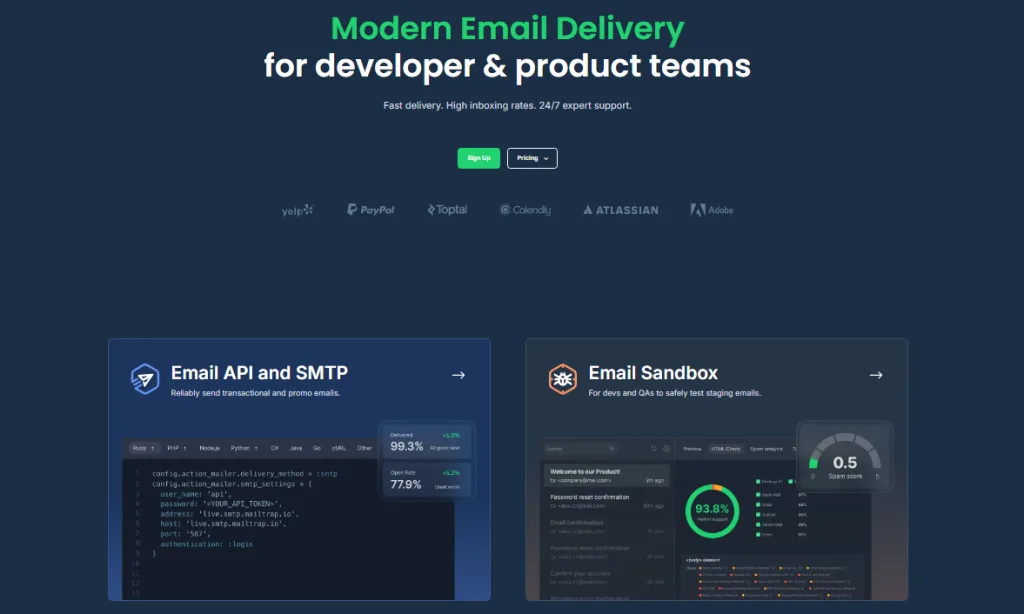
Mailtrap is an email delivery platform built for developer and product teams. It keeps transactional and bulk sending on separate streams with their own IP pools, so a marketing campaign that triggers spam complaints won’t drag down your password resets or order confirmations. Layered on top of that infrastructure, drill-down analytics break delivery performance down by mailbox provider, domain, and stream, included on every paid plan at no extra cost.
The switch from Mailgun
Log depth is the first thing teams notice. Mailgun’s base plan gives you five days; Mailtrap gives you 30, with per-message detail covering SMTP transactions, bounce events, and engagement data per recipient.
The second difference is how the analytics are structured. Mailgun’s dashboard reports aggregate delivery stats. Mailtrap lets you drill into a specific mailbox provider, so you can spot that your password resets are landing fine in Gmail but getting deferred by Outlook, instead of staring at an average open rate that hides the problem.
Stream separation here is part of the architecture itself, not something approximated through subdomain recommendations.
The API and SMTP relay ship with official SDKs for Node.js, Ruby, PHP, Python, .NET, Elixir, and Java, plus more than 25 framework snippets covering Laravel, Symfony, Django, Rails, and Next.js. Setup takes about five minutes.
Teams building AI-powered workflows get an MCP server compatible with VS Code, Cursor, and Claude.
Webhooks cover delivery events, opens, clicks, bounces, and spam complaints, with 40 retries every five minutes. Deliverability alerts catch unexpected drops before they show up in your support queue.
The trade-off
24/7 support only kicks in from the Business plan up. Free and Basic get standard support hours. Dedicated IPs are also gated to Business and above, so if owning your IP reputation at lower volumes matters to your deliverability strategy, factor that into the plan choice.
Pricing
Free tier: 4,000 emails per month. Paid plans start at $15/month for 10,000 emails. The Business plan ($85/month) covers 100,000 emails and adds a dedicated IP with automatic warmup, SSO, and 24/7 priority support. Enterprise starts at $750/month for up to 1.5 million emails and includes a dedicated deliverability manager.
Best for: developer and product teams switching from Mailgun who need 30-day logs, per-provider analytics, and stream separation without bolting on a separate observability tool.
2. Twilio SendGrid: Best for Sending at Scale
Twilio SendGrid is the oldest provider in this comparison. Launched in 2009, acquired by Twilio in 2019, and fully merged into twilio.com in February 2026, it also carries wide SDK adoption, with the PHP SDK alone topping 44 million installs on Packagist. Its pitch isn’t technical differentiation from Mailgun so much as ecosystem consolidation for teams already standardized on Twilio.
The switch from Mailgun
Moving to Twilio SendGrid from Mailgun is less about gaining new capabilities and more about cutting down on vendors. If your team already runs Twilio for SMS, voice, or identity verification, adding Twilio SendGrid for email puts everything under one contract and one billing line. That operational simplicity, more than any feature-by-feature edge, is usually what drives the decision.
Capability-wise, the two platforms land in a similar place. Official SDKs cover Node.js, PHP, Python, Ruby, Java, Go, and C#. Server-side dynamic templates run on Handlebars. Activity logs retain for 30 days on paid plans, and event webhooks retry for 24 hours after a failure. Stream separation isn’t built into the core architecture here; teams that need it configure IP pools or subuser accounts manually.
The trade-off
There’s no free tier, and the starting price sits above Mailgun’s entry point. Support response times show up repeatedly as a complaint in G2 reviews, worth weighing if your team leans on fast incident resolution.
Pricing
No free tier. Essentials starts at $19.95/month for 50,000 emails. Pro runs $89.95/month for 100,000 emails. Premier is custom-quoted.
Best for: enterprise teams already on Twilio who want email, SMS, and voice under a single vendor and are fine setting up stream separation manually.
3. Amazon SES: Best for Cost-Efficient Sending
Amazon SES is email infrastructure stripped to the raw level: no stream separation, no bounce suppression workflows, no analytics dashboards included by default. In exchange, it offers the lowest per-email cost in this comparison and tight native integration with the rest of the AWS stack.
The switch from Mailgun
Cost is almost always the reason teams move from Mailgun to SES. At $0.10 per 1,000 emails, SES undercuts Mailgun by a wide margin at volume, and that gap only grows as sending scales up.
Bounce and complaint notifications route through Amazon SNS rather than being handled natively, and suppression has to be managed on top of the account-level suppression list. There’s no built-in stream separation or deliverability alerting. The optional Virtual Deliverability Manager adds analytics dashboards and reputation monitoring, but it’s a paid add-on, not something included out of the box.
The SMTP interface and RESTful API are reachable through the full AWS SDK across all major languages. Native integrations connect Lambda for event-driven workflows, S3 for log and attachment storage, and SNS for bounce and complaint routing. Multi-region availability supports both latency and data residency needs.
The trade-off
SES makes sense if your team has the DevOps capacity to build what other providers include by default. Without that, the engineering cost of building bounce handling, suppression management, and delivery monitoring from scratch tends to eat up the savings on email volume fairly fast.
Pricing
$0.10 per 1,000 emails. The first 3,000 emails per month are free for the first 12 months when sending from EC2. Dedicated IPs cost $24.95/month each. Data transfer and attachment fees apply separately.
Best for: engineering teams already on AWS where per-email cost is the primary constraint and the team can absorb the operational work SES doesn’t handle for you.
4. Postmark: Best for Delivery Speed
Postmark is a transactional email platform built around delivery speed. Every new account goes through manual review before live sending is enabled, which is the mechanism keeping its shared IP pools clean across all users.
The switch from Mailgun
The log window and delivery speed are the first things you’ll notice. Postmark retains email activity logs for 45 days, the longest of any provider in this comparison and a sizable jump from Mailgun’s five-day base plan limit. The per-message view covers bounce classification, delivery events, and engagement data, all searchable.
Unlike Mailgun’s subdomain approach, Postmark’s separate sending streams can’t affect each other’s reputation regardless of what happens on either side. The Bulk API, released in 2024, lets you define message content once and push it out to thousands of recipients in a single API call. Official SDKs cover Ruby, Node.js, PHP, Python, .NET, Go, and Java. Bounce classification is more granular than most providers offer: hard bounces, soft bounces, transient failures, and spam complaints are tracked and suppressed separately. Integrations include Zapier, n8n, and Slack.
The trade-off
Postmark is the most expensive provider in this comparison at scale. There’s no permanent free tier, just a 100-email trial. Dedicated IPs cost $50/month and are only available once you’re sending more than 300,000 emails per month.
Pricing
No free tier; trial covers 100 emails. Paid plans start at $15/month for 10,000 emails, scaling to $55-66/month for 50,000 emails and $115-138/month for 100,000 emails. All features are included at every tier.
Best for: SaaS teams where 2FA codes, billing notifications, and activation emails need to land in Gmail and Outlook inboxes fast, and where the higher cost at scale is an acceptable trade for that reliability.
How to Decide
The right pick depends on the specific gap Mailgun left open. If five-day log retention and shallow analytics are the pain point, Mailtrap is the most direct fix: 30-day logs with per-provider drill-down included on every paid plan, plus a free tier covering 4,000 emails a month with no expiry.
If your team is already standardized on Twilio, Twilio SendGrid removes a vendor from the stack rather than adding one. If cost at scale is the constraint and you’re already running on AWS, Amazon SES at $0.10 per 1,000 emails is the cheapest option here. If delivery speed is what matters most, Postmark is the strongest choice.
All four providers cover the fundamentals of transactional email: SPF, DKIM, DMARC authentication, webhooks, bounce handling, and suppression management. What separates them is depth, cost structure, and how much comes included versus how much you have to assemble yourself.