
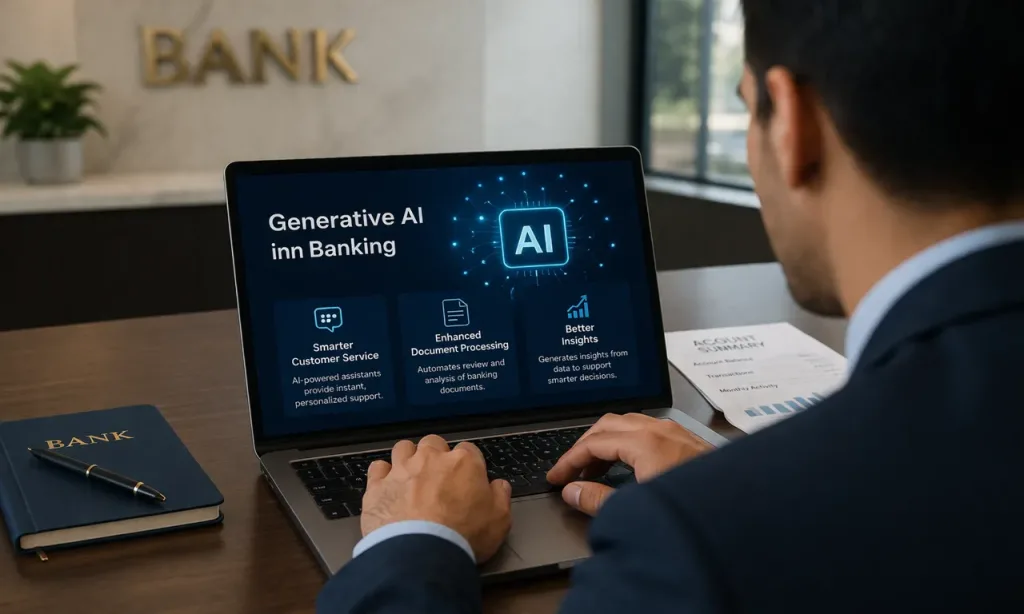
The banking industry has moved beyond automation and basic digital services. Today, banks operate systems that generate insights and support decision-making in real time. This shift is made possible by generative AI.
Banks process large volumes of data from transactions, customer behavior, regulatory requirements, and financial markets. At the same time, expectations for speed, personalization, and security continue to grow. To meet these demands, custom generative AI development services help financial institutions integrate AI into core banking platforms.
As a result, generative AI enables real-time decision-making and advanced risk analysis. These models process complex financial data and generate outputs without rigid rules. The following article explains how generative AI works in banking and what challenges it introduces.
Why Generative AI Has Become Essential in Banking
Continuous streams of data drive banking activities; every single transaction (e.g., payments, transfers, credit transactions, device activity, and geolocation) generates a signal that forms a data stream for banks to operate on. Traditional rule-based systems have rules established in advance. As customer behavior evolves and fraud patterns become increasingly sophisticated, rule-based systems cannot keep pace. This is where Generative AI offers a solution to this limitation, as it can learn from both historical and real-time events.
Rather than using static rules to make decisions and predictions, Generative AI generates predictions and, on the fly, makes decisions based on them. This change increases the scalability of the banking industry. Banks can process more transactions and make more accurate decisions with less manual labor.
AI-Driven Customer Support and Virtual Banking Assistants
With the increase in data volume within banks, the need to manage customer support operations has also risen sharply. The more requests a bank receives and processes manually, the longer the average response time for that request, and the higher the cost of providing customer service. By implementing virtual assistants that utilize Generative AI, banks will be able to quickly respond to customer inquiries about account balances or other transaction information and provide customers with the information they need to make informed financial decisions. As a result, customers receive faster service while banks experience a lower workload in their customer service departments.
Fraud Detection and Risk Management
Fraud prevention is just as significant as customer service for banks and should be addressed quickly, given the constant evolution of fraud patterns, which render traditional detection systems ineffective. The use of generative AI helps identify transactions in real time by analyzing transaction data (how transactions behave) and user activity.
Generative AI can identify anomalies and generate risk predictions in real time. Therefore, banks can identify and stop fraud after a transaction occurs and reduce false positives.
Personalized Financial Services
To keep customers safe, banks are supposed to enhance the overall customer experience. Modern consumers expect financial products tailored to them rather than receiving typical banking products through traditional means such as printed brochures and postal mail correspondence. By studying how you act, generative artificial intelligence (AI) can create detailed customer profiles and personalized recommendations (for example, how to save more or work toward smart investing). Increased interaction between customers and banks helps strengthen their relationship, as it shows that customers have built trust and loyalty with the institutions that provide them with financial services.
Credit Scoring and Loan Processing
Lending criteria are also used for personalized lender selection. Legacy credit scoring systems rely primarily on restricted databases and predictive models to assess a borrower’s risk. On the other hand, advancements in generative AI will analyze numerous data types (for example, transaction history and nontraditional financial health indicators) and significantly reduce the likelihood that they are misclassified as low-quality borrowers.
By using these variables, Generative AI can improve financial risk assessments and approve loans more quickly. This also allows banks to open more credit channels for their customers while still controlling the risk they take on with loans.
Automated Document Processing and Compliance
Banks will have an increasing volume of documentation due to lending and onboarding procedures. There are many documents, such as KYC Data and regulatory reports. Generative AI can automate this process, extract and summarize key information, thereby reducing manual workload and accelerating compliance. It will also reduce the potential for error in critical financial operations.
Automation of Internal Banking Operations
The banks not only manage customer-facing business processes but also have multiple internal workflows, many of which are repeated, taking too much time. Generative AI will automate the work that is done by a bank, including generating reports and analyzing data from the bank’s internal systems – this gives teams the ability to work on strategic initiatives instead of continually doing basic associate-type tasks.
Data Quality, Security, and Compliance Challenges
While there are numerous advantages to using generative AI, there are also numerous challenges associated with its adoption. The most important of these challenges is data quality, as banking data is typically spread across many systems, such as core banking systems and payment networks. It is necessary for banks to clean and consolidate all of this data before training an AI model. Security is another major obstacle; since banks handle highly sensitive information, such as financial transaction data and personally identifiable information, they will need to establish adequate safeguards for the use of their AI systems.
Banks will also need to comply with regulatory requirements for their AI solutions; for example, AI systems must adhere to regulations such as GDPR and financial reporting standards.
Finally, banks will require some level of explainability regarding how their AI systems reach decisions; understanding how an AI model made a specific decision is necessary for both trust and transparency.
Integrating Generative AI Into Banking Systems
To achieve tangible outcomes, generative AI must be integrated into banking processes/operations. If you conduct a trial or experiment outside the bank’s overall processes, you are unlikely to achieve significant business value. Rather, banks should implement generative AI by integrating it across the entire back office and all operational processes, and by continuously monitoring and retraining the models.
Real-time accuracy tracking of generative AI performance is critical for establishing the reliability and correctness of the model(s). Cleveroad’s generative AI banking solutions integrate well with banks’ existing systems, such as algorithmic fraud detection platforms and intelligent automation tools that support respective business processes and operations.
The Future of Generative AI in Banking
Generative AI in cash management will provide banks with more services than ever before, enabling every customer to receive personalized experiences built around their needs. Generative AI will allow banks to automate every financial transaction without human intervention and to provide accurate predictive risk-management assistance.
As banks increasingly turn to generative AI for both generating insights and making decisions, they will become heavily reliant on these technologies and, as a result, will likely develop their business models to depend heavily on them. Those banks that adopt generative AI technologies early on will gain a substantial competitive advantage through greater cost-effectiveness and higher overall customer satisfaction.
Conclusion
Generative AI applications focused on finance are at the forefront of the banking sector. The application of this technology in banks aids in preventing financial fraud whilst improving the general operations of the bank. For banks and credit unions to tap into the potential of generative AI, the focus needs to be on creating secure data and ensuring regulatory compliance. Banks adopting AI-based products will define how banks will function going forward.