
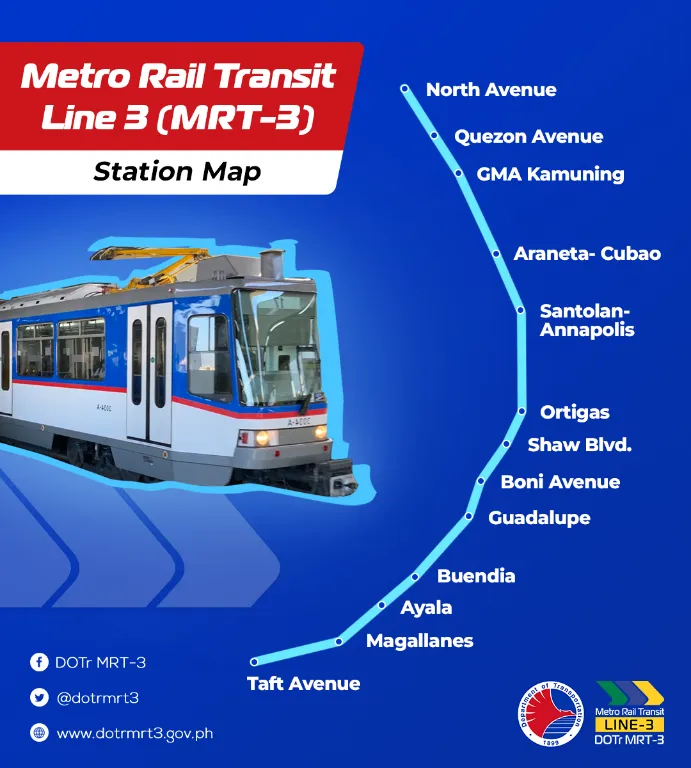
The Metro Rail Transit Line 3 (MRT-3) is one of the busiest and most important transport systems in Metro Manila. Running along EDSA, the country’s busiest highway, the MRT-3 connects Quezon City in the north to Pasay City in the south, serving hundreds of thousands of passengers daily.
If you’re a daily commuter, a student, or even a tourist, this MRT-3 guide will help you understand the stations, fare matrix, operating hours, and commuter tips you need to travel smoothly in 2025.
Also, visit LRT 1 Station and LRT 2 Station Guide.
What is MRT-3?
MRT-3 is a 16.9-kilometer elevated railway with 13 stations that stretches from North Avenue Station in Quezon City to Taft Avenue Station in Pasay City. It runs right through the heart of Metro Manila, making it one of the fastest and most affordable ways to travel across the city.
With recent upgrades, MRT-3 has become more reliable, offering faster travel times and better capacity for passengers.
MRT-3 Guide Stations (North to South)
Here’s the complete list of MRT-3 stations in order:
- North Avenue
- Quezon Avenue
- GMA Kamuning
- Araneta Center-Cubao
- Santolan-Annapolis
- Ortigas
- Shaw Boulevard
- Boni
- Guadalupe
- Buendia
- Ayala
- Magallanes
- Taft Avenue
Each station is strategically located near major business districts, schools, malls, and transport hubs.
MRT-3 Fare Matrix 2025
The MRT-3 fare ranges from ₱13 to ₱28, depending on how far you travel.
- Minimum fare: ₱13
- Maximum fare (North Ave to Taft Ave): ₱28
Passengers can pay using:
- Stored Value Cards (Beep Cards)
- Single-Journey Tickets
Using a Beep Card is highly recommended for frequent commuters to save time in line.
MRT-3 Schedule and Operating Hours
As of 2025, MRT-3 runs daily with extended hours on weekdays.
- Weekdays (Mon–Fri):
- First trip: 4:40 AM
- Last trip: North Avenue – 10:30 PM | Taft Avenue – 11:09 PM
- Weekends (Sat–Sun):
- First trip: 4:40 AM
- Last trip: usually earlier than weekday closing hours (check station notices for updates)
Travel time from North Avenue to Taft Avenue is around 30 minutes end-to-end, making it one of the fastest travel options along EDSA.
MRT-3 Capacity Upgrades
To address crowding during rush hours, MRT-3 now deploys four-car train sets in addition to the usual three-car sets.
- Three-car train: up to ~1,182 passengers
- Four-car train: up to ~1,576 passengers
This means more people can ride during peak hours, reducing waiting times.
Average Daily Ridership
MRT-3 continues to serve over 375,000 passengers per day on average. This highlights its role as a critical public transport backbone in Metro Manila.
Commuter Tips for MRT-3
- Travel early or late: Peak hours (7–9 AM and 5–8 PM) are the most crowded.
- Use Beep Cards: Skip long lines for single-journey tickets.
- Check the last train schedule: Especially if traveling at night to avoid getting stranded.
- Secure your belongings: Like any crowded public transport, always keep an eye on personal items.
- Plan your route: Many MRT-3 stations connect with buses, jeepneys, and other train lines.
Future of MRT-3
The government has allocated additional funding for the continued rehabilitation and modernization of MRT-3. Planned projects include:
- Overhaul of trains and rail tracks
- Upgrades to the power supply and signaling systems
- Improvements in station facilities and accessibility
These projects aim to make MRT-3 safer, more reliable, and more comfortable for commuters in the coming years.
Why Ride MRT-3?
MRT-3 remains one of the fastest and most affordable transport options in Metro Manila. For as low as ₱13, you can avoid the heavy traffic on EDSA and reach your destination in a fraction of the time.
Whether you’re a student heading to school, an employee rushing to work, or a traveler exploring the city, the MRT-3 offers convenience, speed, and affordability.
Key Takeaway
The MRT-3 guide 2025 shows that with extended schedules, four-car trains, and ongoing upgrades, the system is adapting to meet the needs of Metro Manila’s commuters. Despite occasional crowding, it remains one of the best ways to navigate the metro quickly and affordably.