
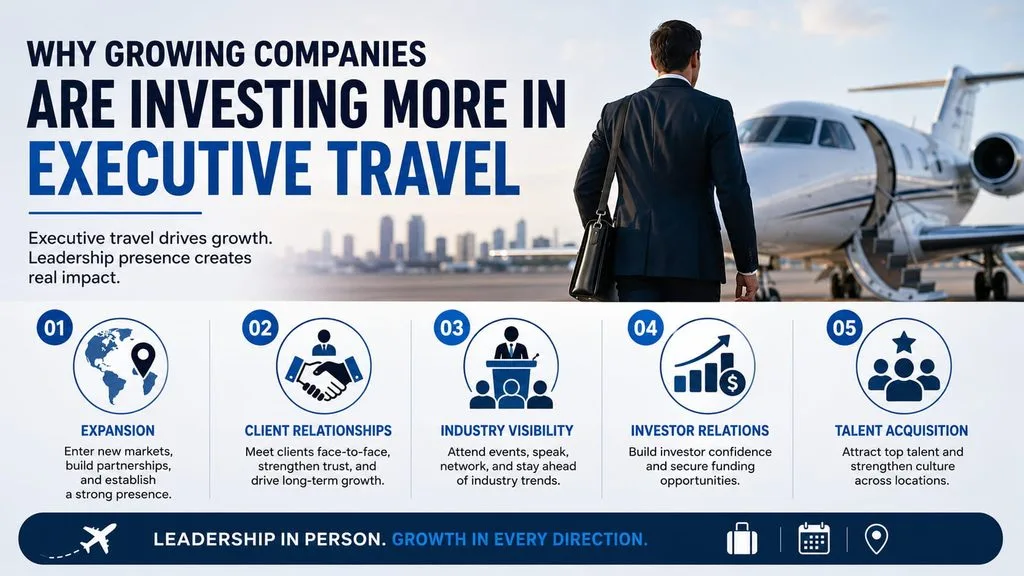
Look at where senior leaders spend their time. More client meetings, more conference appearances, more trips to remote offices — that pattern means something. It signals growth. Companies chasing new markets, bigger accounts, and tighter stakeholder bonds find executive travel shifting from optional line item to genuine strategic necessity. The ones that respond — building real travel infrastructure, coherent policies, proper support — tend to pull ahead on market presence and client satisfaction.
1. Expansion Into New Geographic Markets
Physical presence matters. When a company pushes into a new city or country, the CEO, CFO, and key department heads have to show up — repeatedly — to scout locations, vet partners, and stand up operations. Real estate decisions, local hiring, regulatory compliance: none of that gets sorted from a video call. A software firm moving from California into European markets, for instance, might run monthly leadership trips for half a year just to establish a regional base and earn the trust of local clients.
And it doesn’t stop after launch. Regional offices need ongoing guidance. Performance reviews land differently with an executive in the room. Client relationships at the local level depend heavily on face-to-face contact. Pull back on those trips too early and the new teams drift, client trust erodes, and the expansion stalls. The travel investment pays for itself through faster penetration and stronger regional cohesion.
2. Client Relationship Management and Account Growth
Big clients want access to senior leadership. Simple as that. When a prospect represents serious revenue or strategic value, their decision-makers usually want to look someone in the eye before signing anything. Executive travel becomes the currency of relationship-building at that level — a VP of Sales and CEO flying to a prospect’s headquarters for a final pitch can unlock returns that dwarf the cost of the flight. Skip the trip? Expect a competitor who showed up to walk away with the deal.
Winning the account is only the beginning. Quarterly business reviews, strategic planning conversations, crisis moments — all of these land better when the leader is physically present. Clients notice. They feel valued when someone at the top makes the effort. Companies that sustain that kind of presence see stronger retention, more upsell opportunities, and a relationship depth that remote-only engagement rarely achieves.
3. Industry Visibility and Networking
Conference panels, keynotes, hosted networking events — participation at major industry gatherings has become a core growth lever. When executives show up and speak, the company registers as a credible, forward-thinking voice. That visibility produces brand awareness, press coverage, and business development conversations that are nearly impossible to manufacture any other way. Travel costs are real. But the leads, partnerships, and reputation built in those rooms justify the spend.
There’s also the intelligence angle. A CFO at a financial services conference might stumble onto a technology vendor that cuts operational costs significantly. A CEO might meet a future board member over cocktails. A COO might spot a competitor’s strategic pivot before it becomes public. These encounters don’t happen through virtual attendance — they require being in the room. Companies that send their leaders to these events consistently report sharper strategic decisions as a direct byproduct.
4. Board and Investor Relations
Scale up, and the travel calendar fills fast. Venture firms, private equity partners, institutional investors — all of them expect direct engagement with leadership before and after committing capital. Board members scattered across different cities means quarterly meetings require someone to get on a plane. A fast-growing biotech might need its CEO in New York for investor conversations, then in Boston for regulatory discussions, all within the same week.
The financial stakes here are not abstract. Investor confidence shapes a company’s ability to raise capital. Miss board meetings, let investor relationships go cold, and the funding pipeline suffers. Companies that treat this travel as a direct investment in their financial future budget for it seriously and back their executives with quality logistics. For organizations managing frequent multi-city itineraries across brutal schedules, reputable aviation franchises deliver the flexible, on-demand charter access that keeps leadership moving without commercial aviation’s delays and constraints.
5. Talent Acquisition and Retention
Top talent doesn’t come to you. A CEO traveling to a tech hub to recruit engineers, or an HR director heading to an industry conference to identify specialized professionals — these trips signal something important to candidates. They show that the company takes hiring seriously enough to invest real time and money. Candidates respond to that. Consistently, they warm faster to organizations whose leadership makes the effort to meet them in person.
But it’s not only about recruitment. Multi-location companies need executives physically present at remote offices — running development sessions, reinforcing culture, giving employees direct access to leadership. Morale at satellite offices shifts noticeably when leaders visit regularly. People feel connected rather than peripheral. Neglect those visits and you get what you’d expect: higher turnover at outlying locations, weaker engagement, and teams that feel cut off from the organization’s actual direction.
Conclusion
Executive travel is rising among growing companies because leadership presence drives growth. That’s not a slogan — it’s a pattern visible across market expansion, client management, industry networking, investor relations, and talent development. Executives at scaling organizations find that time on the road is time directly invested in the company’s trajectory. Organizations that back their leaders with proper infrastructure — solid travel policies, expense systems, scheduling support — position themselves to capture opportunities that remote-only approaches can’t fully reach. Personal relationships and local presence keep winning in competitive markets. Executive travel isn’t going anywhere.