
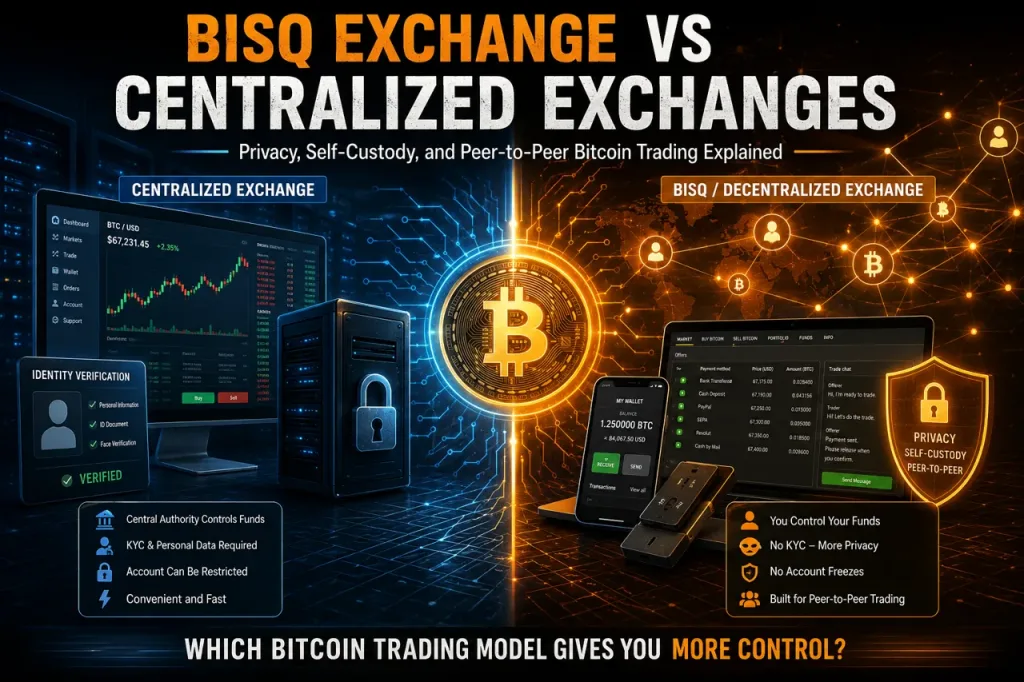
Most people first discover Bitcoin through a large centralized exchange. The process is usually simple: create an account, verify your identity, deposit funds, and start trading. For beginners, this model feels familiar because it works like many other online financial services.
But after using crypto for a while, some users start asking different questions. Who holds the funds during a trade? How much personal information is shared? What happens if an account is frozen or a withdrawal is delayed? These questions are why many people compare centralized platforms with decentralized Bitcoin exchanges.
Centralized exchanges are popular because they are easy to use. They often offer clean interfaces, quick onboarding, high liquidity, and customer support. For many users, that is enough. The trade-off is that the platform becomes the main point of trust. Users depend on the company to protect funds, process trades, manage withdrawals, and apply its rules fairly.
That setup can work well, but it has limits. A centralized platform can change policies, increase fees, request more verification, restrict an account, or delay access to funds. Most users do not think about these risks until they face them directly.
This is where Bisq exchange becomes interesting. Bisq is a decentralized Bitcoin exchange built around peer-to-peer trading. Instead of relying on one central company to manage the full process, Bisq is designed to let users trade more directly with each other while keeping more control over their own funds and data.
The difference is not only technical. It changes the way users think about trading. On a centralized exchange, convenience usually comes first. On a decentralized exchange, control and responsibility become more important. That does not make one model perfect and the other useless. It simply means they serve different types of users.
For someone who wants the fastest and simplest experience, a centralized exchange may feel easier. For someone who cares more about privacy, self-custody, and reducing dependence on a single company, a decentralized model is worth studying. This is why Bisq often appears in discussions about privacy-focused Bitcoin trading.
One of the main ideas behind Bisq is peer-to-peer exchange. Users are not just clicking buttons inside a closed platform. They are taking part in a system where trades happen more directly between people. This gives users more control, but it also means they need to understand what they are doing.
That responsibility matters. Decentralized tools are not always beginner-friendly. Users need to pay attention to wallets, backups, payment methods, security, and trade details. There may be fewer shortcuts and fewer safety nets if someone makes a careless mistake. More control usually means more personal responsibility.
Privacy is another reason people compare Bisq with centralized platforms. Many large exchanges require personal documents and detailed account information before users can trade. Some people are comfortable with that. Others prefer to limit how much personal data they share with a central service.
There is also the issue of custody. When users leave funds on a centralized platform, they trust that company to hold and manage those funds properly. Self-custody takes a different approach. It gives users more direct control, but also makes them responsible for protecting access to their own money.
The best way to look at Bisq exchange is not as a replacement for every other Bitcoin platform. It is better understood as a different model. Centralized exchanges focus on speed, scale, and convenience. Bisq focuses more on peer-to-peer trading, privacy, and user control.
The future of Bitcoin trading will likely include both centralized and decentralized systems. Some users will choose convenience. Others will choose more control. Many will use different tools for different situations.
Bisq exchange is worth paying attention to because it shows how Bitcoin trading can work without relying fully on one central platform. For users who care about privacy, self-custody, and peer-to-peer exchange, it offers a clear example of how financial tools can be built in a different way.