
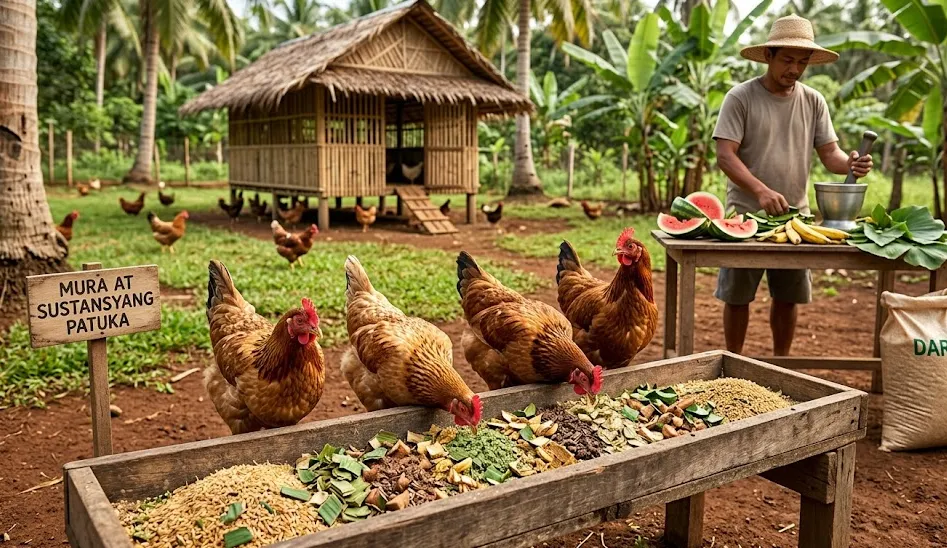
With feed costs accounting for over 70% of total poultry production expenses, finding low-cost alternatives is no longer just an option—it is a survival strategy for Filipino farmers in 2026.
While the core research for these alternatives began in the late 20th century, modern sustainability trends have made these methods more relevant than ever. Here is the updated and expanded guide to high-protein, low-cost chicken feed alternatives.
Commercial feed prices fluctuate with global grain markets. By integrating these eight locally available alternatives, you can reduce your costs by up to 20–30% without sacrificing the growth rate or health of your flock.
1. Watermelon Rind (The Hydration Booster)
Watermelon rinds are often discarded, but they are rich in citrulline and moisture. Research shows they can replace up to 20% of ordinary commercial feed.
- Preparation: Boil the rinds until soft, sun-dry them until crisp, and then grind them into a powder to mix with your standard mash.
- Best for: Free-range chickens during the dry season.
2. Sunflower Seed Cakes (High-Protein Growth)
Sunflower seeds are nutritional powerhouses. After extracting the oil, the remaining “cake” contains between 18% to 26% protein.
- Benefits: Growing chickens (up to 70 days) fed with sunflower cakes have shown faster growth rates and better appetite.
- Preparation: Extract the oil first (can be sold separately) and use the pressed “cakes” as a protein supplement.
3. Tobacco Seeds (Niche Protein Source)
In tobacco-producing regions like Ilocos, tobacco seeds are an abundant byproduct. Every plant yields roughly 30 grams of seeds.
- Nutrient Profile: Contains 20% to 38% protein depending on freshness.
- Safety: Studies confirm that replacing 20% of feed with tobacco seeds does not affect the taste or shape of the chicken.
4. Banana Leaves (Weight Gain Secret)
Research from North Cotabato proves that adding just 5% chopped banana leaves to a broiler’s diet can result in significantly higher weight gain (up to 1.5kg more) compared to pure commercial mash.
- Preparation: Chop fresh leaves finely and mix directly into the starter mash.
- Constraint: Do not exceed 10%, as too much fiber can slow down digestion.
5. Fermented Banana Peel Mix
Banana peels (especially Saba) are high in energy but low in protein. To make them a “complete” feed, follow this specialized Filipino formulation:
- The “Power Mix” Recipe: 1. Chop and boil raw peels for 1 hour. 2. To every 1kg of dried peel, add 150g dried chicken manure and 100g rice bran (darak). 3. Sun-dry and pulverize.
- Result: This mixture can replace 15% of commercial broiler starter or finisher mash with no difference in final weight.
6. Dried Rabbit Manure (The Nitrogen Cycle)
For farms practicing “integrated agriculture,” rabbit manure is a “gold mine.” It contains 18.8% raw protein.
- Ratio: Add 100–200g of thoroughly sun-dried rabbit manure for every kilo of broiler feed.
- Why it works: It is high in MJ energy and provides essential nitrogen for microbial protein synthesis in the gut.
7. Seaweeds (Marine Minerals)
If you are located near coastal areas, brown algae (seaweed) is an excellent mineral supplement.
- Preparation: Sun-dry the algae until brittle and pulverize. Add only 5% to the total feed weight.
- Nutrient Profile: Every kilo contains 2,452 calories and is rich in free nitrogen extract and ash (minerals).
8. Water Lily / Hyacinth (Leaf Protein Concentrate)
Water lilies are often seen as pests that clog waterways, but they are actually a high-protein resource.
- The WHLPC Process: 1. Grind the leaves into a paste. 2. Stir into water to dissolve the protein, then screen out the fibers. 3. Heat the liquid to 80°C to coagulate the protein. 4. Dry and pulverize the result into Water Hyacinth Leaf Protein Concentrate (WHLPC).
- Usage: It can replace 1/4 of soybean meals for chicks aged 1–40 days. It is exceptionally rich in calcium and potassium.
Strategic Summary for Poultry Entrepreneurs
| Alternative Feed | Inclusion Rate | Primary Benefit |
| Watermelon Rind | 20% | Cost reduction & Hydration |
| Sunflower Cake | 18–26% | Rapid growth (Protein) |
| Banana Leaves | 5% | Optimized weight gain |
| Seaweeds | 5% | Mineral & Caloric boost |
| Water Lily (WHLPC) | 25% of Soy | Significant cost savings |
Final Recommendations:
- Freshness Matters: Always ensure organic alternatives are thoroughly sun-dried to prevent mold and toxins.
- The 2026 Shift: Modern poultry farming is moving toward “Circular Economy” models. Mentioning these as “Zero-Waste” solutions will attract eco-conscious investors and farmers.
- Gradual Introduction: Never change a chicken’s diet overnight. Introduce these alternatives at 5% and gradually increase to the recommended levels to avoid digestive shock.



FYI / 1. Sunflower oil cake meal cont. 36/39% of protein, 2. Soya oil cake meal cont. 45/52% of protein, 3. Corn oil cake meal cont. 24/26% of protein.
If somebody would like to try Oil cake meal to feed chicken at own farm, we can provide samples and more details where to buy oil cake meal in Philippines. Feel free to contact via website.
I NEED TITLE ABOUT BROILER
Gwapo
Dearest Business Diary,
Kindly post complete listing or directory where we can buy different vegetable seeds. I would like to bring seeds to Ilocos Norte so we can plant it and make a living. I am a resident of Taguig and i work in Cubao.
Thank you so much po !
Very Truly Yours,
lanie
You can check this list of supplier directory: https://businessdiary.com.ph/2522/agro-forestry-farm-inputs/
very informative. Thanks