
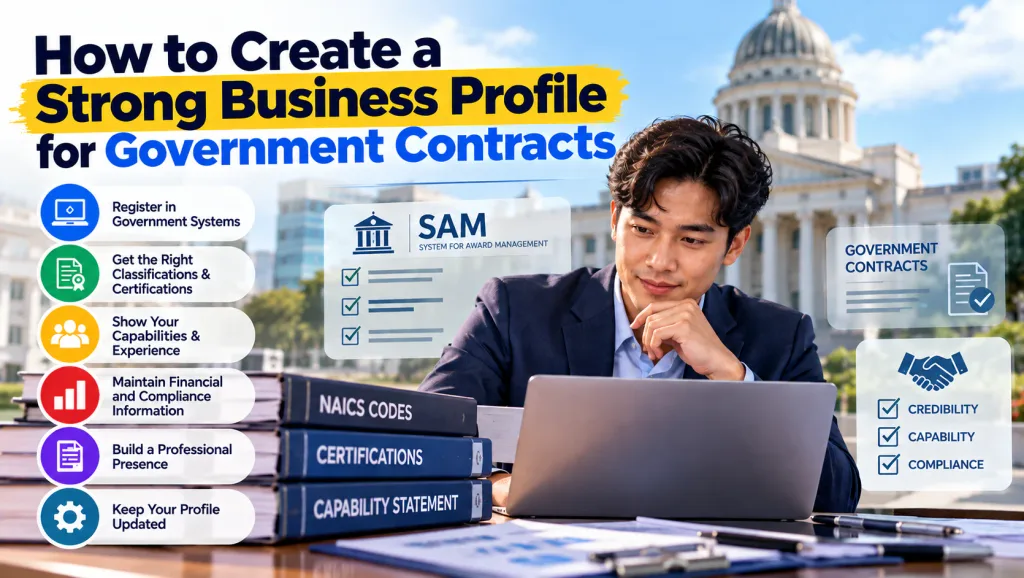
Government contracting represents a significant opportunity for businesses seeking stable, long-term revenue streams. However, winning government contracts requires more than just submitting a bid. A well-crafted business profile serves as your first impression with federal, state, and local procurement officers. Your profile must communicate credibility, capability, and compliance with government standards. Understanding how to build this profile correctly can dramatically improve your chances of winning contracts and establishing yourself as a reliable government contractor.
1. Register with the Appropriate Government Systems
Before you can pursue any government contracts, you must register your business in the correct systems. The System for Award Management, or SAM, is the primary federal database where all government contractors must register. This registration is not optional. It is required for receiving federal contracts and grants. When you register, you provide detailed information about your business structure, ownership, capabilities, and past performance. State and local governments often maintain their own vendor databases, so research the specific requirements in your jurisdiction. Each system has different registration procedures and renewal deadlines, so keep detailed records of when your profiles expire and plan ahead for renewals.
2. Establish Clear Business Classification and Certifications
Government buyers use specific classification systems to find contractors with the right expertise and qualifications. The North American Industry Classification System, or NAICS, assigns numerical codes to different business activities. You must select the NAICS codes that accurately represent your primary business functions. Beyond basic classification, government contracting often requires specialized certifications. For example, if you are a small business, you may want to pursue small business certification through the Small Business Administration. Other certifications might include woman-owned business enterprise status, minority-owned business enterprise status, or service-disabled veteran-owned small business status. These certifications can unlock special contracting opportunities and set-asides designed to support specific business categories.
3. Document Your Business Capabilities and Experience
Government procurement officers need concrete evidence that your business can deliver what you promise. When preparing documentation to submit alongside contract bids, contractors who maintain a professional capability statement ensure that procurement officers receive a clear, structured summary of their qualifications, past performance, and core competencies. Include specific examples of past projects similar to what the government is seeking, and detail your team’s relevant experience, qualifications, and certifications. If you have worked on previous government contracts, highlight those achievements prominently, as past performance is a critical evaluation factor.
Be specific about your technical capabilities, equipment, facilities, and resources. Vague descriptions undermine credibility. Instead of saying you have “extensive experience,” explain exactly what you have accomplished and provide concrete metrics when possible. Specific, measurable evidence gives procurement officers the confidence they need to advance your bid.
4. Maintain Accurate Financial and Compliance Information
Government contracts come with strict compliance requirements, and your business profile must reflect financial stability and adherence to regulations. Ensure your business registration includes current financial information and tax identification numbers. Government agencies conduct background checks on contractors, so having a clean record is essential. If your business has faced legal issues, financial difficulties, or compliance violations, disclose them accurately rather than hoping they go unnoticed. Inaccurate or misleading information can result in debarment from government contracting. Keep your profile updated whenever your business status changes. This includes changes in ownership, location, legal structure, or principal officers. Regular audits of your profile ensure that all information remains current and accurate.
5. Build a Professional Presence with Supporting Materials
While your government profile is the foundation, supporting materials strengthen your overall presentation. Develop a professional company website that mirrors the information in your government profile and provides additional context about your business. Create case studies or white papers that demonstrate your expertise and past successes. Testimonials from previous clients, whether government or private sector, add credibility. High-quality photographs of your facilities, equipment, or completed projects help buyers visualize your capabilities. Ensure all materials use consistent branding and professional language. Inconsistencies between your government profile and other marketing materials raise red flags. Buyers expect government contractors to maintain strict standards of accuracy and professionalism across all communications.
6. Stay Competitive through Continuous Updates
Creating a strong government business profile is not a one-time task. Your profile should evolve as your business grows and your capabilities expand. Regularly review your profile to ensure all certifications remain current and renewal dates have not passed. Update your past performance section as you complete new government contracts. Add new capabilities or service lines as you expand your business. Monitor industry trends and government procurement priorities to ensure your profile highlights relevant skills. Successful government contractors treat their profiles as living documents that require ongoing maintenance and improvement. The effort you invest in keeping your profile current directly translates to improved visibility in government procurement searches.
Conclusion
A strong business profile for government contracts requires careful attention to registration, classification, documentation, and compliance. The process demands accuracy and professionalism at every step. By properly registering in required systems, obtaining relevant certifications, documenting your capabilities, maintaining financial integrity, creating supporting materials, and keeping everything current, you establish the foundation for successful government contracting. The government marketplace rewards contractors who demonstrate credibility, capability, and commitment to compliance. Your business profile is your gateway to this opportunity. Invest time in building it correctly from the start, and continue refining it as your business develops. This commitment to excellence in your professional presentation can open doors to stable, lucrative contracts that support long-term business growth.