
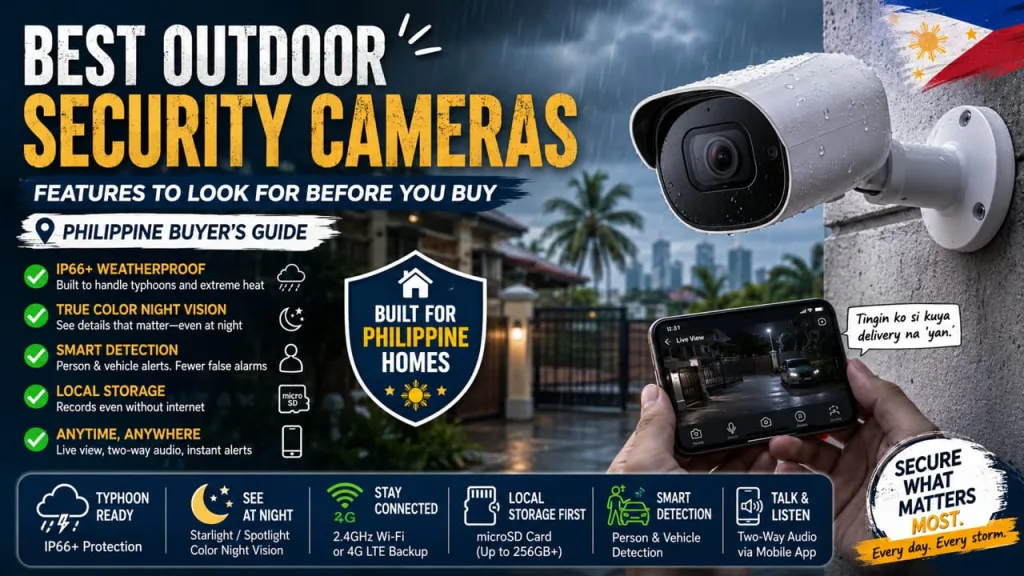
A camera designed for outdoor use that seems impressive on the technical specifications page can let you down when you actually need it, distorted video footage during an intrusion, dead batteries after a brownout or an unstable power source, or simply a case that shatters after a season of rain.
Features such as weather resistance, AI-powered detection, night vision, motion alerts, remote viewing, and reliable storage can make a significant difference in the camera’s performance and long-term value.
Cameras used outdoors are subject to challenges that indoor cameras do not go through, and in the Philippines, this entails being exposed to typhoon-level rains, hot weather, weak Wi-Fi signal in the provinces, and pests gathering around every lamp post.
This guide tells you exactly which features matter and which ones don’t when buying an outdoor camera in the Philippines
Why Outdoor Cameras Are Worth the Investment
There is solid proof behind surveillance being placed outside. It has been proven time and again that surveillance cameras deter theft and vandalism, and according to a study published in the Journal of Electronic Security and Digital Forensics, visible surveillance cameras caused a reduction in retail theft by 25%.
When it comes to residential security, surveillance cameras cut down attempted burglaries by 50% to 70%. In terms of financial damage to Filipino families, a simple break-in can lead to thousands of pesos worth of damages or lost valuables. This is common knowledge because more than 70% of Filipino families think that CCTV cameras are important.
But an outdoor camera only delivers on that promise if it’s built to survive outside. Here’s what actually matters when you’re comparing options.
1. Weatherproofing: IP Rating Is Non-Negotiable
All outdoor cameras advertise themselves as “weatherproof,” but only those with an IP (Ingress Protection) rating are worth looking at, which comprises a two-digit rating that gives you information about its resistance to dust and water ingress.
The minimal acceptable rating for a camera meant for outdoor use is at least IP65, guaranteeing that the device is dust-proof and waterproof for round-the-clock usage all year round. However, general recommendations do not take into account the local climate conditions of the Philippines.
CCTV cameras got destroyed by typhoon Odette that occurred in 2021 due to inadequate weatherproofing. This example proves that cameras that are advertised as waterproof cannot withstand typhoons with heavy rain and debris carried along with wind gusts.
Hence, IP66 should be taken as the minimum rating of weather protection for installation in any outdoor location in the Philippines, such as a gatepost, a perimeter wall, or an uncovered driveway.
2. Night Vision: Where Most Cameras Underdeliver
Security events mostly occur at night, and night vision would be the most critical feature in this list and the one that will most likely turn out disappointing when put to practical use. While a camera might perform brilliantly in terms of resolution during a demonstration at partial illumination by the vendor, it could end up being unable to record useful images at night in actual practice.
There are three tiers worth understanding:
- Standard infrared (IR) night vision is the standard form of technology used in entry-level outdoor cameras. Infrared lights are sent out through the LED lamps in the form of infrared waves. This technology can detect motion and shape but does not see color at all; hence, even if one sees a red motorcycle and a blue car at a distance of 30 meters, they will appear the same.
- Spotlight-assisted color night vision allows color vision using white LED spotlights that turn on automatically when movement is detected, providing full-color illumination of the scene where the color of vehicles and clothes and face details become visible. The drawback of such a system in an outdoor setting in the Philippines is that the spotlights attract insects throughout the year, which are misread as an alarm by motion sensors; hence, seek a “smart mode.”
- Starlight-color night vision works with the use of large-aperture lenses and very sensitive sensors to be able to gather enough ambient light from either a streetlight or the moon itself to create colored recordings without having to have any spotlight whatsoever.
3. Resolution and Field of View
For exterior surveillance purposes, it is recommended that cameras have at least 1080p resolution, but it has become common for 2K and 4K resolutions, which provide a much clearer vision to recognize a license plate or a person’s face from a distance. But it is not only about resolution; another important factor to consider is the field of view (FOV).
The wider field of view (about 120°-180°) means that fewer cameras are required to monitor an entire property since one single camera will see more space. A narrow driveway can be monitored with a bullet camera, but a backyard requires a PTZ camera.
4. Power Options and Connectivity for Philippine Conditions
Outdoor cameras are powered in several different ways, and the right choice depends heavily on your property’s layout and utility access:
- Wired/plug-in power offers the most reliable, always-on operation but requires an accessible outlet or professional cabling.
- Battery-powered (wire-free) cameras are easier to install anywhere but require periodic recharging or battery swaps.
- Solar-powered cameras solve the battery-maintenance problem entirely; for installation points without a nearby outlet, such as a far corner of a rural lot or a rooftop, a solar-powered camera can run indefinitely on Philippine sunlight without manual recharging.
- PoE (Power over Ethernet) delivers both power and data over a single cable, offering a stable, tamper-resistant connection ideal for permanent business installations.
Regarding connectivity, almost all the major Internet Service Provider routers in the Philippines, which include Globe, PLDT, Converge, and Sky, have the capability to emit the 2.4 GHz Wi-Fi frequency which is needed by the majority of outdoor cameras.
Make sure to check if the camera connects on the 2.4 GHz frequency instead of 5GHz when installing it. Properties that lack access to a stable Internet connection can now use 4G LTE on the outdoor cameras using a local SIM card.
5. Local vs. Cloud Storage
This one is also important because the usage of the camera with cloud storage only may become helpless without internet connection because of the storm in the Philippines, which causes interruptions in the Internet connection together with power supply failures.
A camera with a microSD card can record on its own without an Internet connection, assuming that a power supply is available; therefore, the best choice would be to use local storage for most families. The only reason for which cloud storage becomes beneficial is when you need to monitor some other house or a number of rented houses, which are geographically located in various places.
6. Smart Detection and False Alarm Control
Detection of just any motion triggers automatically any time there is movement, whether it is a tricycle or even stray cats and trees. Fatigue sets in due to constant alarms and everyone stops using the camera app. The solution to this has been found through AI-powered person and vehicle detection for outdoor cameras, where only real security threats can be detected while other motions are ignored, as well as sensitivity being adjusted according to specific activity zones such as gateways.
7. Two-Way Audio and Remote Access
The responsiveness of the mobile app can make sure that your outdoor camera works for you every day, not just when you need it during an emergency. What you should be looking for would include a live feed of images, instant push notifications, and easy-to-access videos. Two-way communication means that you will be able to talk right through your camera, whether it’s to direct the delivery person where to deliver your package or deter any intruders.
8. Installation and Mounting Considerations
The height and placement of the cameras are as important as the specifications of the equipment itself. Placing the camera 7 to 9 feet above ground level and inclined downward will provide a clear view of the face but keep the camera out of the reach of anyone trying to tamper with it. In the case of a large property, having overlapping fields of vision by different cameras will help in covering up the blind spots.
Quick Buying Checklist for Filipino Homeowners
- IP66 or higher for any fully exposed outdoor position.
- Starlight or spotlight-assisted color night vision — avoid basic black-and-white IR if identification matters to you.
- 2.4GHz Wi-Fi compatibility confirmed with your specific router or 4G LTE backup for weak-signal areas.
- Local microSD storage as your primary safeguard, with the cloud as an optional extra.
- Person/vehicle detection with smart alert zones to cut down false notifications.
- No mandatory subscription — many capable outdoor cameras now include live view, local recording, and motion alerts free, with cloud storage as a genuinely optional add-on.
Final Thoughts
The perfect outdoor surveillance camera is not necessarily the one with the most impressive resolutions but rather the one that will operate in the best manner possible during a typhoon in the Philippines, blackouts, and unreliable internet connectivity to provide meaningful images.
Your chosen camera should be designed for IP66+ protection, true color at night, and local storage before adding artificial intelligence detection and cloud storage capabilities as extras. With the basic elements covered, your camera would continue to function even on the one night it actually matters.