
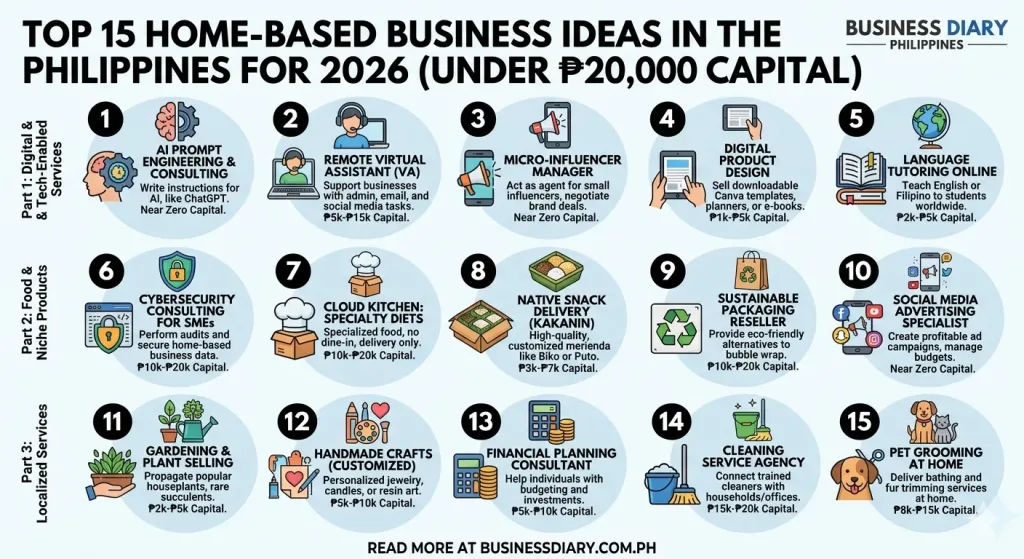
The barrier to entry for Filipino entrepreneurs has never been lower. As the Philippine economy continues its digital transformation into 2026, you no longer need a physical storefront or millions in capital to build a sustainable income.
Whether you are a stay-at-home parent, a fresh graduate, or looking for a profitable side hustle, starting a business from home allows you to leverage your existing skills with minimal financial risk. Below is a comprehensive list of 15 home-based business ideas tailored for the current Filipino market, all of which can be started with less than ₱20,000.
Part 1: Digital & Tech-Enabled Services
1. AI Prompt Engineering & Consulting
Many local SMEs want to utilize Artificial Intelligence to cut costs but do not know how to interact with the technology effectively. If you are skilled at writing precise instructions (“prompts”) for tools like ChatGPT, Claude, or Midjourney, you can offer consulting services.
- Startup Cost: Near Zero (Laptop + Internet).
- Income Model: Project-based kits (e.g., “AI Marketing Prompt Kit for Realtors”) or hourly consulting.
2. Remote Virtual Assistant (VA)
The Philippines remains a global hub for VA talent. As a VA, you support international or local businesses with administrative tasks, email management, scheduling, and customer support. Specializing in niches like real estate, legal, or e-commerce can command higher rates.
- Startup Cost: ₱5,000–₱15,000 (Good headset, webcam, and software subscriptions).
- Income Model: Hourly rate or monthly retainer.
3. Micro-Influencer Manager
Small brands are shifting away from expensive celebrities toward “nano” and “micro” influencers (1,000 to 100,000 followers) who have highly engaged, niche audiences. You can act as an agent—finding influencers, negotiating contracts, and managing campaigns for brands.
- Startup Cost: Near Zero.
- Income Model: Commission on deals (10–20%).
4. Digital Product Design
Instead of selling physical goods, design and sell digital products that customers can download and print. Popular items include Canva templates for social media, digital planners, e-books, and educational worksheets for kids. You build it once and sell it infinitely.
- Startup Cost: ₱1,000–₱5,000 (Design software like Canva Pro or Adobe).
- Income Model: Passive income per download.
5. Language Tutoring Online
With specialized platforms, teaching English as a Second Language (ESL) to students in Korea, Japan, or China remains profitable. Alternatively, you can offer Filipino (Tagalog) lessons to foreigners or second-generation Filipinos living abroad.
- Startup Cost: ₱2,000–₱5,000 (Noise-canceling headset and a stable backup internet connection).
- Income Model: Hourly per session.
6. Cybersecurity Consulting for SMEs
As local businesses move online, they become targets for scams and data breaches. If you have a background in IT, you can offer basic “cyber hygiene” audits, set up secure Wi-Fi, manage password systems, and train employees on how to avoid phishing attacks.
- Startup Cost: ₱10,000–₱20,000 (Certifications and specialized security software).
- Income Model: Flat fee per audit or monthly maintenance retainer.
7. Social Media Advertising Specialist
Managing a Facebook page is different from running profitable Facebook or TikTok ads. Businesses are willing to pay for experts who can generate leads and sales, not just “likes.” You will need to learn how to manage budgets, target audiences, and analyze ad data.
- Startup Cost: Near Zero (Your skill is the capital).
- Income Model: Monthly management fee plus a percentage of the ad spend.
Part 2: Food & Niche Products
8. Cloud Kitchen: Specialty Diets
A “cloud kitchen” is a food business with no dine-in space, relying purely on delivery. Instead of general food, focus on a high-demand niche: Keto, Vegan, Gluten-Free, or specialized “Meal Prep” delivery for busy professionals in your business district.
- Startup Cost: ₱10,000–₱20,000 (Ingredients, packaging, and registering with delivery apps).
- Income Model: Per meal or weekly subscription.
9. Native Snack Delivery (Kakanin)
Filipinos’ love for merienda never dies. You can focus on perfecting one or two high-quality native delicacies or kakanin—like premium Biko, Cassava Cake, or specialized Puto—and sell them in curated boxes for office meetings or family gatherings.
- Startup Cost: ₱3,000–₱7,000 (Kitchen equipment, ingredients, and branding).
- Income Model: Per order/Per box.
10. Sustainable Packaging Reseller
E-commerce is booming, but consumers are demanding eco-friendly alternatives to plastic bubble wrap. You can bulk-buy and resell sustainable packaging materials such as cassava bags, honeycomb paper wrap, and water-activated tape to local online sellers.
- Startup Cost: ₱10,000–₱20,000 (Initial inventory of various eco-materials).
- Income Model: Retail profit margin.
11. Gardening & Plant Selling
The “Plantito/Plantita” trend has matured into a steady market. You can propagate and sell popular houseplants, rare succulents, or “edible garden” starter kits (herbs and vegetables) from your own backyard or balcony.
- Startup Cost: ₱2,000–₱5,000 (Seeds/seedlings, soil, pots, and basic tools).
- Income Model: Per plant/Per kit.
12. Handmade Crafts (Customized)
Personalized gifts are always in demand for weddings, birthdays, and holidays. If you are artistic, you can sell handmade jewelry, customized scented candles, resin art, or personalized tote bags. Use social media to showcase the making process.
- Startup Cost: ₱5,000–₱10,000 (Raw materials and crafting tools).
- Income Model: Project-based or retail sale.
Part 3: Localized Services
13. Cleaning Service Agency
You don’t have to do the cleaning yourself. You can start an agency that connects trained cleaners with households or small offices. Your role is marketing, booking, customer service, and quality control. Focus on specialized services like sofa or mattress cleaning.
- Startup Cost: ₱15,000–₱20,000 ( Specialized cleaning equipment, initial uniforms, and marketing).
- Income Model: Agency fee or percentage of the service cost.
14. Pet Grooming at Home
Filipinos treat their pets like family. Instead of customers traveling to a vet, you can offer mobile grooming services (bathing, fur trimming, nail cutting) in the comfort of their own homes.
- Startup Cost: ₱8,000–₱15,000 (Professional grooming kit, specialized shampoos, and transportation).
- Income Model: Flat fee per grooming session.
15. Financial Planning Consultant
As financial literacy grows in the Philippines, many individuals need help budgeting, managing debt, and understanding insurance or investment options. You can offer personalized financial roadmaps. Note: To sell specific investment products, you will need licensing from the SEC or Insurance Commission.
- Startup Cost: ₱5,000–₱10,000 (Training workshops and exam fees).
- Income Model: Flat consultation fee or commission-based (if licensed).
Next Steps: How to Register Your Home Business
While these businesses are low-capital, they must still be registered to be legitimate and to allow you to issue Official Receipts (OR), which many corporate clients require.
- Step 1: DTI Registration. Register your business name online via the BNRS portal.
- Step 2: Barangay Clearance. Secure a clearance for your home address as a business location.
- Step 3: Mayor’s Permit. Visit your municipal hall to ensure you are compliant with local zoning laws.
- Step 4: BIR Registration (Form 1901). Register as a sole proprietor to stay tax-compliant.
Frequently Asked Questions (FAQ)
Q: Can I run a business from my condo or apartment? A: Yes, as long as your lease agreement allows for “residential-office” use and you obtain the necessary permits from the building administration and the barangay.
Q: Do I need to be a VAT-registered business? A: Not necessarily. If your annual gross sales are below ₱3,000,000, you can register as a Non-VAT taxpayer, which simplifies your filing process.