
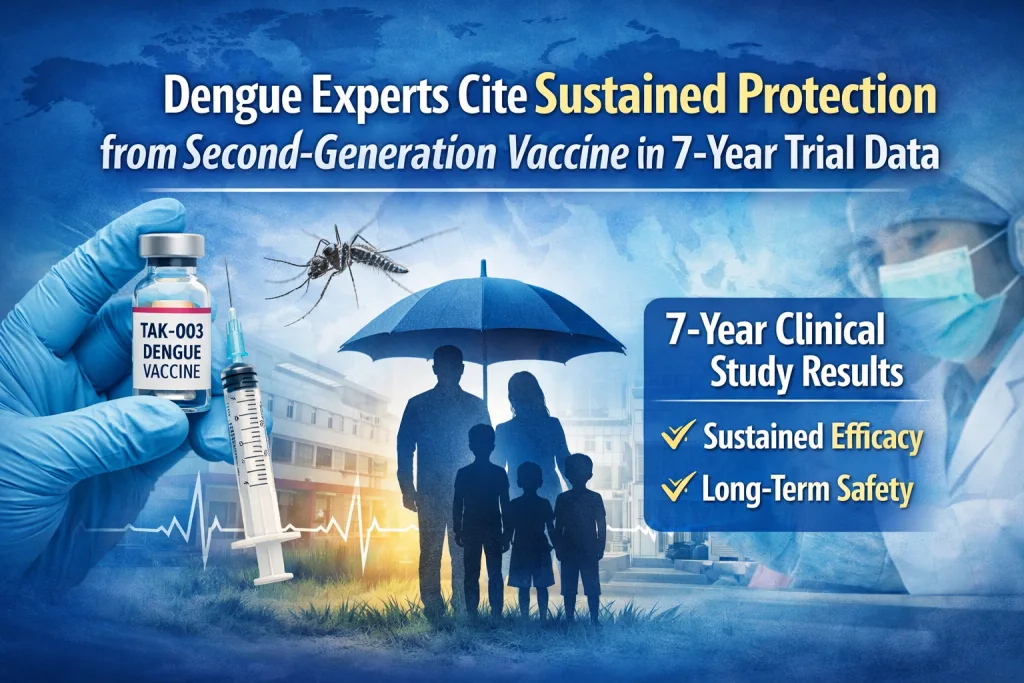
Manila, Philippines — A multi-stakeholder group focused on strengthening dengue prevention and control policies in Asia[1] recently highlighted the sustained protection offered by a second-generation dengue vaccine, taking note of the long-term results of a 7-year global clinical trial.
In a November edition of its Dengue Policy Updates[2], the Asia Dengue Policy Working Group cited the results of the pivotal Phase 3 Tetravalent Immunization against Dengue Efficacy Study (TIDES), which further demonstrated the long-term efficacy and safety of TAK-003, a dengue vaccine developed by the Japanese biopharmaceutical company Takeda.
The update stated that data from the completion of the 7-year Phase 3 TIDES trial, including an exploratory analysis of a booster dose, showed that TAK-003 provides sustained protection against virologically confirmed dengue and that the two-dose regimen provides sustained protection against dengue. This is consistent with its approved indications in multiple countries worldwide, which could simplify vaccination schedules and increase adherence. Experts from the Philippine Foundation for Vaccination (PFV) highlighted the vaccine’s potential for dengue prevention in the country if used together with other integrated dengue control and prevention tactics.
Executive Director of PFV and noted infectious disease expert Dr. Lulu Bravo said: “These 7 years of trial have shown good safety results and protection against hospitalization and severe dengue. That gives us more confidence in the evidence.”
The latest trial data has an analysis of the potential benefits of a booster dose. Some participants in the study received a booster dose 4.5 years after receiving the second of two TAK-003 doses. Researchers then compared them with individuals who did not receive the booster. In a 25-month follow-up, the analysis showed only a slight increase in protection between those who received the booster (74.3%) against those who did not (61.2%). Additionally, protection against dengue hospitalization remained consistently high—90.6% with the booster vs. 84.1% with the two-dose regimen. [3],[4] In this study, these results suggest that two doses is sufficient for sustained protection. No new safety signals were observed even after the administration of the booster dose.
Expert underscores rigorous clinical trials
Dr. Bravo emphasized that vaccines like TAK-003 undergo rigorous clinical testing before they become available to the public. “The first principle with vaccines is that it should not do harm,” she said.
She added that strict trial standards and regulatory inspections ensure reliability and credibility. “A trial that is really world-class, that is really keen on being checked and inspected and audited and really investigated, goes through this kind of strict implementation and processes.”
Ultimately, national regulatory authorities such as the Philippine FDA review these data and decide whether and how a vaccine will be used in their countries.
Dengue burden remains high
Dengue continues to pose a major public health challenge worldwide, causing millions of infections and thousands of deaths each year. In the Philippines, surveillance data from the Department of Health show 234,855 dengue cases and 912 deaths from January to September 20, 2025.[5]
Dr. Erica Tania Davillo, chair of the Philippine Medical Association Ad Hoc Committee on Dengue, lauded the government’s efforts to promote vector control, but she also believes there is room for vaccination in the fight against dengue. “A safe and effective vaccine can help our country reduce the dengue burden, as part of an integrated dengue prevention and control program,” she said. ‘
Global use, pending local review
TAK-003 has been evaluated in more than 20,000 participants across dengue-endemic countries, including the Philippines, through the TIDES trial and related studies.
Since its first regulatory approval in 2022, it has been authorized for use in several countries in Asia, Latin America, and Europe, and millions of doses have been distributed globally. The vaccine is not yet available in the Philippines and remains under review by the FDA.
Improving vaccine confidence
Dr. Bravo said that Filipinos’ attitudes towards vaccination in general and dengue vaccination in particular have been improving. She noted that in a soon-to-be published report from Dr. Heidi Larson of the Vaccine Confidence Project, the Philippines has one of the highest rates of vaccine confidence in the world.
“The Philippines was topping vaccine confidence—85% for dengue vaccine and 88% for vaccination in general,” Dr. Bravo noted. “And this is much higher than some countries in Asia-Pacific … and even Latin America.”
She continues to believe that vaccination plays an integral role in an integrated dengue control strategy. Dr. Bravo said: “We need to get not just comprehensive vector control, 5S protection, and prevention for dengue, but much more. We need to implement a vaccine program, or give the vaccine to the people, whoever wants it at first, and then slowly, when you realize that it is very good to have the vaccine, then you can do the public universal vaccination.”
Dr. Davillo agreed, saying that there is an opportunity for the country to end dengue deaths by 2030. “We need to work together, backed by accurate scientific information. We need to fight disinformation and fear-mongering with regard to effective dengue prevention and control strategies, including vaccination,” she said.