
If you’re self-employed, freelancing, running a small business, or earning through gigs, you’re responsible for taking care of your own government contributions—including your Social Security System (SSS) payments.
The good news? There are no new SSS contribution rates for 2026. The contribution schedule that took effect in January 2025 remains in effect this year. That means the contribution rate is still 15%, with a minimum Monthly Salary Credit (MSC) of ₱5,000 and a maximum MSC of ₱35,000.
Here’s what you need to know before paying your contributions.
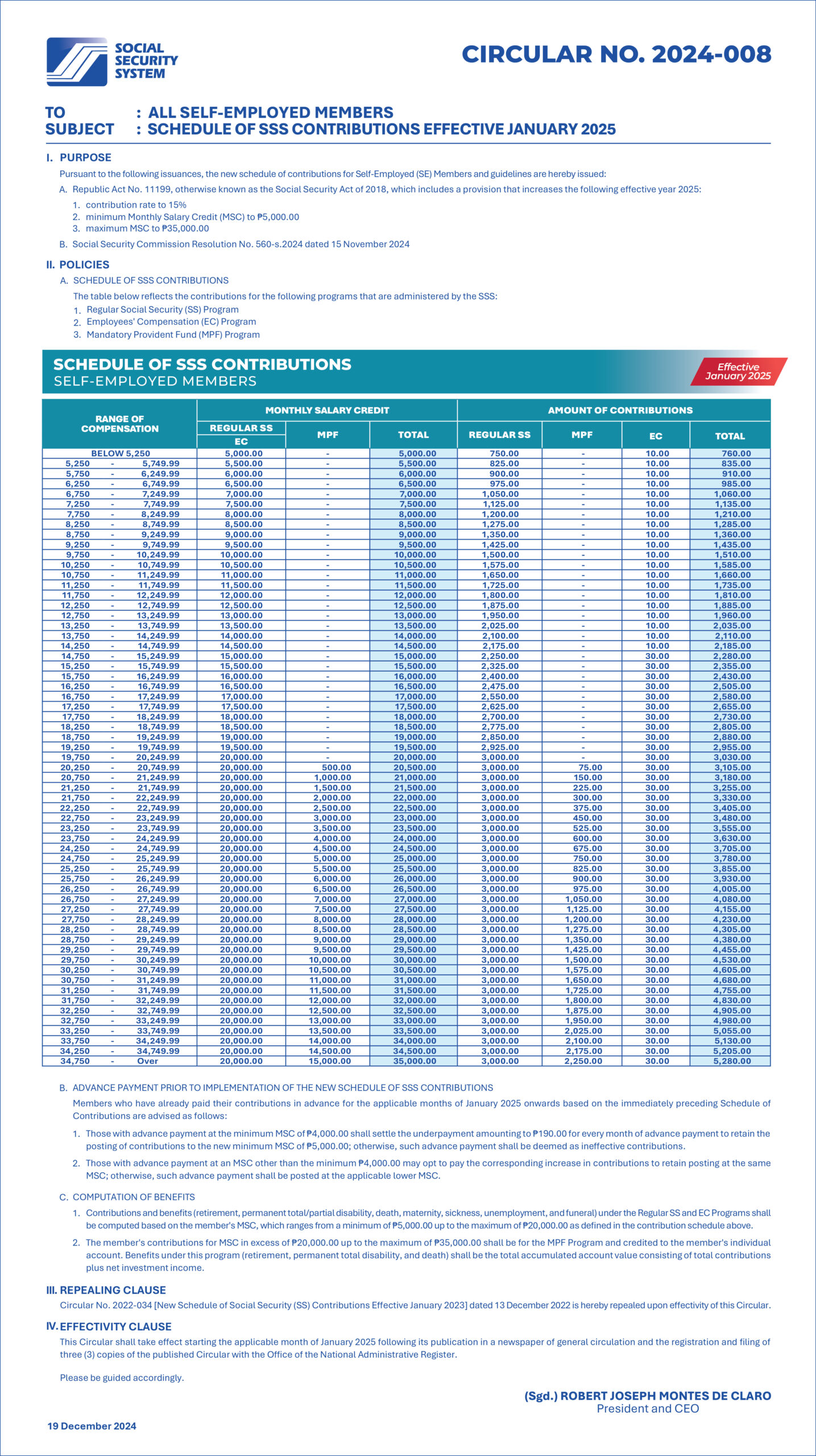
2026 SSS Contribution Table for Self-Employed Members
For 2026, self-employed members continue to follow the same SSS contribution table implemented in 2025.
- Contribution rate: 15% of your Monthly Salary Credit (MSC)
- Minimum MSC: ₱5,000
- Maximum MSC: ₱35,000
- Who pays? Self-employed members pay the entire contribution themselves.
Table: 2026 SSS Contribution Table for Self-Employed Members
What’s Changed for 2026?
Actually, nothing has changed.
Some online articles mention “new” SSS rates for 2026, but the official SSS schedule remains the same as the one introduced in January 2025. If you’ve been paying based on the 2025 contribution table, you can continue using the same rates this year.
Here’s a quick summary:
- Contribution rate remains at 15%
- Minimum MSC remains ₱5,000
- Maximum MSC remains ₱35,000
- Contributions above an MSC of ₱20,000 continue to include allocations to the Mandatory MySSS Pension Booster
Understanding the MySSS Pension Booster
The former WISP and WISP Plus programs are now collectively known as the MySSS Pension Booster.
Instead of simply increasing your regular SSS contribution, part of your payment may be invested under this additional retirement savings program.
Mandatory Pension Booster
If your Monthly Salary Credit exceeds ₱20,000, the contribution on the excess amount is automatically credited to your Mandatory MySSS Pension Booster account.
This fund is professionally managed by SSS and earns investment income, which is credited to your account based on fund performance.
Voluntary Pension Booster
Members who want to build a larger retirement fund may also make additional voluntary contributions.
Unlike regular SSS contributions, these extra savings are invested for long-term retirement growth and may provide higher returns than a traditional savings account, although returns are not guaranteed.
Employees’ Compensation (EC)
Self-employed members also pay the Employees’ Compensation (EC) contribution together with their regular SSS payment.
The EC contribution is:
- ₱10 for MSCs below ₱15,000
- ₱30 for MSCs of ₱15,000 and above
This provides additional benefits in case of work-related sickness, injury, disability, or death.
How to Compute Your SSS Contribution
The basic formula is:
Total Contribution = (MSC × 15%) + EC Contribution
Example
Suppose your declared Monthly Salary Credit is ₱25,000.
- Regular SSS Contribution: ₱25,000 × 15% = ₱3,750
- Employees’ Compensation: ₱30
Total Amount to Pay: ₱3,780
If your MSC is above ₱20,000, part of the contribution is automatically credited to your Mandatory MySSS Pension Booster.
Why Paying SSS Is Worth It
For self-employed Filipinos, SSS is more than just another monthly expense. It provides financial protection during unexpected situations and helps you prepare for retirement.
Some of the benefits include:
- Monthly retirement pension upon meeting eligibility requirements
- Sickness benefit
- Maternity benefit
- Disability benefit
- Death and funeral benefits
- Salary and calamity loans for qualified members
- Lifetime pension after retirement, subject to SSS rules
Consistent contributions also help ensure you qualify for future benefits when you need them most.
Don’t Forget to Keep Your Membership Information Updated
If you’ve recently shifted from being an employee to becoming self-employed, a freelancer, or a business owner, make sure your SSS membership status reflects your current employment type.
Keeping your records updated helps avoid delays or issues when applying for loans or claiming benefits in the future.
Final Thoughts
For 2026, there are no changes to the SSS contribution schedule. Self-employed members will continue using the contribution table that became effective in January 2025.
Although paying 15% of your declared Monthly Salary Credit may seem like a significant expense, your contributions help fund retirement, sickness, disability, maternity, and other social security benefits that can provide financial support when you need them most.
Before making your payment, always verify the latest contribution table and announcements through the official SSS website to ensure you’re following the current guidelines.