
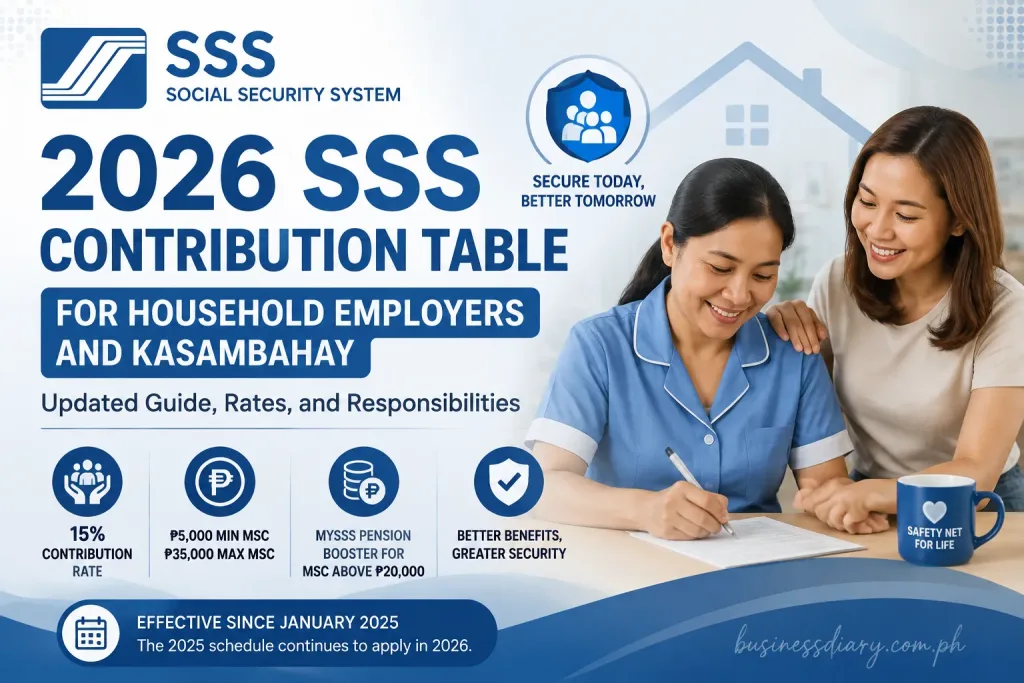
If you employ a kasambahay, helper, nanny, caregiver, gardener, or family driver, you are required by law to register them with the Social Security System (SSS) and remit their monthly contributions.
For 2026, there are no new SSS contribution rates. The contribution schedule that took effect in January 2025 continues to apply this year. Household employers and kasambahay should continue using the same contribution table when computing monthly SSS payments.
2026 SSS Contribution Rates at a Glance
The current SSS contribution schedule provides the following:
- Effective since: January 2025
- Contribution Rate: 15% of the Monthly Salary Credit (MSC)
- Minimum Monthly Salary Credit (MSC): ₱5,000
- Maximum Monthly Salary Credit (MSC): ₱35,000
If the Monthly Salary Credit exceeds ₱20,000, a portion of the contribution is automatically credited to the Mandatory MySSS Pension Booster, which forms part of the member’s retirement savings.
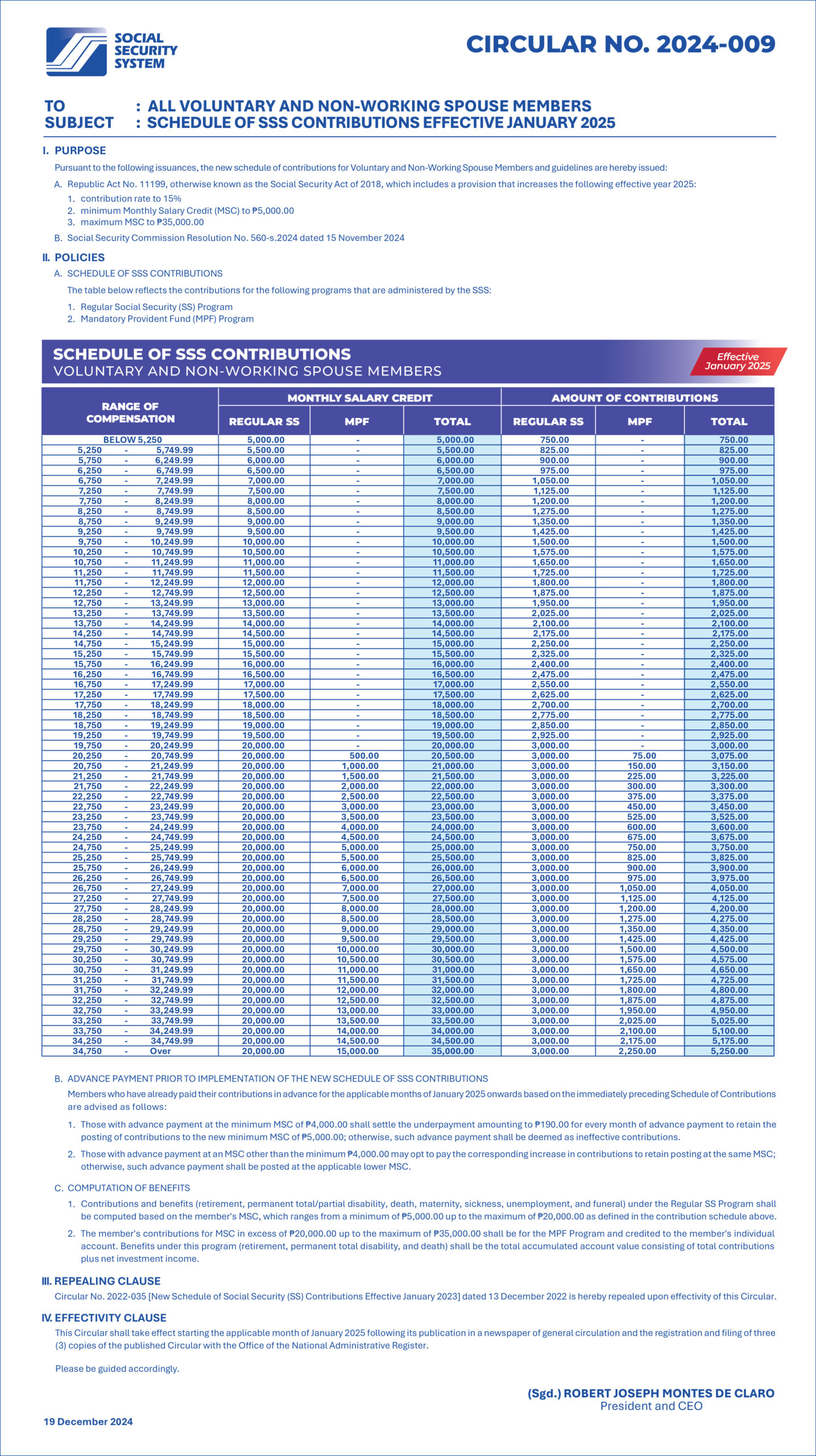
2026 SSS Contribution Table for Household Employers and Kasambahay
Use the official 2025–2026 SSS contribution table when determining the monthly contribution based on the kasambahay’s Monthly Salary Credit (MSC).
Table: 2026 SSS Contribution Table for Household Employers and Kasambahay
Who Pays the SSS Contribution?
The amount paid depends on the monthly compensation of the kasambahay.
If the Monthly Salary is Below ₱5,000
Under the Kasambahay Law and SSS rules, the household employer pays the entire SSS contribution. No deduction should be made from the employee’s salary.
If the Monthly Salary is ₱5,000 or More
Both the employer and the kasambahay contribute based on the official SSS contribution schedule.
The employer shoulders the larger share of the contribution, while the employee pays the corresponding employee share through payroll deduction.
Understanding the MySSS Pension Booster
If the Monthly Salary Credit exceeds ₱20,000, part of the contribution is automatically allocated to the Mandatory MySSS Pension Booster.
Previously known as the Mandatory Provident Fund (MPF), this retirement savings program allows members to accumulate additional retirement funds that are invested by SSS for long-term growth.
Members may also choose to make additional voluntary contributions through the Voluntary MySSS Pension Booster.
Responsibilities of Household Employers
As a household employer, you are responsible for:
- Registering your kasambahay with SSS if they are not yet a member.
- Deducting the employee’s share when applicable.
- Paying the employer’s share every month.
- Remitting contributions on or before the prescribed due date.
- Keeping accurate payroll and contribution records.
Failure to remit SSS contributions may result in penalties, surcharges, and other legal liabilities under the Social Security Act.
Benefits of Paying SSS Contributions
Regular SSS contributions allow household workers to qualify for various social security benefits, including:
- Retirement pension
- Sickness benefit
- Maternity benefit
- Disability benefit
- Death benefit
- Funeral benefit
- Unemployment benefit (for qualified members)
- Salary and calamity loans, subject to eligibility requirements
Generally, higher Monthly Salary Credits result in higher benefit amounts because many SSS benefits are computed based on the member’s contribution history and credited salary.
Frequently Asked Questions
Are there new SSS contribution rates for 2026?
No. The SSS continues to use the contribution schedule that became effective in January 2025.
What is the SSS contribution rate?
The contribution rate remains 15% of the Monthly Salary Credit.
What is the minimum Monthly Salary Credit?
The minimum Monthly Salary Credit is ₱5,000, while the maximum is ₱35,000.
Who pays the SSS contribution of a kasambahay?
If the monthly salary is below ₱5,000, the household employer pays the entire contribution.
If the monthly salary is ₱5,000 or higher, both the employer and the kasambahay share the contribution according to the official SSS contribution table.
What is the MySSS Pension Booster?
The MySSS Pension Booster is SSS’s retirement savings program. For members whose Monthly Salary Credit exceeds ₱20,000, part of the contribution is automatically credited to the Mandatory MySSS Pension Booster to help increase retirement savings.
Final Thoughts
Although many people refer to them as the “2026 SSS contribution rates,” the current schedule has actually been in effect since January 2025 and remains unchanged this year.
Household employers should continue using the existing SSS contribution table when computing monthly remittances, while kasambahay can look forward to continued access to retirement, maternity, sickness, disability, and other valuable social security benefits through consistent contributions.
To avoid errors, always refer to the latest contribution table and announcements published by the Social Security System before making payments.