
Let’s be real—seeing your monthly contributions go up isn’t exactly the same feeling as finding an extra PHP 1,000 in your old jeans. But as a freelancer, gig worker, or business owner in the Philippines, you are the CEO, the HR, and the janitor. Managing your own “company benefits” is a non-negotiable part of the hustle.
Following the final phase of the Social Security Act of 2018 (RA 11199), the SSS contribution rate has officially peaked at 15% for 2026. This guide breaks down the new tables, the PHP 35,000 ceiling, and why that “extra” money is actually a long-term win for your retirement.
2026 SSS Contribution Table for Self-Employed
The new schedule features a minimum Monthly Salary Credit (MSC) of PHP 5,000 and a maximum of PHP 35,000. Note that any MSC exceeding PHP 20,000 is automatically funneled into the Mandatory MySSS Pension Booster.
Table: 2026 SSS contribution rates for self-employed members
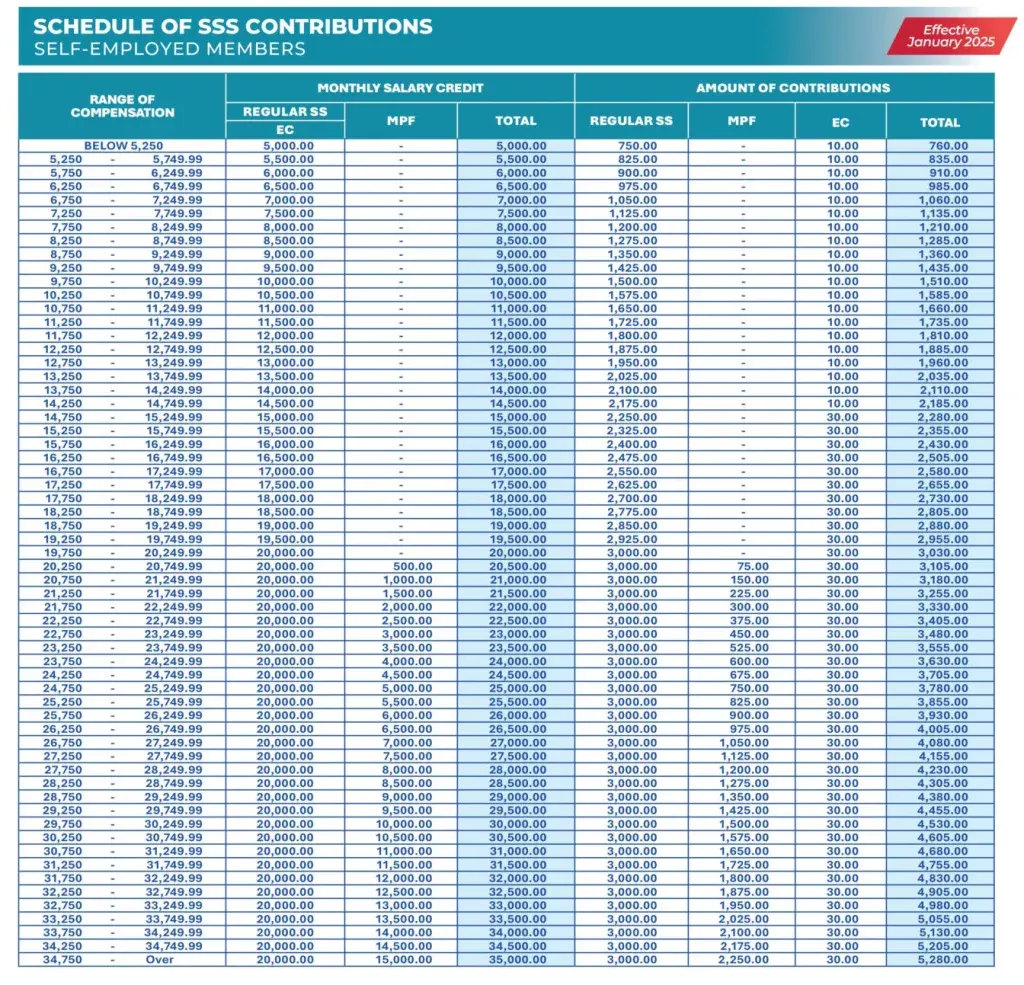
Note: For the full detailed list of brackets, always check the official SSS website.
Key Updates for 2026: 15% Rate & PHP 35k Ceiling
If you’ve been paying SSS for a while, you probably remember when the rate was lower. Here is the direct impact of the 2026 changes:
- The 15% Rule: Unlike employed members where the employer pays 10% and the employee pays 5%, self-employed members shoulder the full 15%.
- The PHP 35,000 Ceiling: The maximum MSC has been raised from 30k to 35k. This allows high-earning freelancers to “save” more under the SSS umbrella, which directly leads to a higher retirement pension.
- Minimum MSC: You can no longer contribute at the PHP 4,000 bracket. The floor is now PHP 5,000 (a total of PHP 760 including EC).
Understanding the MySSS Pension Booster
Formerly known as WISP and WISP Plus, these are now under the MySSS Pension Booster brand. Think of it as a secondary, tax-free savings account within SSS.
- Mandatory Booster: If your MSC is higher than PHP 20,000, your 15% contribution for the excess amount automatically goes here. It earns interest based on SSS investment performance (around 6-7% ROI).
- Voluntary Booster: Any member can contribute extra (as low as PHP 500) to this fund, regardless of their MSC. It’s a great alternative to traditional bank savings because the returns are often higher and completely tax-exempt.
Employees’ Compensation (EC) for the Self-Employed
Many freelancers overlook the EC portion. This is a mandatory add-on that provides extra benefits for work-related contingencies (e.g., getting injured while on a business trip or working at your desk).
- MSC below PHP 15,000: Pay an additional PHP 10.
- MSC PHP 15,000 and above: Pay an additional PHP 30.
How to Compute Your SSS Contribution
Calculating your contribution is straightforward. Use this formula:
Total = (MSC x 0.15) + EC
Example: You earn PHP 25,000 monthly.
- Base SS: 25,000 x 15% = 3,750
- Breakdown: The first 20,000 x 15% = 3,000 (Regular) + the excess 5,000 x 15% = 750 (Mandatory Booster).
- EC Addition: Add PHP 30 (since MSC is >15k).
- Final Pay: PHP 3,780.
Why SSS is Still a Must for Freelancers
It’s easy to think of SSS as just another “tax,” but for self-employed Filipinos, it’s the only guaranteed safety net that doesn’t rely on a corporate HR department.
- Sickness & Maternity: Get a daily cash allowance if you can’t work due to illness or childbirth. For those at the max MSC (35k), maternity benefits can reach up to PHP 80,000+.
- Salary & Calamity Loans: Access low-interest loans after just 36 months of contributions.
- Lifelong Pension: Unlike private insurance which might have a “maturity date,” SSS pays you a monthly pension for as long as you live after retirement.
- Funeral Benefit: A cash benefit ranging from PHP 20,000 to PHP 60,000 to assist your family.
Pro-Tip: Advance Payments
If you paid for the whole of 2026 in advance back in 2024 at the old rates, you will likely have an underpayment. Check your My.SSS portal or mobile app to generate a new PRN (Payment Reference Number) to settle the difference and keep your account active.
Final Thoughts
The 2026 SSS update is about one thing: sustainability. By increasing the ceiling and the rate, the fund is projected to last longer, ensuring that when we’re finally ready to “log off” for good, our retirement is secure.
Are you currently registered as “Voluntary” or “Self-Employed”? Make sure your status is correct in the SSS system to avoid issues when filing for benefits!