
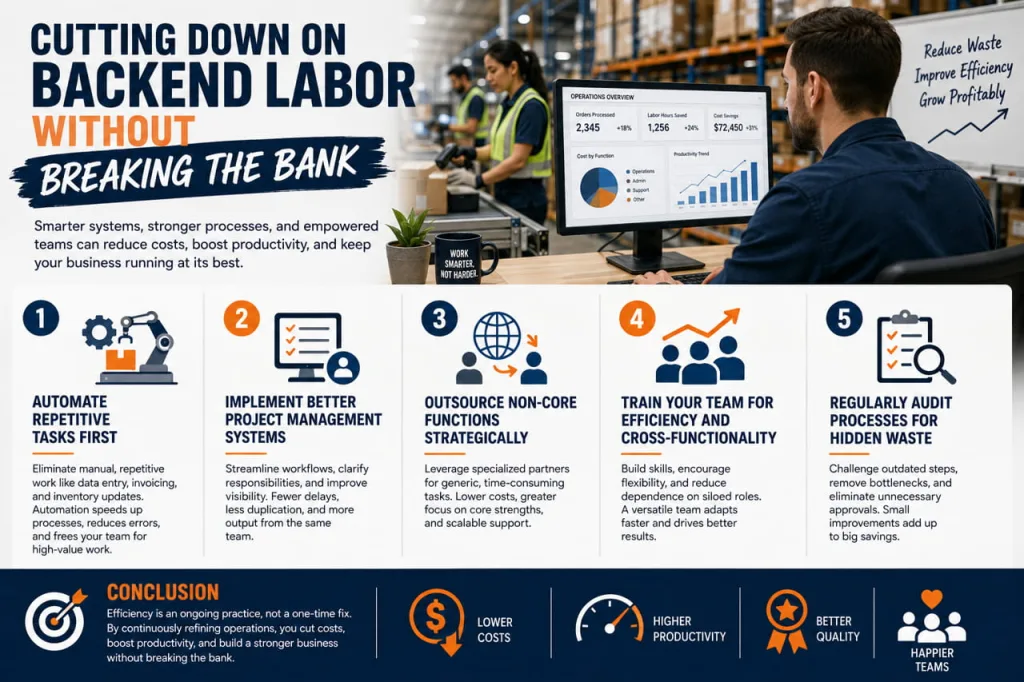
Every business owner knows the tension: keep labor costs down without letting operations fall apart. Backend labor — the work grinding away in warehouses, support centers, and admin departments — eats a disproportionate share of most operating budgets. Most leaders assume the only options are layoffs or slower service. Neither is true. With the right moves, you can tighten backend operations through planning and targeted investment that actually pays back.
1. Automate Repetitive Tasks First
Start with the obvious targets. Data entry, invoice processing, order confirmation, inventory updates — these follow the same pattern every single time. No judgment required. When a task is that predictable, software handles it faster and cleaner than any person will. A warehouse running barcode scanning and automated sorting, for instance, can burn through orders in a fraction of the time manual methods take — freeing workers for the messy, complicated stuff that actually needs a human brain.
And automation doesn’t have to mean six-figure enterprise software. Plenty of businesses get real traction from lightweight workflow tools that just connect the systems they already have. Sync customer orders straight into your accounting platform, no manual re-entry needed. Setup takes time and some upfront cost — that part’s real. But the labor savings stack up fast. Most operations hit ROI within the first year, and the clock keeps running in your favor after that.
2. Implement Better Project Management Systems
Disorganized backends are expensive. Duplicate work, constant clarification requests, hours lost hunting for information that should be obvious — it all adds up. A solid project management system cuts through that noise. When everyone can see their responsibilities, their deadlines, and how their work connects to the next person’s, the unnecessary meetings stop. A customer service team on shared task software, for example, can instantly see which issues are already claimed and skip the time-wasting overlap.
There’s a deeper benefit too. Good systems make bottlenecks visible. Sometimes a task drags not because someone is slow, but because they’re missing a resource or waiting on information nobody thought to send them. Give people the right tools, and you’ll often discover the same output is achievable with a leaner team — simply because the team operates without the friction. The best platforms require almost no learning curve because they mirror how people actually want to work.
3. Outsource Non-Core Functions Strategically
Not everything has to live inside your organization. Some backend functions are necessary but genuinely generic — bookkeeping, payroll, basic customer support, data entry. Specialized service providers do this work at scale. Their unit costs are lower than yours. A mid-sized company paying two full-time accounting
salaries to handle payroll, benefits, and tax compliance will often find a professional firm does the same work for considerably less.
But be selective. Core functions that touch your competitive edge or demand real institutional knowledge belong in-house. Standardized, industry-agnostic work is fair game for external partners top breakaway advisors rely on outsourced backend support to keep overhead lean while staying locked in on client relationships and growth. One caveat: vet vendors hard before committing. A bad outsourcing partner doesn’t save labor — it creates more of it.
4. Train Your Team for Efficiency and Cross-Functionality
Sometimes the cheapest fix is making your existing people more capable. A warehouse worker who knows the inventory software, can run quality checks, and operates multiple pieces of equipment is worth far more than someone with one narrow function. That flexibility means fewer bodies needed to cover everything. It also means the team holds up better when someone’s out sick or when volume spikes unexpectedly.
Cross-training has a side effect worth mentioning: it improves retention. Workers who learn new skills stay longer. And turnover is expensive — recruitment, onboarding, the productivity gap while someone new gets up to speed. Spending a few hundred dollars training existing staff to cover additional responsibilities typically saves thousands compared to replacing them. The math isn’t complicated.
5. Regularly Audit Processes for Hidden Waste
Processes accumulate dead weight. Steps nobody questions because “that’s how we’ve always done it.” Pull them apart periodically. Ask what each step actually requires versus what’s just habit or outdated caution. You might find an approval chain with three sign-offs where only one manager ever catches a real problem. Cut the redundant steps, and work stops waiting — labor hours drop with it.
Writing processes down helps. There’s almost always a gap between how something is supposed to work and how it actually happens. Document the reality, not the ideal, and the inefficiencies get harder to ignore. Outdated tools, communication gaps, skills mismatches — they surface fast. And the people doing the work daily? They already know where the friction is. Ask them.
Make this a habit, not a project. When teams feel comfortable flagging waste as part of normal operations, small savings compound across the year. Quarterly walkthroughs of key processes are enough. No formal program required. Just consistent attention — because waste has a way of quietly rebuilding once you stop looking.
Conclusion
Cutting backend labor costs doesn’t demand layoffs or degraded service. Automation, tighter organization, smart outsourcing, cross-trained teams, and regular process audits — together, these moves produce real cost reductions while often improving speed and quality simultaneously. The businesses that win treat backend efficiency as an ongoing discipline, not a one-time cleanup. Keep examining. Keep investing in the right places. The labor needs shrink, and the productivity and satisfaction numbers tend to move the other direction.