
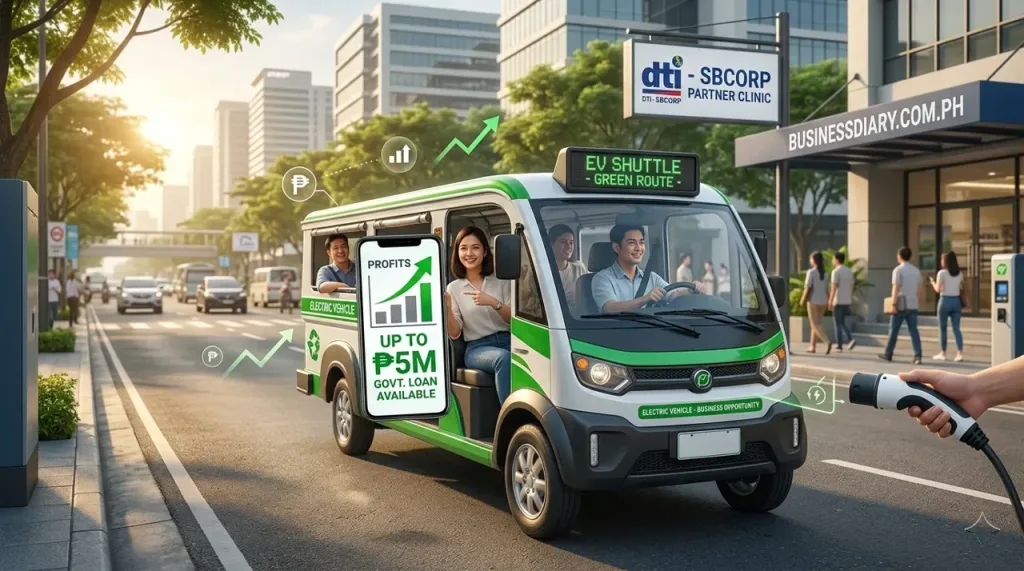
The “Green Revolution” on Philippine roads has moved from a trend to a massive business opportunity. As of April 21, 2026, the Department of Trade and Industry (DTI) and SBCorp officially launched the ₱2-billion E-Transport Loan program. This initiative is designed to help Public Utility Vehicle (PUV) drivers and transport operators transition to Electric Vehicles (EVs) amid the ongoing global energy crisis.
Whether you are looking to modernize a jeepney fleet or start a private EV shuttle service, here is your 2026 roadmap to tapping into government funding and launching a profitable EV venture.
1. Why the EV Business is Booming in 2026
With traditional fuel prices remaining volatile and new environmental mandates in place, the cost-per-kilometer for EVs is now 60% lower than diesel or gasoline counterparts.
Key Market Drivers:
- Government Support: Access to loans up to ₱5 Million per operator.
- Charging Infrastructure: The “EV Charging Hub” is the new gas station, with thousands of fast-chargers now active across Luzon, Visayas, and Mindanao.
- Consumer Preference: Commuters and corporate clients are prioritizing “Green Certified” transport for their ESG (Environmental, Social, and Governance) goals.
2. The ₱2-Billion SBCorp EV Loan: What You Need to Know
The Small Business Corporation (SBCorp) is currently offering the most aggressive lending rates for EV acquisition in Philippine history.
Loan Highlights:
- Maximum Loan Amount: Up to ₱5,000,000.
- Purpose: Purchase of electric jeepneys (e-jeepneys), electric trikes, or EV shuttle vans.
- Interest Rates: Significantly lower than commercial bank rates to encourage the “Green Shift.”
- Eligibility: Open to registered cooperatives, MSMEs, and individual transport operators with valid franchises.
3. Step-by-Step: How to Launch Your EV Transport Service
Step 1: Choose Your Business Model
- Modernized Public Transport: Partner with a cooperative to replace traditional PUJs with e-jeepneys.
- Corporate Shuttle Services: Provide eco-friendly employee transport for BPOs and multinational firms.
- EV Logistics/Delivery: Partner with e-commerce giants for “Last-Mile” green delivery using electric vans.
Step 2: Secure Your SBCorp Funding
Gather your DTI or SEC registration, latest financial statements, and a Fleet Modernization Plan. Apply via the SBCorp online portal.
Step 3: Partner with a Charging Network
Profitability in the EV business depends on “Uptime.” Establish a contract with charging providers like Unioil EV, Shell Recharge, or Meralco’s e-Mobility units to ensure your fleet never runs out of power.
4. Funding Limits: The ₱3M Standard vs. ₱5M Flex
There has been significant discussion regarding the maximum loan amount. During the official launch at the DTI main office in Makati, Trade Secretary Ma. Cristina Roque provided critical clarity on the funding ceilings.
The Official Loan Structure:
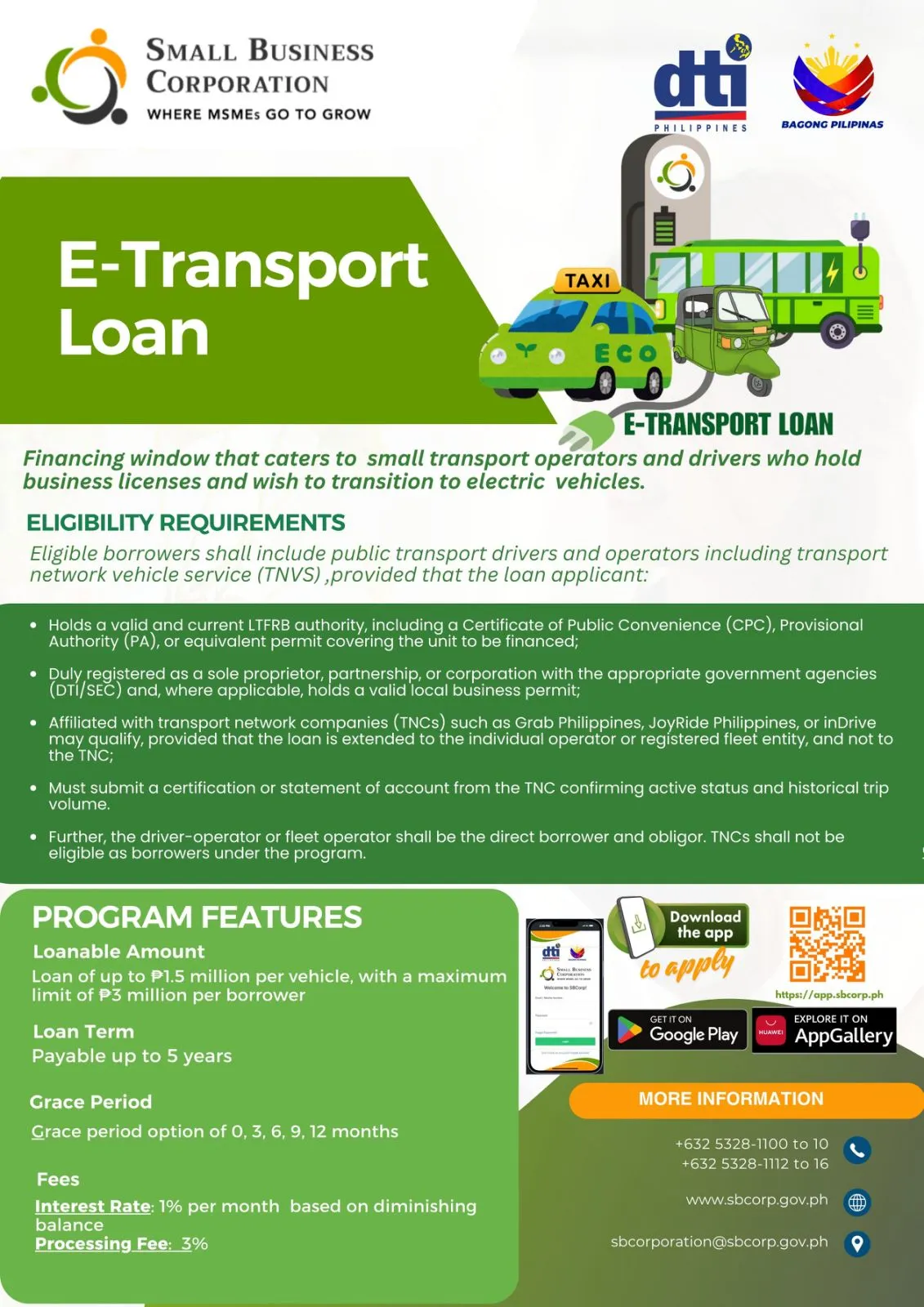
- Per Vehicle Cap: Operators can borrow up to ₱1.5 million per unit.
- Standard Borrower Limit: The official program guidelines set a maximum limit of ₱3 million per borrower.
- The ₱5M “Roque” Provision: Secretary Roque clarified that operators may actually borrow as much as ₱5 million. She explained that while the initial E-Transport fund is ₱2 billion, it can be replenished via the broader MSME Business Fund once depleted. This allows larger fleet operators to secure higher financing to meet their modernization needs.
5. Updated 2026 Loan Terms & Benefits
This is the most aggressive and subsidized credit line ever offered for Philippine transport:
- Interest Rate: Approximately 1% monthly on a diminishing balance (effectively ~6.7% annually).
- Repayment Period: Up to 5 years.
- The Grace Period: To ensure operators can stabilize their cash flow, the loan offers a one-year (12-month) grace period on both principal and interest payments.
- Incentives: Under the EVIDA Law, EV operators enjoy prioritized registration and exemption from the Unified Vehicular Volume Reduction Program (UVVRP) or “Coding.”
6. Why the EV Pivot is Profitable in 2026
With the current Middle East crisis affecting fuel prices, the cost-per-kilometer for EVs is now 60% lower than diesel.
| Operational Metric | Diesel Jeepney/Van | Electric Vehicle (EV) |
| Fuel/Energy Cost | ~₱7.50 / km | ~₱2.20 / km |
| Maintenance | High (Oil, Filters, Belts) | Minimal (Battery & Motors) |
| Daily Operation | Subject to Coding | Coding Exempt (7 days/week) |
7. How to Apply: A Digital-First Process
SBCorp has bypassed traditional bank queues. Applications are handled entirely through their digital ecosystem.
Step-by-Step Application:
- Download the App: Get the SBCorp Money App on your mobile device.
- Select Program: Choose the E-Transport Loan icon.
- Submit Documentation:
- Valid Business Name Registration (DTI/SEC).
- Valid Bank Account/Statement for disbursement.
- Proof of Government Compliance (LTFRB permit/CPC).
- Photos of the business or specific vehicle requirements.
- Assistance: If you need help, visit any of the 1,300+ Negosyo Centers nationwide or call the SBCorp hotline at 1-800-10-651-3333.
Frequently Asked Questions (FAQs)
Q: Is this open to Grab or JoyRide drivers?
Yes. TNVS drivers and operators with valid LTFRB permits are eligible, provided they are registered as sole proprietors, partnerships, or corporations.
Q: Can I use the loan for charging stations?
The E-Transport loan is primarily for vehicle acquisition. However, Secretary Roque has encouraged private companies to accelerate charging hub rollouts, and separate MSME loans may be used for infrastructure.
Q: What if the ₱2B fund runs out?
As stated by Secretary Roque, the fund will be replenished using the ₱4-billion MSME Business Fund, ensuring that the transition to green energy remains a priority through 2026.
Final Thoughts
The 2026 EV shift is a “whole-of-government” approach spearheaded by President Ferdinand R. Marcos, Jr. and Secretary Ma. Cristina Roque. By leveraging the ₱5M funding potential and the 12-month grace period, Filipino entrepreneurs can build a sustainable, future-proof transport business that is no longer at the mercy of global oil prices.