
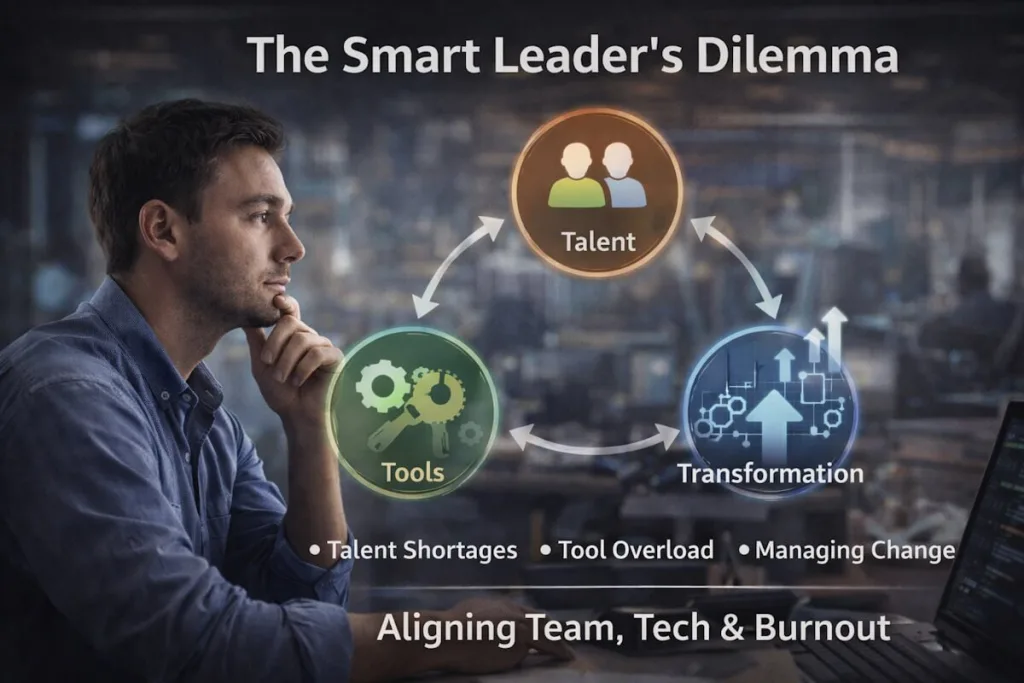
Leading in tech is a strange kind of game. You’re expected to hire top talent, pick the right tools, and somehow lead change that actually works. On paper, it sounds doable. But if you’ve ever sat in back-to-back meetings wondering why simple projects get stuck or why your team looks burned out, then you already know it’s not that simple.
This isn’t just a tech problem. It’s a leadership one.
At some point, every smart leader hits a wall. You’ve hired good people. You’ve bought decent software. You’ve set goals. But things don’t move as fast as they should. Communication starts slipping. Processes turn clunky. And even small decisions feel heavier than they should.
Let’s break this down and call it what it is — a messy combo of talent issues, tool overload, and the pressure of transformation that never really stops.
The Talent Trap: Why Great People Still Struggle
Let’s be real. Most job descriptions are written by someone who’s not even part of the team. They’re packed with buzzwords, vague responsibilities, and unrealistic expectations. But even if you manage to cut through the noise and bring in good hires, there’s still a bigger challenge:
Keeping them aligned.
Hiring doesn’t fix team dynamics. It doesn’t build culture. It doesn’t magically create strong communication or deep product understanding. That’s leadership.
Some leaders think the answer is more headcount. But adding more people to a broken system just makes the problem bigger. More meetings. More blockers. More misalignment.
Here’s what usually goes wrong:
- Teams work in silos. Devs don’t know what product needs. Product doesn’t talk to support. Everyone’s guessing.
- People are doing work, but not the right work. There’s movement, but no direction.
- Senior devs are babysitting juniors instead of solving high-level problems.
- Turnover is high, and hiring feels like a hamster wheel.
So what actually helps?
A few things:
- Hire based on adaptability, not just skills. Projects change. So should your people.
- Set clear expectations without micromanaging. People do better when they know what matters.
- Bring in specialists when needed. You don’t need a full-time architect for a 3-month job. That’s where Hire IT Consultants comes in. Short-term experts, long-term impact.
Good talent is everywhere. But smart leaders know how to set it up for success.
The Tool Problem: When Tech Gets in the Way
Here’s something no one talks about enough — tools often slow teams down.
Sounds wrong, right? After all, software is supposed to speed things up. But that’s only true if the tools match how your people actually work.
If your team is using five different platforms just to get through one sprint, you’ve got a problem. If they’re updating the same data in two places, you’re wasting time. If tools are bought just because your competitors use them, stop.
The best tools are the ones your team barely notices. They’re just part of the flow.
Ask yourself:
- Do your tools support your actual workflows?
- Are people using workarounds because the tools don’t fit?
- Is your team spending more time updating tools than solving real problems?
A lot of businesses hit this wall. They invest in big-name platforms that sound impressive but don’t fit their team’s rhythm. That mismatch leads to frustration, slow progress, and eventually burnout.
What works better?
Start simple:
- Clean up the stack. Kill tools no one uses. Combine overlapping ones.
- Talk to your team. Ask what slows them down.
- Build custom tools where it makes sense. Don’t force one-size-fits-all software.
If you’re planning a new build or want to overhaul your current system, check out this software development guide. It covers how to approach development without overcomplicating things.
The goal isn’t to have more tools. It’s to have fewer tools that actually do the job.
Transformation: Everyone Talks About It, Few Do It Right
You’re told you need to “transform.” Go digital. Automate. Migrate. Modernize.
Cool. But what does that even mean for your team?
Transformation sounds big. Sometimes it is. But often, it’s a series of small, intentional changes. The mistake many leaders make? They try to change everything at once — tech, teams, workflows — and end up stuck halfway through.
If you’re serious about leading real change, here’s what you need to understand:
- Change is emotional. People resist change not because they’re lazy, but because they’re scared. Scared of failing. Scared of looking slow. Scared of being replaced.
- Change is messy. You’ll hit friction. Some things won’t work. Some people will leave. That’s part of it.
- Change is slow. Real transformation doesn’t happen in a quarter. It takes time, patience, and constant adjustment.
So, how do smart leaders make change stick?
- Involve your team early. Ask for feedback. Let them poke holes in your plan.
- Roll out changes in phases. Small wins build trust.
- Celebrate progress, not perfection.
Don’t expect everyone to cheer for change. That’s not the goal. The goal is to build systems that help people do better work, with less friction.
Wait — What About AI Replacing Developers?
Let’s talk about the elephant in the room.
Everyone’s saying AI is about to take over. Some believe developers will be replaced entirely. That’s not how this plays out.
Yes, AI can write code. It can generate quick functions, fix syntax errors, and maybe even scaffold an app. But can it understand product goals? Talk to users? Adapt to a business model? Prioritize based on limited data?
Not really.
People forget that writing code is only part of the job. Great developers don’t just code. They debug, refactor, communicate, prioritize, and work across teams. AI can support that. It can enhance productivity. But it doesn’t replace judgment, empathy, or real-world decision-making.
If you’re stuck on this topic, here’s a solid breakdown on software developers vs AI. It covers the practical roles humans and machines play in modern dev teams.
The future of development isn’t man vs machine. It’s man with machine — smart humans using smarter tools.
How Smart Leaders Handle the Mess
There’s no clean formula here. No 10-step plan to fix every team or tech setup. But there are patterns. The smartest leaders tend to follow a few common habits:
- They listen more than they talk. Feedback is gold.
- They don’t chase every trend. Just because it’s hot doesn’t mean it fits your org.
- They prioritize clarity. People need to know what matters, not just what’s urgent.
- They know when to bring in outside help. Not every problem should be solved in-house.
Being a smart leader isn’t about being right all the time. It’s about noticing when things are off — and being brave enough to fix them.
Start Here, Then Adjust
If you’re feeling stretched thin, you’re not the only one. Juggling talent, tools, and transformation is hard. You’ll never get it perfect. But you can make steady progress if you focus on what really matters.
So here’s where you can start:
- Audit your current tools. Ask your team what works and what doesn’t.
- Look at your hiring strategy. Are you bringing in the right people at the right time?
- Map out your biggest bottlenecks. What’s slowing you down most?
- Pick one area to improve this quarter. Just one. Then go deep.
Leadership isn’t about having all the answers. It’s about asking better questions — and listening hard to the answers you get.
Let’s Wrap This Up
Talent, tools, transformation — these are the three big buckets where most teams sink or swim. When they’re out of sync, things feel broken. But when you find the balance, the results speak for themselves.
Don’t overthink it. Don’t wait for a perfect moment. Just start small and build on what works.