
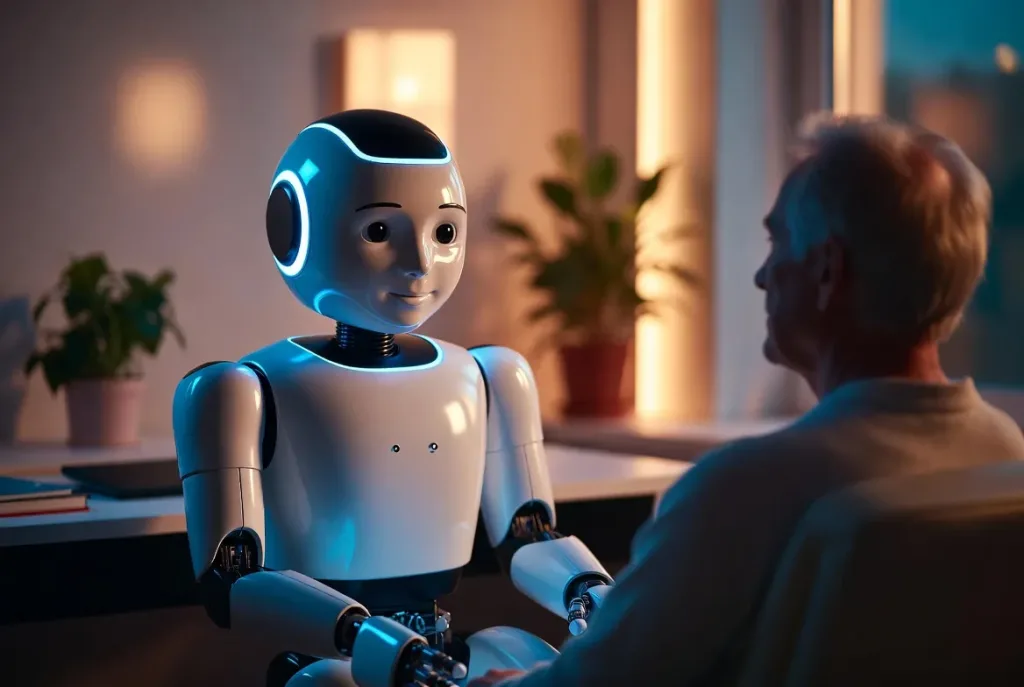
The trend of increasing the focus on emotionally intelligent digital solutions is transforming the way people approach technology as a way of wellness and personal support. With the ongoing development of adaptive intelligence, the need to have systems capable of interpreting situations, detecting emotional responses, and reacting to them in a therapeutically sensitive manner is growing at an alarming rate. This is placing the development of a therapy chatbot in a new stage, in which the dialogues will seem natural, personal, and highly intuitive. The new applications developed on the basis of emotional support are based on advanced AI technologies, which have the ability to read patterns, detect mood, and create meaningful conversations that are relevant to the changing needs of the user.
Influencing Emotionally Intelligent Online communications.
Therapy-oriented AI systems are designed to imitate nurturing dialogue with the help of the accurate data modeling and situational arguments. Every interaction is algorithmically manipulated to get a sense of sentiment, tone, and the purpose of behavior. This will enable the developers to develop bots that will interact with the user with responses being more in tune with their emotional state instead of generic responses.
The development of chatbots, a specialized company, is a key factor in reaching such a refined level. With the combination of state-of-the-art NLP engines, neural conversational models, and contextual behavior mapping, designers could create therapeutic applications in which users would be made to feel truly comprehended. Such solutions are more than mere dialogue, they are adaptive friends which are programmed to change as they learn.
Taking advantage of Adaptive Conversational AI.
The adaptive AI models deal with one of the largest demands of the emotional support system: the opportunity to modify the output in response to a conversation. These models do not handle user feedback using fixed scripts, but rather update themselves in response to changes in the user feedback to progress further into the future. This transformation helps therapy bots to be more predictable in complicated emotional situations where the tone often changes.
To realize this adaptiveness, developers that are involved in the development of the artificially intelligent therapy chatbots commonly incorporate several layers of reasoning frameworks. These comprise emotional classification engines, intent prediction engines as well as behavioral response mapping. All these technologies allow bots to produce responses that are emotionally consistent and naturally in tune with the flow of the conversation.
Improving Personal Support Cognitive AI Layers.
As the digital therapy disruptor space changes, cognition layers in conversational models are able to give more insight into the emotional patterns of users. These systems have models that do not merely process text but rather extract the psychological cues on the user communication. These signals guide the future actions of the bot so that every interaction is improved with time.
A cognitive style takes therapy bots to the next level of being more than just a chat-bot to a smart emotional companion. A set of psychological data, behavioral pattern and intent matching approaches are combined by developers to provide an encouraging atmosphere to users who want to be comfortable, thoughtful, or at ease of mind. This trend is in line with the current demands of the emotional wellness platforms, which place more emphasis on sincerity and human-like empathy.
Aligning Architecture With Multi-Platform Environments
The other fundamental aspect in constructing therapy-driven AI systems is to design it with multi-platform compatibility. The current applications should be able to work harmoniously in the web, mobile and hybrid digital platforms. This necessitates a dynamic architecture that would be able to support real time data processing, emotional analysis as well as adaptive conversational output.
In the mobile application life cycle, the development teams integrate the backend smarts with very fast responding UI that have smooth interactions. The multi-layered solution consists of real-time message delivery, chat caching, and emotion-sensitive display. These aspects enable the user to have continuous sessions, although the system may be busy working on grand insights of emotions in the background.
This is particularly a critical area of integration when applications are to be implemented by high numbers of users. Optimization of performance, predicting scaling and conversational models in a cloud make sure that the system is a reliable one in spite of traffic.
Building Context-Driven Therapist-Like Dialogue Models
One of the key pillars of the contemporary therapeutic chat systems is context-aware dialogue delivery. The developers have to provide AI models to monitor the context in long conversations to maintain continuity and emotional stability. It includes the study of past interactions, the analysis of recurring patterns, and the creation of a conversation that incorporates the reasoning based on memory.
A chatbot development agency that is focused on the creation of therapy systems combines historical data modeling with predictive algorithms to keep the emotional tone within the same range. This is to make sure that the bot does not contradict itself and provide answers that seem unrelated with previous sections of the conversation.
Integrating Individualization Using AI-based Insights.
In digital therapy, the aspect of personalization will maintain user expectations. The behavior mapping with the help of AI becomes a critical component, as systems can provide the messages that appeal in the emotional situation of the user. Advanced data modeling is used to make the interaction map of each user unique by developers. This enhances the level of discussion and the bot becomes more attuned to personal needs as opposed to the bot being a universal solution.
In the mobile app development process, the personalization logic has been implemented in the interaction engine. This will make sure the system improves with the user as time goes by and be able to adapt to their communication pattern, vocabulary, emotional stimulations, and mental indicators.
Conclusion
The use of smart therapy bots driven by adaptive AI models is a massive change in digital emotional support evolution. Such systems are becoming increasingly intuitive, emotionally sensitive and context sensitive, features that are necessary to have therapeutic interactions that matter. As the development of the chatbot based on artificial intelligence (ai) progresses, developers are building services that can provide personalized and human-like assistance on a large scale.
The central role in this transformation is played by a reliable chatbot development company which incorporates adaptive AI, cognitive reasoning models and multi platform structures. With the proliferation of the digital space, therapy bots will only keep on improving and becoming intuitive companions to assist their users with emotional clarity, chat accuracy, and engaging depth and personalization.