
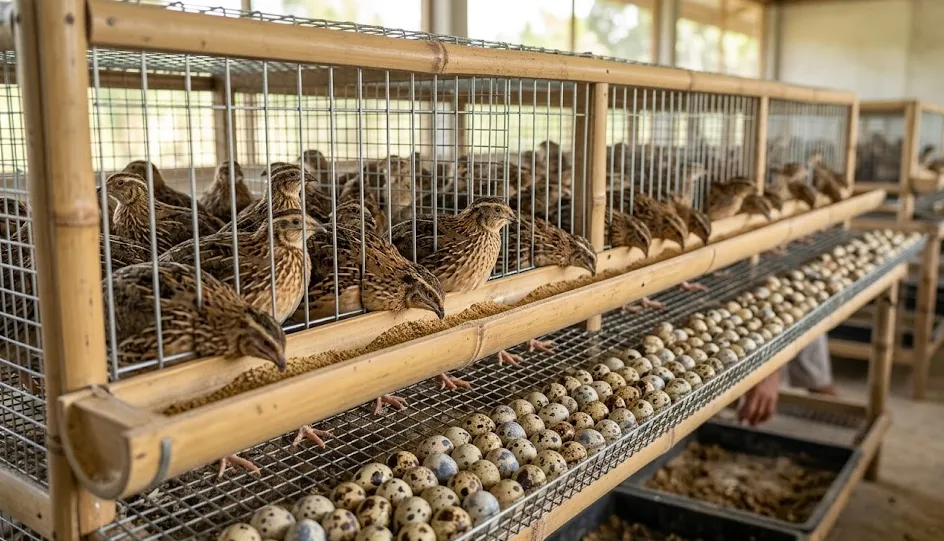
Commercial quail raising, or Pugo Farming, is one of the fastest-growing agri-ventures in the Philippines for 2026. Because quails require minimal space, have a rapid turnover, and offer a high return on investment (ROI), they are perfect for both backyard hobbyists and large-scale investors.
However, the difference between a profitable farm and a failing one lies in precise management—specifically nutrition. This guide provides an updated, comprehensive blueprint for commercial quail success.
Stock Selection: Choosing Your Foundation
Don’t just buy any birds. Your profit starts with the quality of your initial stock.
Breed Comparison
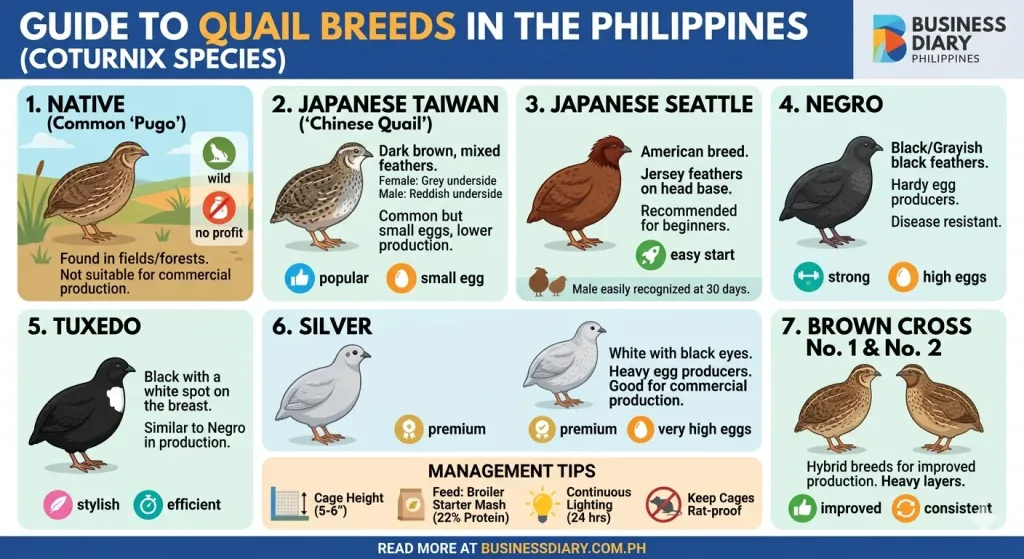
Selection Checklist:
- Age: Start with 30–35 day old pullets. This is the “sweet spot” before they start laying.
- Physical Appearance: Feathers should be neat and tidy. Avoid birds with white or black streaks, as these are often signs of weak genetics or in-breeding.
- Uniformity: Ensure all birds are of similar size to prevent bullying and ensure even feeding.
- Parent Records: If buying from a commercial breeder, ask for the Laying Efficiency record. Aim for a stock with at least a 65% average (meaning 65 eggs per 100 birds daily).
Housing and Space Requirements
Quails are small, but they are sensitive to overcrowding. Proper spacing reduces stress and prevents cannibalism. You can house 250–300 layers in a single 4 x 8 x 1 foot cage.
Space Allocation per Stage
- Chicks: 2.5 x 2.5 inches per bird.
- Growers: 3 x 3 to 3.5 x 3.5 inches per bird.
- Layers: 3.5 x 3.5 to 4.5 x 4.5 inches per bird.
Cage Design Tips:
- Height: Keep layer cages low—5 to 6 inches high. This prevents quails from flying upward and hitting their heads, which is a common cause of injury.
- Materials: Framework should be 1 x 1 inch lumber with 1/4 inch mesh wire for the flooring to allow droppings to pass through.
- Biosecurity: Ensure the brooder box is rat-proof and cat-proof.
Life Cycle Management
The Brooding Stage (Days 1–15)
Temperature control is life or death for chicks.
- Temperature: Start at 95°F for the first five days. Reduce to 85°F by the 10th day. By day 15, they can usually handle room temperature.
- Flooring: Cover mesh wire with 5–6 layers of newspaper. Roll up the top layer every other day to remove manure instantly. This keeps the environment dry and warm.
- Water: Change water daily. Avoid spills; dampness leads to disease.
The Growing Stage (Days 16–35)
- Light Control: Do not expose growers to more than 12 hours of light. Too much light triggers premature laying before their bodies are physically ready.
- Sexing: By day 35, males develop dark brown feathers on the breast. Transfer females to laying cages and move males to the “fattening” pen.
The Layer Stage (Day 45 onwards)
- Laying Cycle: Expect 300–320 days of production with a 65–80% efficiency.
- Lighting: Provide extra light up to midnight. This allows weaker birds to eat in peace after dominant birds have settled and stimulates the pituitary gland for better egg production.
- Culling: Every quarter, perform “massive culling.” Remove fat birds, sickly ones, or those with small vents (a sign they aren’t laying).
The “Secret Sauce”: Precision Feeding
The #1 mistake investors make is using chicken feed for quails. Quails have much higher protein requirements than chickens.
Protein Requirements Comparison
| Stage | Quail Requirement | Chicken Requirement |
| Chick | 28% Protein | 21% Protein |
| Grower | 24% Protein | 16% Protein |
| Layer | 26% Protein | 15% Protein |
Warning: Feeding quails chicken mash often results in a 70% mortality rate. Survivors will be stunted, lay poorly, and stop producing after only 6 months.
Daily Feed Consumption
| Breed | Chick Stage | Growing Stage | Laying Stage |
| Japanese | 7g / day | 17g / day | 32g / day |
| American | 10g / day | 32g / day | 45g / day |
Tips:
Strengthen the Shells: Add finely ground limestone or shell grit to the feed to prevent soft-shelled eggs.
Stop the Scratching: Place a 1/2-inch mesh wire directly on top of the feed inside the trough. This prevents the birds from scratching and wasting expensive feed.
The Bejar Formula: Using Organic “Super-Additives”
Dr. Bejar’s research found that integrating three specific organic components into the quail’s diet leads to a faster Return on Investment (ROI) and superior products.
1. Trichanthera gigantea (Madre de Agua)
Commonly known as Madre de Agua in the Philippines, this shrub is a high-protein fodder tree that thrives in local tropical conditions.
- Role: Used as a leaf meal replacement in feed.
- Benefit: Rich in water-soluble carbohydrates and starch. It acts as a natural growth booster.
- Winning Level: 15% inclusion in the total feed mash.
2. Aloe Vera Extract
Used in the quail’s drinking water, Aloe Vera serves as more than just a skin-care plant.
- Role: Natural anti-inflammatory and therapeutic agent.
- Benefit: Contains polysaccharides and anthraquinones that protect the quail’s gut health and stimulate growth.
3. Acid Cheese Whey
Whey is the liquid remains of milk after coagulation (cheese making).
- Role: Natural probiotic.
- Benefit: Packed with lactic acid bacteria, it maintains a healthy intestinal microbial balance in the birds, leading to better nutrient absorption.
The Results: Better Eggs, Better Profit
According to the study, the combination of 15% Madre de Agua meal with Aloe Vera and Acid Cheese Whey in drinking water produced the following results:
Sturdier Transport
Eggs were found to be longer, wider, and had thicker shells. For a commercial farmer, this means significantly less breakage during transport from the farm to the market.
Healthier “Low-Cholesterol” Eggs
The most marketable result was the lowered cholesterol content of the egg yolks. In 2026, marketing “Heart-Healthy Pugo Eggs” allows farmers to command a premium price in high-end grocery stores and health shops.
Increased Net Income
By replacing a portion of expensive commercial feeds with 15% Madre de Agua and utilizing probiotic whey, the total cost of production dropped while the production performance increased.
Technical Corner: How to Apply the Research
If you are looking to replicate Dr. Bejar’s success, follow this experimental ratio:
| Component | Application Method | Recommended Level |
| Madre de Agua Leaf Meal | Mixed in Feed Mash | 15% of total weight |
| Aloe Vera Extract | Added to Drinking Water | 15mL per Liter |
| Acid Cheese Whey | Added to Drinking Water | 15mL per Liter |
The Hatchery: Operating Your Incubator
Imported commercial breeds will not brood their own eggs. You must use an incubator to maintain your flock.
Temperature Guide:
- Table-Top Electric: Maintain 101°F – 103°F.
- Forced-Draft: Keep it at 98°F – 100°F.
- Humidity: Keep all water pans filled. Cover them with a fine screen so newly hatched chicks don’t fall in and drown.
The Incubation Timeline:
- Days 1–15: Turn eggs 3x a day (Left at morning, Right at noon, Downward at night).
- Day 11: Candle the eggs to remove infertiles.
- Day 15: Stop turning the eggs.
- Day 16–18: Expect the hatch. Open air vents fully once feathers are dry.
Health and Biosecurity
Quails are hardy, but ammonia is their enemy.
- Manure Management: Because of high-protein diets, quail manure is very high in ammonia. Remove it daily to prevent respiratory issues.
- Salt Sensitivity: Keep salt levels at exactly 0.7%. Anything higher is toxic to quails.
- Disinfection: Between batches, scrub cages with strong water and spray with a broad-spectrum disinfectant. Dry them under direct sunlight for at least 24 hours.
Marketing and Products
- Fresh Eggs: Market fresh eggs in cartons with dividers. Freshness lasts about 7 days in a cool, dry place.
- Dressed Broilers: These are young males (60 days old). They are tender and command a premium price.
- Stewers: These are culled layers. They are tougher but excellent for traditional soups.
- 2026 Digital Tip: Use Facebook Marketplace and TikTok to show your “Farm-to-Table” process. Modern consumers pay more for birds raised in clean, well-managed environments.
Cost and Pricing Analysis (500-Bird Starter Project)
This sample analysis assumes a 500-bird setup, which is the ideal “small commercial” size to see a significant return while remaining manageable for a backyard operation.
Estimated Initial Investment (CAPEX)
| Item | Estimated Unit Cost | Total Cost |
| 35-Day Old Pullets (500 pcs) | ₱42.00 | ₱21,000.00 |
| Multi-Tier Layer Cages (DIY) | ₱8,000.00 | ₱8,000.00 |
| Feeding/Watering Troughs | ₱2,500.00 | ₱2,500.00 |
| Initial Feed Supply (2 Bags) | ₱1,850.00 | ₱3,700.00 |
| Miscellaneous (Vitamins, Lights) | ₱1,500.00 | ₱1,500.00 |
| TOTAL INITIAL CAPITAL | ₱36,700.00 |
Monthly Operating Expenses (OPEX)
- Feed Consumption: 500 birds x 32g/day = 16kg daily.
- Monthly Feed: 480kg (approx. 9.6 bags).
- Feed Cost: 9.6 bags x ₱1,850 = ₱17,760.00.
- Utilities & Labor: ₱1,500.00.
Projected Monthly Revenue
- Egg Production: 500 birds x 70% efficiency = 350 eggs daily.
- Monthly Eggs: 10,500 eggs.
- Wholesale Price: ₱2.20 per egg.
- Total Egg Revenue: ₱23,100.00.
- Secondary Revenue: (Manure sales/Culled birds) ~₱1,000.00.
Net Monthly Income
- Total Revenue: ₱24,100.00
- Total OPEX: ₱19,260.00
- MONTHLY NET PROFIT: ₱4,840.00
- Return on Investment (ROI): Approximately 7.5 months.
Business Registration Guide
Visit this page to know how to register your business.
Strategic Recommendations for 2026
To stay ahead of the competition and maximize your margins, consider these three advanced strategies:
1. Value-Added Processing
Don’t just sell raw eggs. The real profit in 2026 is in processing.
- Kwek-Kwek Ready: Sell pre-boiled and peeled eggs to street food vendors. You can charge a 20% premium for the convenience.
- Pickled Quail Eggs: Bottle your eggs in brine or vinegar with chili. These have a 6-month shelf life and appeal to the “gourmet” market.
- Quail “Balut”: There is a growing niche for 10-day incubated quail eggs, often called “Mini Balut.”
2. Digital Direct-to-Consumer Marketing
Skip the middleman. Use Facebook Reels or TikTok to document your farm’s cleanliness.
- Subscription Model: Offer weekly egg deliveries to your local neighborhood or barangay at a slightly higher price than wholesale but lower than retail grocery prices.
3. Integrated Farming
Use the high-ammonia quail manure to fertilize a small vegetable garden or a vermicompost pit. This turns a waste product into either a cost-saving (free fertilizer) or a secondary income stream (selling organic compost).
Conclusion: Is Quail Farming Right for You?
Quail farming is an excellent venture for those who have limited space but are detail-oriented. While the birds are hardy, their sensitivity to nutrition and hygiene means this is not a “set and forget” business.
Success in 2026 requires a focus on Precision Feeding—ensuring that the 26% protein requirement is met—and Market Agility. If you can manage the daily cleaning and have a clear plan for your egg distribution, the rapid ROI and high production volume make Quail Farming one of the most stable agricultural investments in the Philippines today.



the article is very interesting and useful, if you need a reference, you can check it here http://news.unair.ac.id/2019/12/23/pakar-fkh-unair-temukan-suplemen-tingkatkan-kualitas-telur-puyuh/
thnks for the info….