
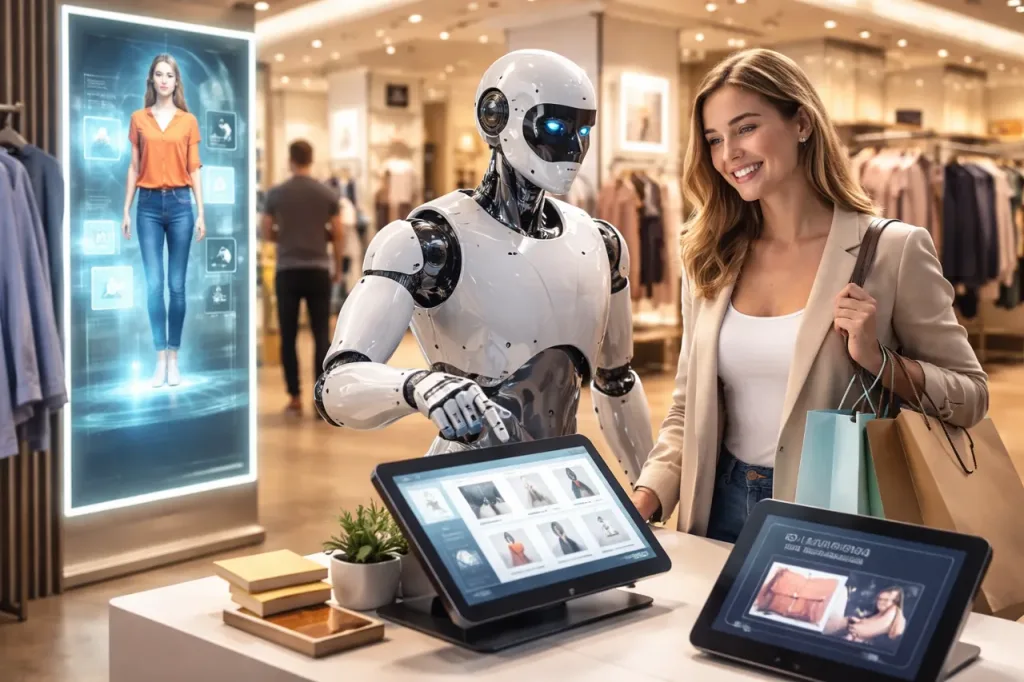
The retail industry has moved beyond automation, analysis, and product content creation. Today, the retail industry has platforms capable of making decisions independently. All of this is made possible by generative AI.
The retail industry is facing a lot of information resulting from customer actions. In addition, the industry is facing challenges posed by customer demand. To make this work effectively, generative AI development services have enabled businesses to integrate AI into their eCommerce platforms.
The use of generative AI in the retail industry has enabled real-time data analysis. This is because generative AI can make decisions effectively. In this article, we will discuss how generative AI works in the retail industry and the challenges it faces.
Why Generative AI Has Become Essential in Retail
Retail is an industry with a constant flow of data. Every event in the retail environment sends out signals such as views, clicks, purchases, returns, devices, and location. However, a set of rules must be followed for the systems to process the information effectively. This is where the problem of adapting to new customer behavior and market conditions arises.
This is where generative AI can be of great help. Generative AI can learn from existing data. It can generate output without a set of rules. This is where the retail sector can benefit the most.
This directly impacts how a retail platform can scale. For instance, a business can handle more transactions and improve overall performance without resorting to manual methods.
AI-Generated Product Content and Catalog Management
Retailers can manage thousands of products, with multiple categories and regions to oversee. Creating content in this way can be a slow process.
The solution offered by generative AI is to create product descriptions and other content directly from product attributes. It can also generate content in multiple languages, which is vital for any retail business wanting to expand its reach.
This can save retailers significant time when launching new ranges and ensure that the information they provide to their customers is always up to date and accurate.
Personalized Shopping Experiences
Today’s customers have new expectations regarding the level of personalization they receive in their online experience. They now expect the online platform to recognize them and provide relevant information at every step.
This is where generative AI comes in. It can provide the necessary personalization in real time based on customer behavior, delivering the right offers and information. Customers no longer get static web pages but rather dynamic online stores.
Conversational Commerce and AI Assistants
The concept of generative AI is introducing a new interaction model in retail. In this case, customers will not be required to navigate through menus to interact with a retailer. Instead, they will be able to interact with a conversational AI that will help them through their purchase process.
The interaction will be natural and will help to ease the complexity of the process.
Dynamic Pricing and Demand Optimization
The pricing models have to be adjusted rapidly in response to changing demand patterns and inventory levels. Static pricing models are inflexible, which hurts profitability.
The generative AI model can be used to perform dynamic pricing based on the analysis of changing patterns in real-time data. It also helps generate promotions and forecast demand. This can be done instantly in response to changing market conditions.
This model can increase profitability while providing effective inventory management.
Automation of Internal Retail Operations
Moreover, generative AI plays a major role in internal processes. Generally, retail businesses manage a large volume of information that requires significant manual work.
AI technology automates processes such as creating and optimizing marketing content and responding to customer queries. It also provides analytics, which further assist with quick decision-making.
The automation also allows retail businesses to scale their processes without increasing the number of employees at the same rate.
Data Quality, Security, and Compliance Challenges
The quality of the data is vital to the performance of the generative AI. In the retail sector, data is dispersed across various systems, such as CRM and payment systems.
Data normalization is needed before training the AI models. In addition, there is the issue of data privacy. Another significant factor is security, particularly with financial and personal data.
Another significant factor is explainability. It is vital for the retailer to understand how the AI models work.
Integrating Generative AI Into Retail Systems
However, to realize business value from generative AI, it must be fully integrated into a business process. Otherwise, experiments will not yield any results.
To implement generative AI, it must be continuously monitored and retrained. In addition, performance must be evaluated in real time. It also has to be able to cope with uncertain predictions.
Cleveroad is a company that offers AI-based solutions for retailers. They can be integrated with existing systems and include recommendation systems and price optimization tools.
The Future of Generative AI in Retail
The role of generative AI in retail environments will continue to grow. Future retail environments will shift toward fully personalized storefronts, where each user has a unique experience. AI will also be used to enable autonomous shopping flows and behavioral analytics.
The retail environment will be native to AI, with dynamically generated content and interactions. Those retailers who are first to market with this type of environment will have a competitive advantage in terms of speed and customer experience.
Conclusion
Generative AI has now become an essential part of retail technology. It has helped businesses in content creation and optimization.
For effective use, retail businesses must ensure high-quality data and compliance. Generative AI, when used effectively, becomes an integral part of retail businesses. Retail businesses using AI-driven technology will be at the forefront of the next era of retail.