

A GPU dedicated server is a distinct class of server infrastructure that has become increasingly востребован with the growth of computationally intensive workloads. The development of machine learning, AI, 3D graphics, video analytics, and scientific computing has shown that standard CPU-based servers are not always capable of handling such workloads efficiently.
Unlike cloud-based GPUs, a GPU dedicated server provides physically dedicated hardware with graphics accelerators assigned to a single customer. This enables predictable performance, full control over configuration, and stable resource characteristics, which are critical for production workloads.
What Is a GPU Dedicated Server
A GPU dedicated server is a physical dedicated server equipped with one or more graphics processing units (GPUs) that is fully allocated to a single client. All server resources, including GPUs, CPUs, memory, and networking, are used exclusively within a single project or team.
Unlike virtualized or cloud GPU solutions, the dedicated model does not involve sharing hardware with other customers. This eliminates resource contention and ensures stable performance under any load.
Key Components of a GPU Dedicated Server
The core of such a server is the graphics accelerator. The GPU is responsible for parallel computation and accelerating tasks related to matrix operations, rendering, and data processing.
In addition to GPUs, the following components play an important role:
- CPUs that handle task orchestration and data preparation;
- large-capacity system memory for working with models and scenes;
- high-speed data storage systems;
- high-performance networking for data transfer and cluster operation.
All components are selected to ensure that GPUs are not underutilized due to memory, I/O, or network bottlenecks.
GPU Dedicated Server vs Standard Dedicated Server
A standard dedicated server is designed for general-purpose workloads such as web applications, databases, and enterprise services. It is optimized for sequential CPU-based processing.
A GPU dedicated server, by contrast, is designed for:
- parallel computing;
- graphics and AI workloads;
- long-running and resource-intensive tasks;
- high compute density.
The presence of dedicated GPUs is what makes this type of server a specialized tool for workloads where CPU-only servers are no longer sufficient.
What Are GPU Dedicated Servers Used For
A GPU dedicated server is used in scenarios where high computational power and parallel data processing are required. Such servers are applied to workloads that scale poorly on CPUs or require specialized accelerators.
- Machine learning and AI. One of the key use cases for a GPU dedicated server is training and running machine learning models. GPUs significantly accelerate neural network training and enable efficient inference in production. A dedicated server provides stable performance and full data control, which is especially important for enterprise and sensitive projects.
- Inference and production workloads. A GPU dedicated server is used to serve models in real-world systems, including image recognition, video analysis, text generation, and recommendation engines. In production environments, predictable latency, high throughput, and the absence of resource contention are critical, which is difficult to guarantee in shared environments.
- High-performance computing (HPC). GPUs are widely used in scientific and engineering computations. A GPU dedicated server is applied to simulations, optimization tasks, and large-scale data analysis, where maximum compute density and high memory bandwidth are required.
- Computer vision and video analytics. Image and video processing tasks require intensive matrix computations. A GPU dedicated server is used for training computer vision models, processing video streams, and performing real-time analytics.
- 3D rendering and graphics. A GPU dedicated server is used for rendering 3D scenes, VFX, animation, and visualization. Dedicated GPUs accelerate rendering and ensure stable operation of graphics applications without time or resource limitations.
GPU Dedicated Server for AI and ML
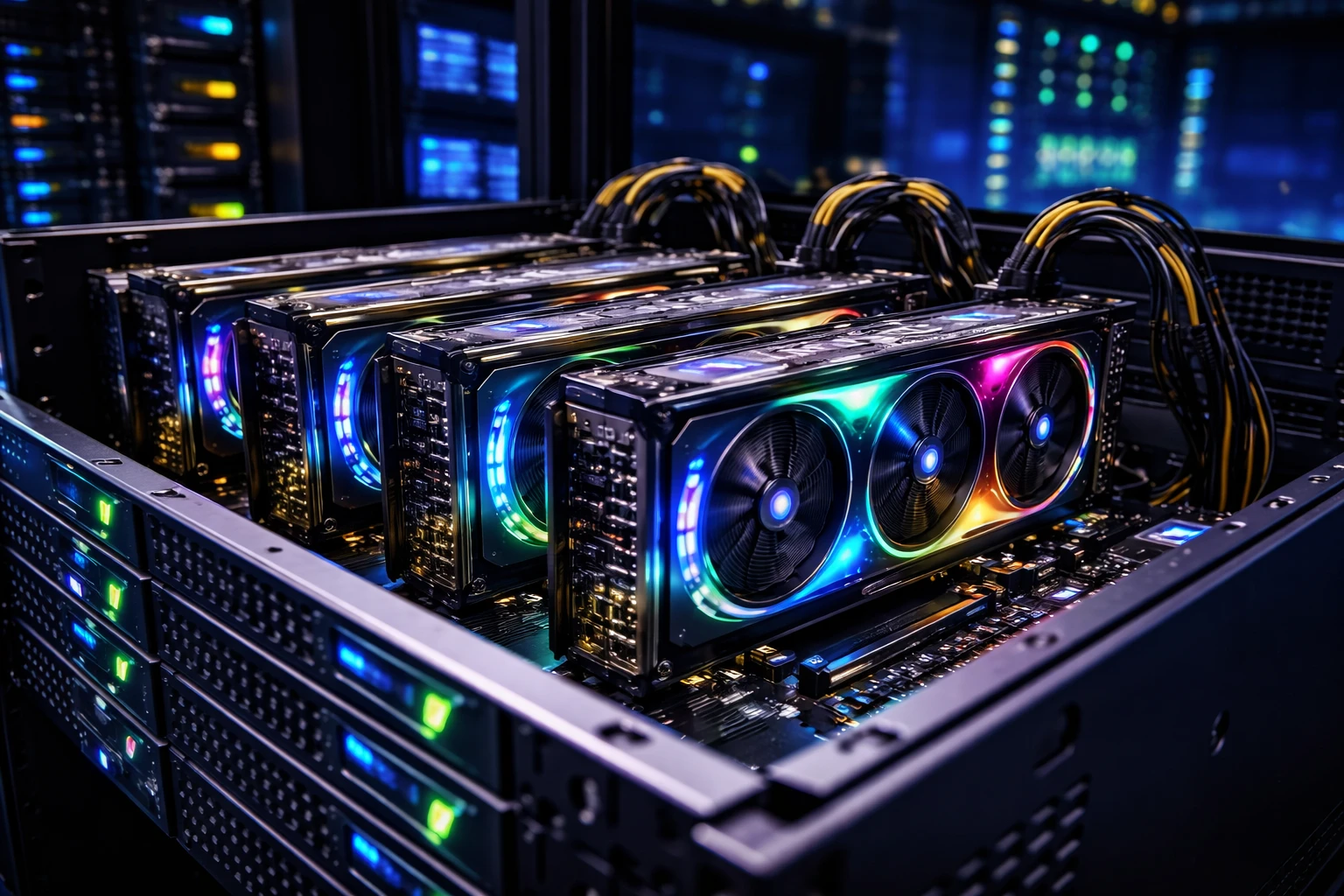
In machine learning and artificial intelligence projects, a GPU dedicated server often becomes the core infrastructure. The reason is straightforward: GPUs directly determine training speed and production stability.
Why GPUs Are Critical for Model Training
Training neural networks involves a large number of matrix operations and parallel computations. CPUs handle these tasks significantly slower, whereas GPUs are designed to execute thousands of operations simultaneously.
Using a GPU dedicated server makes it possible to:
- reduce training time from days to hours;
- work with more complex and deeper models;
- run experiments and iterations faster;
- use large datasets more efficiently.
Single-GPU and Multi-GPU Configurations
For small models or testing workloads, a server with a single GPU may be sufficient. As model size and data volume increase, multi-GPU configurations are used, where multiple accelerators operate together.
In such scenarios, it is important to consider:
- the balance between GPU and CPU resources;
- memory capacity and bandwidth;
- interconnect and network throughput.
A GPU dedicated server allows flexible configuration tailored to specific workloads, without the limitations typical of cloud instances.
Dedicated Server vs Cloud GPUs
Cloud GPUs are convenient for quick starts and experimentation, but for continuous workloads they can be less predictable in performance and more expensive in the long term.
A GPU dedicated server provides:
- no competition for GPU resources;
- consistent performance characteristics;
- full control over the environment and data;
- the ability to fine-tune configurations for specific models.
For these reasons, dedicated servers are often chosen for production AI and ML systems.
GPU dedicated servers for AI and ML are used for model training, inference serving, working with large language models, recommendation systems, and enterprise analytics. Wherever GPUs are used continuously, dedicated infrastructure delivers the greatest value.
GPU Dedicated Server for Inference and Production
After models are trained, the key stage becomes their operation in real-world systems. For this purpose, a GPU dedicated server is often used as the foundation of production infrastructure.
Latency and Stability
In production scenarios, not only compute power matters, but also predictable response times. A GPU dedicated server delivers stable latency due to the absence of resource contention and fixed hardware configuration. This is especially important for real-time services.
Online and Batch Inference
A GPU dedicated server is suitable for both online inference and batch data processing. In online scenarios, high availability and fast response times are critical, while batch workloads focus on efficiently processing large volumes of data within limited time windows.
Dedicated GPUs make it possible to optimize both approaches without trade-offs between performance and stability.
Unlike virtualized environments, a GPU dedicated server provides full control over resources. This simplifies monitoring, load planning, and bottleneck elimination. For business-critical systems, such predictability is often more important than flexibility.
GPU Dedicated Server for Graphics and Rendering
In addition to AI workloads, GPU dedicated servers are widely used in projects related to graphics, visualization, and media processing. In these scenarios, the GPU is the primary computational component.
- 3D rendering. A GPU dedicated server is used to render 3D scenes in architecture, design, gaming, and industrial visualization. Dedicated graphics accelerators significantly reduce rendering times and enable work with more complex scenes and materials. Unlike cloud solutions, a dedicated server ensures consistent GPU utilization and eliminates compute queues.
- VFX and post-production. In the visual effects industry, GPU dedicated servers are used for compositing, upscaling, tracking, simulations, and other resource-intensive tasks. Dedicated infrastructure enables continuous production pipelines without dependence on external resources or time-based usage limits.
- Real-time graphics and simulations. GPU dedicated servers are also applied in interactive scenarios such as game servers, simulators, and VR/AR projects. High GPU performance allows real-time graphics and physics processing, ensuring stable application behavior under load.
Where GPU Dedicated Servers Are Used
GPU dedicated servers can be deployed and used across different infrastructure models. The choice depends on requirements for control, scalability, and budget.
On-Premise
In on-premise scenarios, GPU dedicated servers are deployed within a company’s own infrastructure. This approach is chosen when full control over hardware, data, and network architecture is required. On-premise deployment is suitable for projects with strict security, latency, and regulatory compliance requirements, but it requires significant capital investment and in-house expertise.
Colocation
With colocation, GPU dedicated servers are owned by the company but hosted in a professional data center. This allows organizations to combine hardware control with high facility reliability, power and cooling redundancy, and high-quality network connectivity. Colocation is commonly used for GPU clusters and scalable compute workloads.
Server Leasing
In a server leasing model, a company rents a GPU dedicated server from a provider without purchasing the hardware. This approach reduces upfront costs and enables faster infrastructure deployment. Leasing is often chosen for commercial AI projects, rendering workloads, and continuous GPU-intensive tasks with predictable resource consumption.
Hybrid Scenarios
In many cases, a hybrid model is used. For example, model training or rendering runs on GPU dedicated servers, while auxiliary services or peak-load scaling are handled in the cloud. This approach helps optimize costs and manage resources more flexibly.
Benefits of GPU Dedicated Servers
GPU dedicated servers are selected not only for raw compute power, but also for infrastructure manageability.
- Dedicated resources. All server resources, including GPUs, CPUs, memory, and networking, are allocated to a single customer. This eliminates resource contention and ensures stable operation even under high load.
- Predictable performance. Fixed hardware configurations and the absence of “noisy neighbors” make it possible to accurately predict performance. This is critical for production systems, inference workloads, and long-running computations.
- Configuration control. A GPU dedicated server provides full control over both software and hardware environments. Customers can choose GPU types, driver versions, CUDA stacks, and network and storage parameters without platform-imposed limitations.
- Long-term cost efficiency. For continuous GPU workloads, a dedicated server is often more cost-effective than cloud GPUs. The absence of hourly billing and predictable fixed costs simplify long-term financial planning.
Limitations and Risks
Despite its advantages, a GPU dedicated server is not suitable for every scenario.
- Cost. GPUs are an expensive infrastructure component. Initial investment or rental costs may be higher than for standard servers, especially when using modern accelerators.
- Power consumption and cooling. GPU dedicated servers require robust cooling and stable power supply. This is particularly important for on-premise deployments or when selecting a data center for colocation.
- Expertise requirements. Operating GPU infrastructure requires expertise in drivers, compute optimization, and monitoring. Without sufficient expertise, the server may be used inefficiently.
When a GPU Dedicated Server Is Not the Right Choice
A GPU dedicated server may be excessive if:
- GPUs are used infrequently or irregularly;
- workloads can be efficiently handled by CPUs;
- instant scaling is required for highly variable workloads.
In such cases, cloud GPUs or hybrid models may be more suitable options.
How to Choose a GPU Dedicated Server

The configuration of a GPU dedicated server directly affects infrastructure efficiency and cost.
GPU Type
It is important to consider the server’s purpose. Different GPU types are used for AI and ML workloads than for rendering and graphics. GPU memory capacity and support for the required software stack also matter.
Server Configuration
Balancing GPUs, CPUs, memory, and storage is critical. Insufficient performance of any single component can become a bottleneck for the entire system.
Networking and Storage
For clusters and distributed workloads, high network throughput and fast data access are essential. This is especially relevant for multi-GPU and multi-node configurations.
SLA and Support
When selecting a provider, attention should be paid to SLA terms, availability of technical support, and hardware replacement timelines. For business-critical systems, these factors are decisive.