
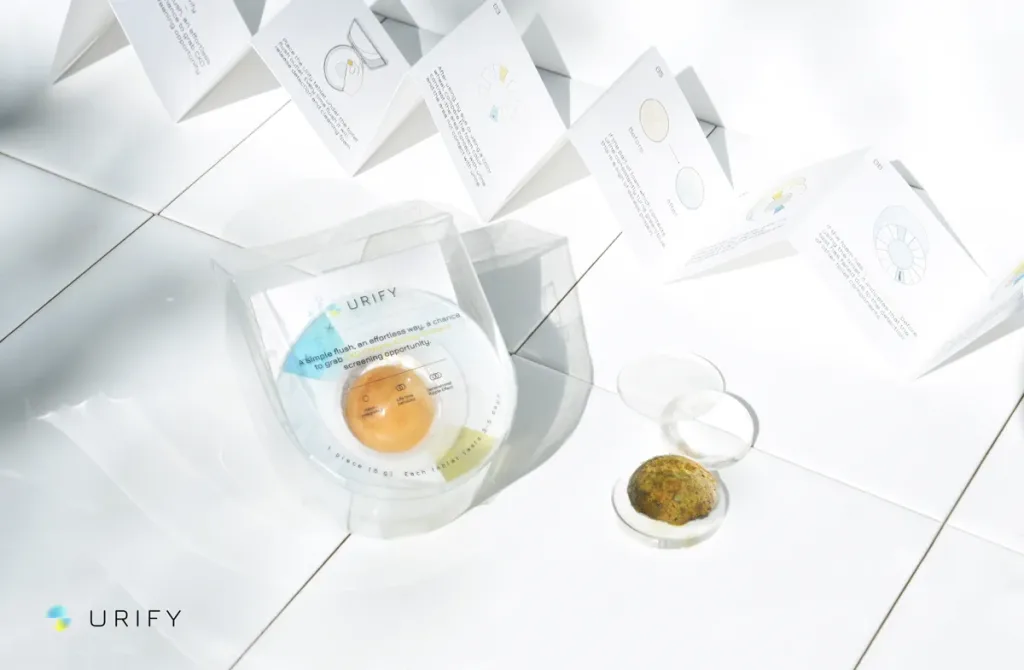
More than 850 million people worldwide live with chronic kidney disease (CKD), yet most remain unaware until the damage becomes irreversible. Early detection—especially of urinary albumin (protein in urine)—has been proven to slow kidney decline and reduce cardiovascular risk (Early Identification of CKD, 2022). To address this, Urify, a groundbreaking toilet-cleaning tablet invented by Yidan Xu from the United Kingdom and a 2025 James Dyson Award finalist, transforms an ordinary bathroom routine into a health screening tool. Designed to identify early signs of kidney damage during regular use, Urify turns every flush into a simple, preventive health check (James Dyson Award, 2025).
What Is Urify and How It Works
Urify combines hygiene and healthcare in one product. It works by releasing a reagent under the toilet rim that foams during flushing. If urinary albumin levels are elevated—an early sign of kidney damage—the foam changes color from pale yellow to blue. Users can interpret results visually using a color chart or an optional computer vision app for accuracy.
Each tablet lasts three to five days, and Xu recommends using it once or twice a year for proactive monitoring. This approach balances convenience, affordability, and accessibility for people who may not undergo regular clinical testing (James Dyson Award, 2025).
The Science Behind Early Detection
Research shows that early detection of CKD dramatically improves treatment outcomes and overall life expectancy. In a global review of 3.7 million individuals across 83 countries, CKD stages 3–5 were detected in about 8% of the population, rising to 15% among high-risk groups like those with diabetes or hypertension (Kidney International Reports, 2022).
Meanwhile, the ONDAAS Study (2024) found that 14.1% of Spanish adults had elevated urinary albumin levels—even with normal kidney filtration rates—indicating early-stage kidney problems that often go unnoticed (Clinical Kidney Journal, 2024).
Albuminuria, or the presence of albumin in urine, is not only an early marker of kidney damage but also a predictor of cardiovascular disease and mortality (European Heart Journal, 2024). Tools like Urify could therefore serve as life-saving innovations for early risk identification.
What Makes Urify Different
| Feature | Traditional Testing (uACR, Lab Tests) | Urify’s Innovation |
|---|---|---|
| Ease of Use | Requires urine sample and lab visit | Passive; works during flushing |
| Frequency of Testing | Annual or symptom-based | 1–2 times yearly, active for several days |
| Affordability | Clinic-dependent, limited in rural areas | Low-cost, household-friendly |
| Accuracy | Single test can miss variations | Monitors urine over multiple flushes |
| Interpretation | Needs trained personnel | DIY color chart + optional app |
Urify does not replace medical diagnostics but enhances them. Its role is to prompt users to seek medical advice when irregular results appear—bridging the gap between awareness and professional care.
Development Story
Xu’s inspiration came from her father’s battle with stage 3 CKD, discovered only after years of undetected albuminuria (James Dyson Award, 2025). Determined to prevent similar cases, she spent months developing Urify—conducting user testing, chemical experiments, and consultations with nephrology experts to refine the color-change mechanism and ensure safety across various water conditions.
The result is a patent-pending innovation that merges design, science, and public health impact.
The Global Impact of Urify
Urify symbolizes a larger trend in preventive healthcare innovation—embedding diagnostics into daily activities. With CKD affecting 1 in 10 people globally (Nephrology Dialysis Transplantation, 2025), accessible tools like this could dramatically reduce late-stage diagnoses, especially in developing regions with limited lab access.
Governments and public health organizations could integrate such tools into community wellness programs, enabling widespread, low-cost CKD screening.
Call to Action
- Individuals: If you have risk factors like diabetes or hypertension, consider using CKD screening tools such as Urify to track your kidney health early.
- Healthcare Providers: Explore passive screening solutions to increase early detection rates among low-access populations.
- Investors & Manufacturers: Urify’s scalable, low-cost design offers a promising avenue for preventive health innovation worldwide.
Conclusion
Urify redefines preventive medicine—bringing disease screening to one of the most routine places: the toilet. With its capacity to detect early kidney issues effortlessly, Urify embodies a new era of health-conscious living, where awareness starts with the simplest everyday action: a flush.
References
- Early Identification of CKD—A Scoping Review of the Global Populations. (2022). Kidney International Reports, 7(6), 1341–1353. https://pubmed.ncbi.nlm.nih.gov/35685314/
- James Dyson Award. (2025). Project Urify. https://www.jamesdysonaward.org/2025/project/urify-1
- ONDAAS Study. (2024). Impact of albuminuria screening in primary care on the detection and management of chronic kidney disease. Clinical Kidney Journal. https://academic.oup.com/ckj/article-abstract/18/5/sfaf123/8120273
- Global burden of CKD and importance of early detection. (2025). Nephrology Dialysis Transplantation. https://academic.oup.com/ndt/article/40/9/1786/8087355
- Prevention of cardiorenal damage: importance of albuminuria. (2024). European Heart Journal. https://academic.oup.com/eurheartj/article/44/13/1112/6881117
Photo and project details courtesy of the James Dyson Award (2025) official project page.