
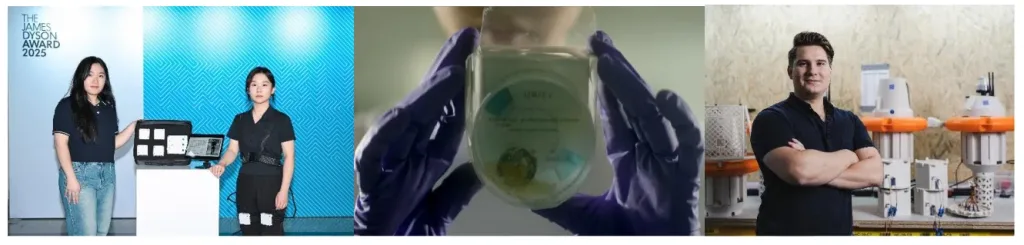
–This year’s Top 20 shortlist includes a toilet-cleaning kidney disease detector, an AI-powered water quality monitor, and a wearable sensor for scoliosis detection.
–Global winners will be selected by Sir James Dyson from this list and announced on 5 November, each receiving ₱2,168,000 to support the development of their invention.
Today, 20 student-led inventions from around the world have been shortlisted as finalists in the 2025 James Dyson Award, bringing them one step closer to the global prize.
Celebrating bold approaches to problem-solving, the James Dyson Award is an international design engineering competition that challenges young inventors to develop solutions to real-world issues. This year, entries tackle problems from climate change, accessibility in healthcare, to disaster response.
The Award’s Top 20 shortlist addresses the world’s most pressing problems
- Overcoming anxiety towards medical screening: In the UK, Yidan Xu progresses to the Top 20 shortlist with Urify, a toilet-cleaning tablet which also screens for early kidney disease. The invention was inspired by Yidan’s father, whose chronic kidney disease was diagnosed at a late stage due to delayed screening. Dr. Jayanti Kumari in India has also been shortlisted for her invention OncoALERT, a needle-free oral cancer test powered by paper-based nanotechnology.
- Empowering individuals to move and live better: Innovators from China, Lu Hanwen and Song Xinyuan, created ScolioDetect, a wearable sensor that monitors walking patterns and flags early signs of scoliosis through an integrated sensor-AI system. Designed for use in schools and communities, it offers a proactive, non-invasive way to catch spinal issues before they progress. Across the globe in the US, Bradley Wagman and Viktor Bokisch address mobility challenges for people with foot drop with their invention Sole¹, a soft, wearable device that uses artificial muscles to help people move more naturally.
- Addressing everyday environmental challenges: In Poland, Filip Budny transforms how communities monitor water quality. His invention, WaterSense, uses AI to deliver real-time and precise insights—an essential tool for regions where contamination risks are high and monitoring is still manual and infrequent. Tackling waste in the healthcare sector, Pablo Yániz González in the Netherlands designs POMPA, a reusable inflator for blood vessel procedures using components which can be sterilised then used again.
This year’s global finalists were selected by a panel of 15 Dyson engineers based in the UK, US, Singapore, Malaysia and the Philippines. They bring a wide range of expertise, from product design and sustainability to electronics and materials science. Each invention was evaluated on its functionality, design process, originality, and commercial viability.
Robyn Coutts, Head of Innovation and Delivery at Dyson and James Dyson Award 2025 Top 20 Judge said: “This year we had a wide ranging and innovative submissions that addressed some of the biggest challenges facing our society today. The judges had a real challenge to choose the Top 20 shortlist, and had some great debates about which ideas were both truly innovative and realistic for the market. All the entrants should be proud of their inventions. I look forward to seeing who wins!”
The overall global winners, selected by Sir James Dyson, will be announced on 5th November. Each winner will receive ₱2,168,000 in prize money to support the next phase of their invention.
The Top 20 Shortlist
| Invention | Solution | Inventor(s) | Country |
| Urify | A toilet-cleaning tablet which detects kidney disease. | Yidan Xu | United Kingdom |
| WaterSense | An AI-powered water quality monitor. | Filip Budny | Poland |
| ScolioDetect | A wearable sensor for scoliosis detection. | Lu Hanwen and Song Xinyuan | Mainland China |
| BrailleSteps | An interactive Braille learning mat for visually impaired children. | Sema Betül Akkurt, Zhala Imamova, Rümeysa Aygündüz, Beste Toprak | Türkiye |
| Blloom | A discreet and insulated fertility injection device. | Seoyeon Kim, Junhyung Kim, Yoonjung Jang, Sungbeen Lee, Heejin Kim | South Korea |
| CropKit | A modular electric micro-tractor for farmers. | David Soche | The Netherlands |
| Flow | A fully recyclable mattress system. | Maximillian O’Brien | Australia |
| Lymphia | A handheld device for self-lymphatic drainage. | Zoë O’Sullivan | Ireland |
| nido | A portable insulin needle holder for storage and disposal. | Zheng Qi Chan | Singapore |
| Nozzlemate | An agile hose carrier for firehoses. | Adrian Kombe, Meihan Liu, Sirinda Limsong | United States |
| OncoALERT | A rapid, needle-free oral cancer testing device. | Jayanti Kumari | India |
| OnCue | An adaptive keyboard for individuals with Parkinson’s. | Alessandra Galli | The Netherlands |
| POMPA | A reusable inflator for blood vessel procedures. | Pablo Yániz González | The Netherlands |
| Pureco | A waterless eco-toilet for off-grid communities. | Huang Junming, Liang Ji | Mainland China |
| Smart Triage Tag | A wristband tracking patient vitals during mass-casualty incidents. | Jacek Bajer, Arkadiusz Kurasz, Klaudia Szwajkowska, Rafał Amrozik | Poland |
| Softletics | A lightweight, adjustable prosthetic socket. | Cara Ammann, Lisa-Marie Frühauf | Switzerland |
| Sole¹ | A robotic sock for individuals with mobility impairments. | Bradley Wagman, Viktor Bokisch | United States |
| SpermView | An at-home AI sperm test kit. | Eléonore Abadie, Jack Bourdin White, Julie Simon, Mika Ziegler | France |
| SyriSter | A portable UV-C syringe steriliser. | Hannah Gough | Australia |
| UNBLOK | A biodegradable kitchen drain filter. | Ong Jing Rou, Natalie Tham, Ng Wen Kai | Malaysia |
ABOUT THE COMPETITION
The brief. Design something that solves a problem. This problem may be a frustration that we all face in daily life, or a global issue. The important thing is that the solution is effective and demonstrates considered design thinking. Unlike other competitions, participants are given full autonomy over their intellectual property.
The process. Entries are judged first at the national level by a panel of external judges and a Dyson engineer. Each operating market awards a national winner and two national runners-up. From these winners, a panel of Dyson engineers then selects an international shortlist of 20 entries. The top 20 projects are then reviewed by Sir James Dyson who selects his global winners.
The 2025 prizes
- Global winners, chosen by Sir James Dyson, each receive a prize of ₱2,168,000.
- Each national winner receives ₱361,300.
Previous global winners
A portable and affordable hair-loss prevention device for chemotherapy patients.
A reusable, nature-inspired sensor to improve weather forecasting and tackle e-waste.
A hands-free IV device for disaster zones.
A sustainable exterior wall coating with a high cooling effect, reducing environmental costs of air conditioning.
An off-road trailer ambulance for universal towing.
A smart sensor for dressings which indicates how well a wound is healing by measuring its pH level.
A machine that recycles plastic bottles into affordable 3D printer filament for developing nations.