
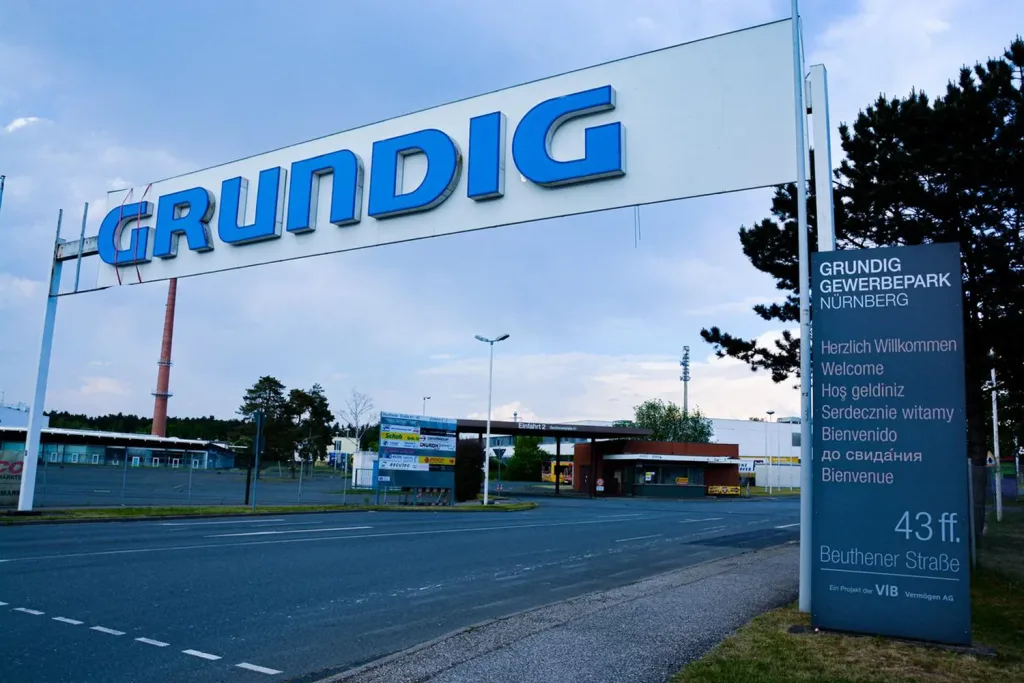
There’s a particular kind of credibility that only time can build. Not the credibility that comes from a polished brand identity or a well-managed social media presence — the kind that comes from having actually made things, to a consistent standard, across decades of changing technology and shifting markets. The kind of credibility that accumulates in manufacturing culture, in institutional knowledge, in the habits of precision that develop when you’ve been held accountable for your output for long enough.
In the automotive performance world, that kind of credibility has never been more valuable — or harder to find. The market is full of products that look the part. Far fewer are made by companies that have actually earned the right to claim engineering heritage as something more than a marketing line.
Grundig Auto is one of the exceptions. And understanding why requires going back to the beginning.
Fürth, 1945: Where Precision Became a Survival Strategy

On May 15, 1945 — days after the end of the Second World War in Europe — Max Grundig reopened a small electronics shop in Fürth, northern Bavaria, with a handful of employees and almost nothing else. Germany was in ruins. Manufacturing was controlled by Allied occupation authorities. The conventional route to rebuilding a radio business was effectively closed.
What Max Grundig did next established the engineering philosophy that would define the company for the next eight decades. Unable to produce a conventional radio — valve-based receivers required permits that were strictly controlled — he designed something that wasn’t, technically, a radio at all. The Heinzelmann was a self-assembly kit that buyers constructed themselves at home, circumventing the regulations through a combination of legal creativity and engineering ingenuity. It worked because it was designed to work: clear instructions, precise components, a product that delivered what it promised when assembled by a layperson.
The Heinzelmann was a runaway success, and it funded the first Grundig factory. Within a few years, Grundig had become the largest radio manufacturer in Europe — not by cutting corners, but by applying relentless precision to every stage of manufacturing. By the mid-1950s, facilities in Nuremberg, Frankfurt, and Karlsruhe were producing radios, televisions, and portable tape recorders to a standard that set benchmarks across the European consumer electronics industry.
At its peak, Grundig AG employed over 38,000 people across 21 factories and 19 production sites, generated annual revenues exceeding 4.5 billion Deutsche Marks, and operated sales organisations in over 60 countries across every continent. It was, as German economic historians routinely acknowledged, one of the defining enterprises of the Wirtschaftswunder — the post-war economic miracle that rebuilt West Germany from rubble into an industrial powerhouse within a generation.
The Road: Grundig’s Automotive Commitment
Grundig’s connection to the automotive world is older than most people in the performance community realise. In 1951, as car ownership across Europe began its post-war acceleration, Grundig built the Autosuper 248 — a purpose-designed in-car radio that marked the company’s formal entry into automotive electronics. It wasn’t a sideline. It was a strategic commitment to the idea that the driving environment deserved the same quality of engineering attention as any other space where people spent time with Grundig products.
The automotive division that developed from the Autosuper 248 grew steadily over the following decades, eventually becoming Grundig Car InterMedia System — a dedicated division producing vehicle audio systems, telematics devices, and entertainment products for European OEMs and the aftermarket, based in Nuremberg with production in Braga, Portugal. By 2002, that division alone had revenues of approximately €180 million and employed 1,000 engineers and manufacturing specialists.
In 2003, Delphi Technologies — the former General Motors engineering and supply subsidiary — acquired Grundig’s automotive electronics division, integrating European manufacturing precision with American automotive methodology and expanding distribution across North America through Delphi’s established networks. That acquisition brought together two distinct engineering traditions: the tight tolerances and quality-first culture of German manufacturing, and the systems-level thinking of an organisation that had spent decades supplying components to one of the world’s largest automakers.
Today, Grundig Auto operates as a global mobility solutions provider, carrying forward 80 years of accumulated automotive engineering knowledge into a product range that spans performance parts, lighting systems, audio and entertainment, and precision mechanical components — with manufacturing and distribution infrastructure covering Europe and global markets.
What Old-World Precision Looks Like in a Modern Catalogue
The phrase “old-world precision” risks sounding nostalgic — as though the value being claimed is purely historical, disconnected from what happens on a dyno or a track. That’s not what it means here.
What it means is a manufacturing culture in which precision is the default rather than the aspiration. Where tolerances are set by engineers thinking about how a component behaves under stress, not just how it fits during installation. Where quality control is embedded throughout the manufacturing process rather than applied as a filter at the end. Where the engineers responsible for a product have thought seriously about its second year and its fifth, not just its first.
That culture produces components that behave differently in service from those made without it. Not always differently in ways that show up in the first week — but consistently differently over time, under repeated stress, in the conditions that reveal what a part is actually made of.
The Grundig Auto performance parts catalogue reflects exactly this. Every component carries the engineering lineage of a company that has been held accountable for precision manufacturing across multiple product categories since Max Grundig first opened a workbench in a rented room in Bavaria. That accountability doesn’t disappear when the product category changes. It becomes the standard against which new products are measured.
Why the Tuning Community Should Care About Heritage
There’s a practical argument and a philosophical one.
The practical argument is straightforward: parts made by companies with genuine engineering depth tend to perform more consistently over time than those without it. The manufacturing culture that produces quality doesn’t just apply to the parts you can see — it runs through the entire production process, in the tolerances of components you’ll never inspect, in the material choices made before the product ever reached a catalogue.
The philosophical argument is about what the tuning community stands for at its best. The builds that endure — the ones that get documented, discussed, and referenced years after completion — aren’t just fast. They’re executed with the same kind of care and precision that their builders expected from every component they chose. That precision has to come from somewhere. It comes from engineering cultures that have spent decades earning it.
Grundig spent those decades. The precision that began in a post-war Bavarian workshop, that drove the construction of Europe’s largest consumer electronics manufacturer, that powered an automotive engineering division supplying OEMs across the continent — that precision is still there. It’s in the product. It’s what old-world precision actually looks like when it becomes the new standard.
Explore the full Grundig Auto performance and tuning range at grundig-auto.com.