
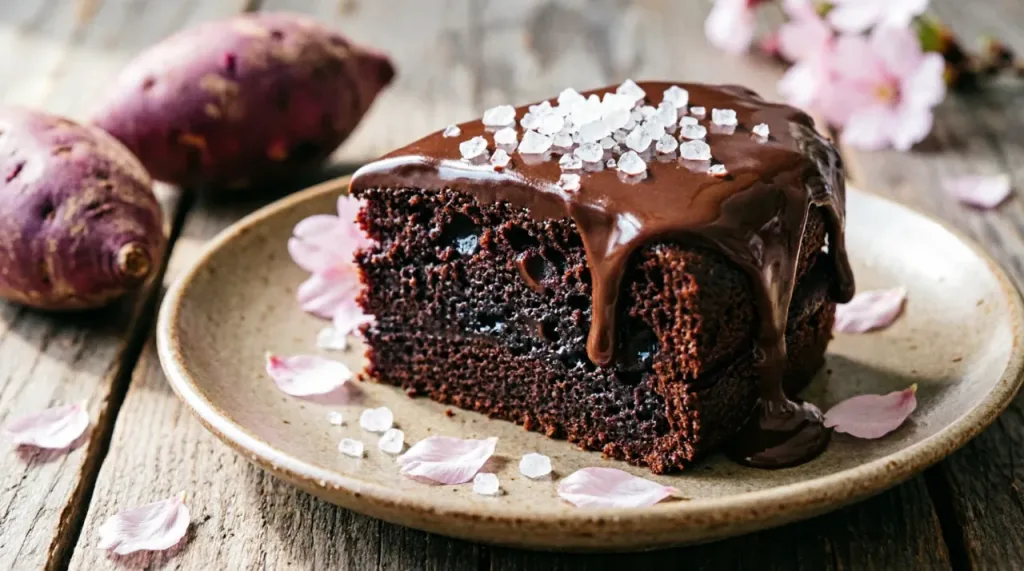
I’ll be honest with you—my first attempt at this cake was a disaster.
I had heard whispers in baking forums about the Japanese sweet potato chocolate cake. People claimed it was moister than any avocado or banana bread I’d ever made. Skeptical but curious, I bought what I thought were sweet potatoes at my local Whole Foods, baked the cake, and… well, let’s just say it was dense enough to be a doorstop.
I had used the orange-fleshed American yams instead of the specific purple-skinned Japanese variety. It was too wet, too sweet, and completely overwhelmed the cocoa.
But I didn’t give up. After tweaking the ratio of puree to flour and finally tracking down the right tubers at my neighborhood H-Mart, I cracked the code. The result? A cake that was velvety, rich, and had a subtle earthiness that made the chocolate taste more like chocolate, not less.
If you’re looking to elevate your baking game or just want a healthy chocolate cake with sweet potato puree that doesn’t taste like health food, you’re in the right place. This isn’t just a recipe; it’s a lesson I learned the hard way so you don’t have to.
What Exactly is a Japanese Sweet Potato? (And Why It Matters)
Before we preheat the oven, we need to talk about the star of the show. In the US, “sweet potato” is a loose term. I used to grab whatever looked sweet in the produce bin. Big mistake.
The Japanese sweet potato, often labeled as Murasaki or Satsuma-imo, is different from the Beauregard variety we see on Thanksgiving tables.
How to Spot Them
When I go shopping now, I look for three things:
Skin: Deep purple or reddish, almost looking like a yam but smoother.
Flesh: Creamy white or pale yellow when cut (not orange!).
Shape: They tend to be longer and thinner than the chubby American sweet potatoes.
The Flavor Difference
The first time I tasted a steamed Murasaki potato plain, I was surprised. It wasn’t sugary. It tasted nutty, almost like a chestnut. This is crucial for baking. Because the Murasaki sweet potato baking properties lean towards earthy rather than syrupy, they don’t compete with the chocolate. They support it.
Plus, the texture is fluffier. American sweet potatoes can get gluey when mashed. Japanese sweet potatoes break down into a light, airy puree that integrates beautifully into batter without weighing it down.
The Baking Science: Why I Trust This Method
You might be wondering, why put a vegetable in a cake? I asked myself the same thing before my third test batch.
In traditional baking, we rely on butter or oil for moisture. But fats can sometimes make a cake feel heavy. Sweet potato puree acts as a natural humectant. It holds onto water molecules during the baking process.
1. Moisture That Lasts
I did a little experiment. I baked two cakes: one standard butter-based chocolate cake and one with 30% of the fat replaced by sweet potato puree. I left them both on the counter, uncovered.
Day 1: Both were delicious.
Day 3: The butter cake was dry. The Japanese sweet potato chocolate cake? Still moist.
The fiber in the potato locks in hydration. If you live in a dry climate (like I do in Arizona), this is a game-changer.
2. Natural Sweetening
Because these potatoes have a natural glycemic sweetness, I found I could reduce the granulated sugar in my recipe by about 25%. This appeals to anyone looking for healthy chocolate cake with sweet potato puree options. It’s not “sugar-free,” but it feels lighter.
3. The Emulsification Trick
The starches in the potato help bind ingredients. In my early failures, my batter would separate. Once I started mixing the puree with the eggs before adding the dry ingredients, the batter became smooth and glossy. It mimics the texture of high-end patisserie cakes without the fancy equipment.
Sourcing Ingredients: Where I Buy My Potatoes in the US
One of the biggest hurdles for my readers is finding the right ingredients. Five years ago, I had to drive 45 minutes to an Asian market. Today, it’s easier, but you still need to know where to look.
My Go-To Stores
Asian Supermarkets: H-Mart, 99 Ranch, and Mitsuwa are my top picks. The turnover is high, so the potatoes are always fresh.
Mainstream Grocers: I’ve found them at Whole Foods and Wegmans, but they are often labeled specifically as “Japanese Sweet Potatoes” to distinguish them. Check the skin color carefully.
Online: If you’re in a rural area, I’ve had luck with Amazon Fresh. Just read the reviews to ensure they aren’t sending the orange variety by mistake.
Sweet Potato Flour vs. Fresh Puree
Recently, I experimented with sweet potato flour vs. almond flour baking for a gluten-free version.
Fresh Puree: This is my recommendation for your first try. The moisture content is predictable, and the flavor is fresher.
Flour: I use this when I’m batch-prepping. It’s shelf-stable, but you have to be careful with hydration. I usually add an extra 10% liquid when using the flour.
For the recipe below, we’re using fresh puree. It’s worth the extra 20 minutes of prep time.
Japanese Sweet Potato Chocolate Cake – Complete Recipe
Here’s the full, tested recipe I use in my own kitchen. I’ve included exact measurements, timing, and all the tips I learned through my trial-and-error process.
Recipe Overview
Prep Time: 30 minutes
Cook Time: 35-40 minutes
Total Time: 1 hour 10 minutes (including potato prep)
Servings: 12 slices
Difficulty: Easy-Intermediate
Dietary: Can be made GF & Vegan
Ingredients
For the Sweet Potato Puree
Japanese sweet potatoes (Murasaki): 1 lb (450g) — About 2-3 medium potatoes
Water: As needed for steaming
For the Cake Batter
Sweet potato puree (cooled): 1 cup (240g) — From above
All-purpose flour: 1¾ cups (220g) — Or GF 1:1 blend
Dutch-processed cocoa powder: ¾ cup (65g) — High quality recommended
Granulated sugar: 1 cup (200g) — Can reduce to ¾ cup
Brown sugar: ½ cup (100g) — Adds moisture
Baking soda: 1½ tsp — Make sure it’s fresh
Baking powder: 1 tsp
Salt: ½ tsp
Large eggs: 2 — Room temperature
Buttermilk: ½ cup (120ml) — Or coconut milk for vegan
Melted dark chocolate: 4 oz (115g) — 60% cocoa
Coconut oil or butter: ⅓ cup (80ml) — Melted
Vanilla extract: 2 tsp — Pure vanilla
Hot coffee or water: ½ cup (120ml) — Enhances chocolate flavor
For the Chocolate Glaze
Dark chocolate chips: ½ cup (90g)
Heavy cream or coconut cream: ¼ cup (60ml)
Flaky sea salt: To taste — For topping
Instructions
Step 1: Prepare the Sweet Potato Puree (20 minutes)
Wash and peel the Japanese sweet potatoes completely. I learned this the hard way—leaving the skin on creates a gritty texture.
Cube evenly into 1-inch pieces. Uniform size ensures even cooking.
Steam, don’t boil. Place in a steamer basket over simmering water for 15-18 minutes until fork-tender. Boiling adds too much water and makes the puree soggy.
Process until smooth. Transfer to a food processor and blend until completely smooth. No lumps!
Cool completely. This is crucial—warm puree will scramble your eggs. I spread it on a plate to speed up cooling.
Yield: You should have about 1 cup of puree. Extra can be frozen for up to 3 months.
Step 2: Prep Your Kitchen (10 minutes)
Preheat oven to 350°F (175°C).
Grease and line a 9-inch round cake pan or 8×8 square pan. I use parchment paper on the bottom plus a light spray on the sides.
Measure dry ingredients in a large bowl: flour, cocoa powder, sugars, baking soda, baking powder, and salt. Whisk together well.
Melt your chocolate gently in a microwave-safe bowl (30-second intervals) or double boiler. Let it cool slightly.
Step 3: Mix the Wet Ingredients (5 minutes)
In a separate bowl, whisk the cooled sweet potato puree with the eggs until smooth.
Add the melted chocolate, melted coconut oil (or butter), buttermilk, and vanilla extract.
Mix until combined. The mixture should be glossy and uniform.
Pro Tip: If your puree is too thick, add 1-2 tablespoons of buttermilk to loosen it up.
Step 4: Combine Wet and Dry (3 minutes)
Pour wet ingredients into dry ingredients.
Fold gently with a spatula until just combined. I stop mixing when I see the last streak of flour disappear.
Add hot coffee or water slowly while stirring. The batter will thin out—this is normal! The hot liquid blooms the cocoa powder for deeper chocolate flavor.
Don’t overmix. This is the #1 mistake I made in my early batches. Overmixing = dense cake.
Step 5: Bake (35-40 minutes)
Pour batter into prepared pan and smooth the top.
Bake at 350°F for 35-40 minutes. Start checking at 35 minutes.
Test for doneness:
Toothpick inserted in center comes out with moist crumbs (not wet batter)
Cake springs back when gently pressed
Edges pull slightly away from the pan
Cool in pan for 10 minutes, then transfer to a wire rack.
My Mistake to Avoid: I once pulled the cake out too early because it looked done on top. The center was still raw. Now I always use a toothpick test!
Step 6: Make the Glaze (5 minutes)
Heat cream until just simmering (microwave for 45-60 seconds).
Pour over chocolate chips in a small bowl. Let sit for 2 minutes without stirring.
Stir gently from center outward until smooth and glossy.
Cool slightly for 3-5 minutes until it thickens but is still pourable.
Step 7: Assemble and Serve
Pour glaze over cooled cake. Let it drip naturally down the sides.
Sprinkle with flaky sea salt immediately while glaze is still wet.
Let set for 10 minutes before slicing.
Serve at room temperature or slightly warmed.
Recipe Notes & Tips
Sweet Potato Substitutions
If you have orange sweet potatoes: Use 1 cup puree. Reduce sugar by 15% and reduce liquid by 10%.
If you have sweet potato flour: Use ½ cup flour. Add extra ¼ cup liquid to batter.
If you have canned sweet potato puree: Use 1 cup. Drain excess liquid first.
Gluten-Free Version
Swap all-purpose flour for 1:1 GF baking blend (I use Bob’s Red Mill)
Add ½ tsp xanthan gum if your blend doesn’t include it
Bake time may increase by 3-5 minutes
Vegan Version
Eggs (2): Replace with 2 flax eggs (2 tbsp ground flax + 6 tbsp water)
Buttermilk: Replace with coconut milk + 1 tsp apple cider vinegar
Butter: Replace with coconut oil or vegan butter
Heavy cream: Replace with full-fat coconut cream
Chocolate: Use dairy-free dark chocolate
Storage Instructions
Room Temperature: Up to 2 days in an airtight container
Refrigerator: Up to 5 days — Let come to room temp before serving
Freezer: Up to 3 months — Wrap slices individually in plastic wrap
Make-Ahead Tips
Puree can be made 2 days ahead and refrigerated
Cake bakes well 1 day before serving—flavor actually improves!
Glaze can be made ahead and reheated gently before pouring
Nutrition Information (Per Slice)
- Calories: 285 kcal
- Total Fat: 12g
- Saturated Fat: 7g
- Carbohydrates: 42g
- Fiber: 4g
- Sugar: 26g
- Protein: 4g
- Vitamin A: 15% DV
- Vitamin C: 8% DV
Note: Nutrition is estimated. Values will vary based on specific ingredients used.
Troubleshooting Common Issues
Cake is too dense: Likely caused by overmixed batter or old baking soda. Solution: Mix gently, check expiration dates.
Cake is dry: Likely caused by overbaking or too little puree. Solution: Reduce bake time, ensure 1 cup puree.
Glaze is too thin: Likely caused by cream being too hot or not enough chocolate. Solution: Let cool longer, add more chocolate.
Glaze is too thick: Likely caused by cooling too much. Solution: Reheat gently with 1 tsp cream.
Cake sank in middle: Likely caused by underbaking or opening oven too early. Solution: Bake longer, don’t open oven before 30 min.
Sweet potato flavor too strong: Likely caused by using orange sweet potatoes. Solution: Source Japanese Murasaki variety.
Is It Actually Healthier?
I’m not going to lie to you—it’s still cake. But compared to a standard box mix? Yes, there are benefits.
Japanese sweet potatoes are packed with Vitamin A, C, and fiber. By reducing refined sugar and utilizing the fiber in the potato, you lower the glycemic impact slightly. It’s a “better-for-you” indulgence. I feel less guilty serving this to my kids than a standard sugary sponge.
Final Thoughts
The Japanese sweet potato chocolate cake isn’t just a trend for me; it’s a staple in my kitchen now. It taught me patience and the importance of ingredient sourcing.
For my US readers, I know finding the Murasaki potato might feel like a hunt. But trust me, once you taste that moist, rich crumb, you’ll keep a bag of them in your pantry at all times. Whether you’re a seasoned baker looking to experiment with Murasaki sweet potato baking properties, or just someone who loves chocolate, this recipe delivers.
Have you tried baking with sweet potatoes before? I’d love to hear about your successes (or failures!) in the comments below. Let’s learn from each other.
Frequently Asked Questions (FAQ)
1. Can I use American orange sweet potatoes instead?
I tried this, and honestly, the result was too wet. If you must use them, reduce the added liquid in the recipe by 10% and cut the sugar by 15%. But for the best texture, hunt down the Japanese variety.
2. Where can I buy sweet potato flour in the USA?
I usually order mine online from Thrive Market or Amazon. Sometimes Whole Foods carries it in the gluten-free aisle. Just make sure it’s 100% sweet potato flour, not a blend.
3. Does the cake taste like potatoes?
I get this question a lot. No, it doesn’t. The cocoa is dominant. The potato just adds depth. My husband didn’t even know it was in there until I told him after he finished his second slice.
4. Is this cake suitable for diabetics?
While sweet potatoes have a lower glycemic index than white flour, there is still sugar and chocolate involved. I always recommend consulting your dietary guidelines, but it is a lower-glycemic alternative to traditional cakes.
5. How do I prevent the cake from becoming too dense?
Make sure your baking soda is fresh (I replace mine every 3 months). Also, don’t over-mash the potatoes into a glue. And please, don’t overmix the batter!
About the Author
Sarah Jenkins is a home baker and food writer based in Phoenix, AZ. She specializes in fusion desserts and healthy baking swaps. When she’s not in the kitchen, she’s hunting for unique ingredients at local ethnic markets.