
In 2026, generative AI has transitioned from simply being “cool demos” to concrete business solutions for organizations. Many organizations have now tested AI solutions for use as assistants (AI) as well as for generating Digital Content and Automating processes. Instead of focusing on whether or not generative AI can produce text and imagery, organizations will now focus their efforts on creating trust in their AI Solution that encourages it to be measured, protected, supported, and become an increasingly large part of the organization over time.
To create a new generative AI tool in 2026, your first consideration should be that it is treated holistically and not simply as an AI Model. You must develop an entire product ecosystem upon which your new product will be delivered back to the market through your customers.
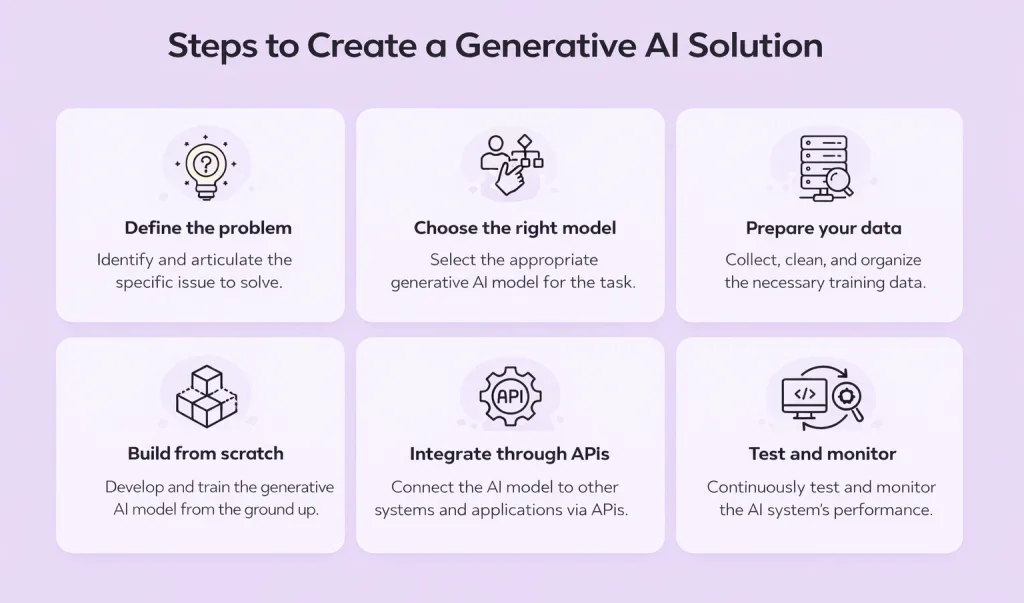
1) Start With a Business Outcome (Not a Model)
1) Start With What You Want to Gain from the AI (Not With an AI Product)
The way to fail the quickest at deploying an AI is to think, “Let’s create a Chatbot.” A better question would be “What processes would benefit from the use of Artificial Intelligence?”
High value instances for using GenAI would be jobs that are typically high in volume and repetitive. They would also be jobs focused on words, such as, reading and writing and summarising. Additionally, they have clear and identifiable reference material, e.g., documents, policies and knowledge bases. Finally, they can be measured, e.g., time saved, accuracy increased and cost decreased.
Some examples of real world use of GenAI in 2026 include a customer service response based on your help centre, HR and IT assistants to assist with internal knowledge, automating summaries of meetings, creating pipelines for generating content, and creating automated report or proposal templates for agents.
2) Choose a Model Method That Matches Your Limitations
Typically, in the year 2026, you will either build with one of the following methods (or a combination of the methods):
- When you require quality output produced quickly, and speed is important, utilize a Model API.
- When you require consistent behaviour, tone, or a specific domain output use a Custom Model (Fine-tune/adaptors).
- When privacy, compliance, or cost predictability is important choose to Self-Host an open weight model.
The most mature providers will utilize multiple Models to assign jobs to the best Model based on:
- Level of complexity
- Latencies
- Your budget
- Requirements regarding accuracies.
3) Build the System Around the Model
The primary engine of your system is your model. Your AI solution, though, is the vehicle which will run your solution. There are usually several different levels to be built when building a production-grade solution.
Core building blocks
- Orchestration layer: standardises prompts, manages routing and tool Usage and implements controls over Policies.
- Knowledge layer: deals with ingestion and Indexing of Documents, implementation of Acces Control features and Retrieval processes.
- Tool layer: all secure API Calls (to CRM Tools, Databases, Ticketing, and other Internal Services)
- Safety Layer: all filtering, protection from Injection Attacks, Data Redaction, and Rejection functionalities.
- Observability Layer: all Logging and Tracing operations, all Evaluation and Feedback Loop setups.
The difference between a prototype and a finished product lies in these layers.
4) Use Retrieval (RAG) to Make It Reliable
When creating AI applications that leverage an organisation’s knowledge — policies, manuals, ticket history or documentation — do not use general model memory for this process! Instead, use Retrieval-Augmented Generation (RAG), which allows the AI:
– To find information using your knowledge base.
– To retrieve snippets of content related to what the user asked.
– To use those snippets as context when generating a response.
– To generate a response using the provided context.
When implemented correctly, RAG provides:
– More factual accuracy.
– More trust and transparency.
– More up-to-date information.
– Better compliance (because organisations control what the RAG can access).
In 2026, what will make RAG effective?
– Smart chunking (semantic chunking rather than fixed-size).
– Hybrid search (keyword and vector).
– Re-ranking for precision.
– Strict user role permission filters.
– Citation in the final response.
In many enterprise settings, retrieval quality is more important than model size.
5) Add Tools to Turn AI Into an Agent
The most impactful solutions on the GenAI landscape by 2026 will be those that will allow for more than just answering questions, but act as true agents that complete tasks.
For example, agents could perform the following:
– Review customer records and draft responses to support inquiries.
– Create Jira tickets.
– Generate proposals from templates.
– Query through analytics dashboards.
– Summarise internal reports and create draft emails.
The Safety Rules That Agents Must Follow:
– Only allow approved tools on the allow list.
– Define role-based access to certain tools.
– Require confirmation steps for all high-risk actions.
– Maintain audit logs of all user activity including who accessed what and the actions taken.
In 2026, agent design is treated like security engineering.
6) Review as an Engineer (instead of being a Demo)
AI solutions typically do not function, since they do not undergo proper testing in a live environment and only failed when users asked random questions or queries with non-standard facts.
To create a successful solution, you need:
1. Gold standard includes all of the exact questions from actual users.
2. All the possible answers, either by scoring or scoring systems.
3. To have separate assessments of retrieval and generation.
4. Continuous monitoring of all aspects of the production process.
Metric records such as Accuracy Metric, Correct Refusal Metric, Hallucination Metric, User Satisfaction Metric, Cost per Job Metric, Latency Metric, etc. will allow you to track and improve your products and/or production methods. If you can’t measure something, you cannot improve it!
7) Scale With Cost and UX in Mind
When developing a generative AI solution for deployment in 2026 keep the following basic principles in mind. Use scalable methods to build your solution so that AI models run fast, cost-effectively, and are easy to understand. Ask yourself the following
– What are the benefits of using a scalable approach?
– What are some potential bottlenecks?
– What steps can we take now to overcome those bottlenecks, and where do we want to focus as we move toward deployment of our own generative AI solution in 2026?
– What is the ultimate goal of generative AI?
In addition to developing a scalable model for your solution, you will also need to adopt and implement “good UX.” A good example of a good UX is the ability to easily give feedback on how well the generative AI worked for you (useful/not useful), and to suggest changes on how the generative AI works (regenerate, shorter, more formal, etc.).
Final Takeaway
If you’re going to create a generative AI solution in 2026, don’t just worry about the model. Think about how all the different parts of the system (retrieval, orchestration, tool integration/safety/evaluation) will work together with user experience (UX). That’s what makes them reliably used every day, and not just for demos. And it’s exactly where gen ai development services can make the biggest difference.