
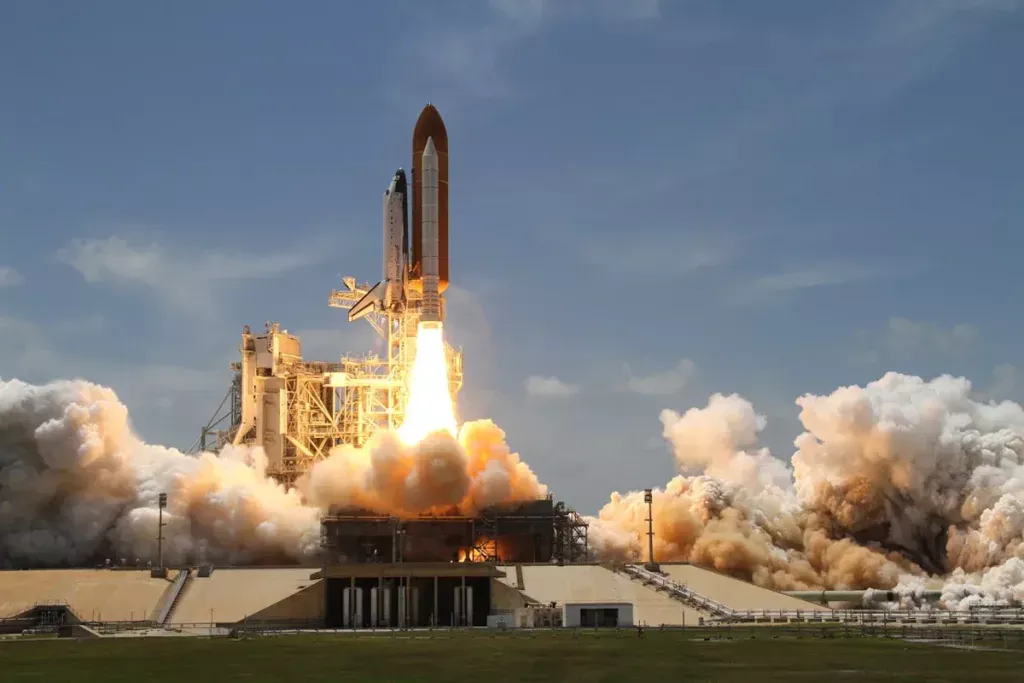
The frontier is no longer a preserve of government agencies and astronauts wearing bulky suits. Over the last few years, the space economy has become open to the likes of private companies, investors, and innovators who can see the opportunity in orbit and beyond. The rush to construct rockets, satellites, and even future colonies has caused excitement and cynicism. To the keen observer, the answer is obvious: Does the space frontier become the next great leap among all the investments of all countries of the world, or is it a high-risk bet whose results are hard to predict?
The Commercial Rise of Space
Until the early 2000s, space exploration was virtually an entirely government-financed and national pride initiative. The players were the United States, Russia, and subsequently China, who had funded ambitious programs that focused on science, defense, and exploration rather than on profits. The landscape nowadays is very different. SpaceX, Blue Origin, and Rocket Lab, among other private companies, have reduced the cost of launch by a significant margin and made access to orbit much more accessible. What used to be a government-owned sector is now a free market. This change has enabled another group of new startups and investors to join, setting out opportunities that were unheard of several decades ago.
Groundbreaking Satellite Services.
Satellite technology is one of the most realizable forces behind the modern space economy. Satellites are the foundation of the civilian lifestyle and the defense infrastructure, as communications, navigation, weather forecasting, and earth monitoring are all dependent on satellites. To investors, it is at this point that the space story starts to emerge. Focus has moved to the constellation of the satellites in the heavens above, rather than concentrating on rockets. Business organisations are competing to develop networks that will deliver high-speed internet connectivity even in distant parts of the globe. Such practical use ensures that the space sector has nothing to do with science fiction and is rather a way of addressing practical issues. It also emphasizes the increasing significance of space investment as a growing force of daily connectivity and world economic advancement.
Beyond Satellites: New Brave Ideas.
Satellites offer a time-tested revenue model, but most people can read the greater reward in what would have been considered a fantasy venture. Mining of asteroids, extraction of resources on the moon, and even human settlements on Mars are being taken seriously. These ideas are yet to mature, but they demonstrate the aspiration of the industry. To investors, these projects are dangerous but could be life changing. Supply chains around the world would be massive in case resources like rare metals could be extracted from asteroids. Likewise, infrastructural construction on the Moon would act as a steppingstone to greater space exploration. Such notions will not produce immediate profits, but they will keep the long-term dream alive.
Government as Partner, Not Competitor
Governments are still seen as playing a decisive role in the space frontier despite the influx of private activity. Funding, contracts, and partnerships supplied by agencies such as NASA, the European Space Agency, and other similar agencies across the globe have assisted in supporting innovation by the private sector. As a matter of fact, numerous commercial space firms heavily depend on government contracts to provide a continuous income. The existence of defense and security interests also guarantees that governments are keenly engaged in the industry.
Space Economy Dangers and Reality.
There is a lot of hype about space, which usually obscures the difficulties. Failure to launch, extended development cycles, and enormous upfront expenses are a reality. Even the regulatory frameworks remain in the process of development, and it is not clear who will own space and have what impact on the environment. The second issue is market saturation, especially in the satellite industry, where the number of competitors may be too many to saturate the skies with rival systems. In the case of investors, due diligence should be taken care of.
Conclusion:
The space frontier is no longer a far-off dream but an emerging reality that is being shaped by innovation and government backing, as well as world ambition. To investors, there will be established satellite services and visionary projects that seek to transform the future of human beings. However, the hazards are also now high, and you must be careful and patient. Space is not an investment where people seek fast gains, but a vision that can match long-term and integrate technology, infrastructure, and human exploration.