Anthurium (Anthurium andreanum Lind.) belongs to the family Araceae. There are two types of anthurium under cultivation: the foliage and the flowering types. The foliage is grown for their velvety leaves while the flowering type is for their showy flowers, which consists of spadix and spathe. The true flowers are borne on a spike called spadix protruding from the base of the spathe.
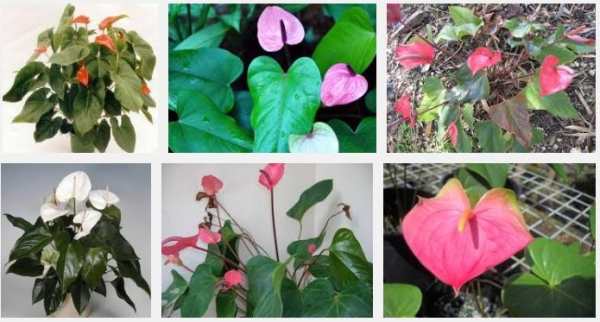
The spathe is a modified leaf typically heart shape. It comes in different colors – pink, white, green white and red.
Anthurium Production Guide
Recommended Varieties
Cultivars grown locally are the following:
Nitta (orange)
Kaumana (red)
Ozaki (dark pink)
Kaonaiwan (white)
Pink Exotica (light pink)
Other varieties introduced from Holland:
Margaretha (white)
Midori (green)
Mauricia (dark pink)
Claudia (red)
Leigh (beige)
Cultural Management
Methods of propagation
division or separation of suckers
top cuttings
tissue culture
Planting
Anthurium can be grown in raised bed or clay pots. Larger pots are used for larger varieties. Enough holes in the bottom or sides of the pots should be provided for efficient drainage. The size of beds depends on the growers but the ideal distance of planting should be 1 meter to accommodate nine mature plants per square meter.
Growth Medium
The selection of the growth medium depends on the availability, cost and ease of handling.
The most common media used are:
coconut husks
coir dust
red or black cinder
Light Requirement
The light requirement ranges from 60 – 75% shade. Three to four layers of net 10 feet above the plants should be installed.
Temperature Requirement
The best temperature in growing anthurium ranges from 10 – 20°C (night temperature) and 27 – 30°C (day temperature).
Water Requirement
The amount and frequency of watering depends on the prevailing climatic condition in the production area, medium and degree of shading. Anthurium needs water during all the stages of growth. It requires high relative humidity
Fertilizer requirements
Both inorganic and organic fertilizers may be used in anthurium. Complete fertilizers such as 16-16-16, 30-10-10 and 10-20-30 at the rate of 1 tablespoon per gallon of water sprayed or drenched on the medium.
Pest and disease control
PESTS
Anthurium flowers are susceptible to pests that such as aphids, scales, spider mite, mealybugs and thrips. Thrips and mealybugs are found on new growth. Aphids feed on the flower buds. Symptoms of anthurium flower that infested by
aphids include yellowing, distortion of leaves and poor growth. Scales seem to be particularly fond of the tough bird nest type. Symptoms of anthurium flower that infested by scale insects include infested stems and leaves.
Control measures
There are some “insecticidal soaps” which work well on the soft insects, but scales may need stronger insecticide. The best method of insect control is to monitor anthurium fl ower and treat it before the insect get out of hand. One of the best ways to stay clear of the use of chemicals is with periodic wiping of the foliage and a gentle spray using water.
FUNGAL DISEASE: RHIZOCTINIA
The biggest disease problem that infects anthurium flower is rhizoctinia. The rhizoctinia is caused by high temperature and humidity coupled with soil that is poorly drained. Over watering should be avoided and if anthurium flower is replanted, a well drained soil should be used in order to prevent rhizoctinia disease. Rhizoctinia can also be controlled by a wide range of fungicides chemicals. The best approach is prevention via cultural practices. The symptoms of rhizoctonia disease include falling of anthurium flowers’ tree especially during rainy season.
Harvesting
Anthurium flowers are generally harvested when the spadix is almost fully developed. Flowers picked too early wilt quickly. Development of true flowers on spadix is also used as a criterion for determining the harvest stage. The anthurium flowers are harvested after the unfolding of the spathe is completed. Anthurium flowers are best harvested in the morning. The anthurium flowers are harvested by hand using sharp secateur scissor. About 8 – 12 flowers per plant are obtained annually.
Classification of Flowers
Flowers are sold according to sizes of the spathe (length across the broadest part)
extra large (10.0 cm and above)
large (8.0 – 8.5 cm)
medium (7.0 – 7.5 cm)
small (6.0 – 6.5 cm)
miniature (5.5 cm and below)
Packing
Anthurium flowers are packed in plastic sleeves with stem ends insert in plastic tube with water. Flowers are also packed in boxes containing moistened shredded paper to prevent dehydration.
References
Bureau of Plant and Industry Technoguides.
Sources: bar.gov.ph, nda.agric.za