


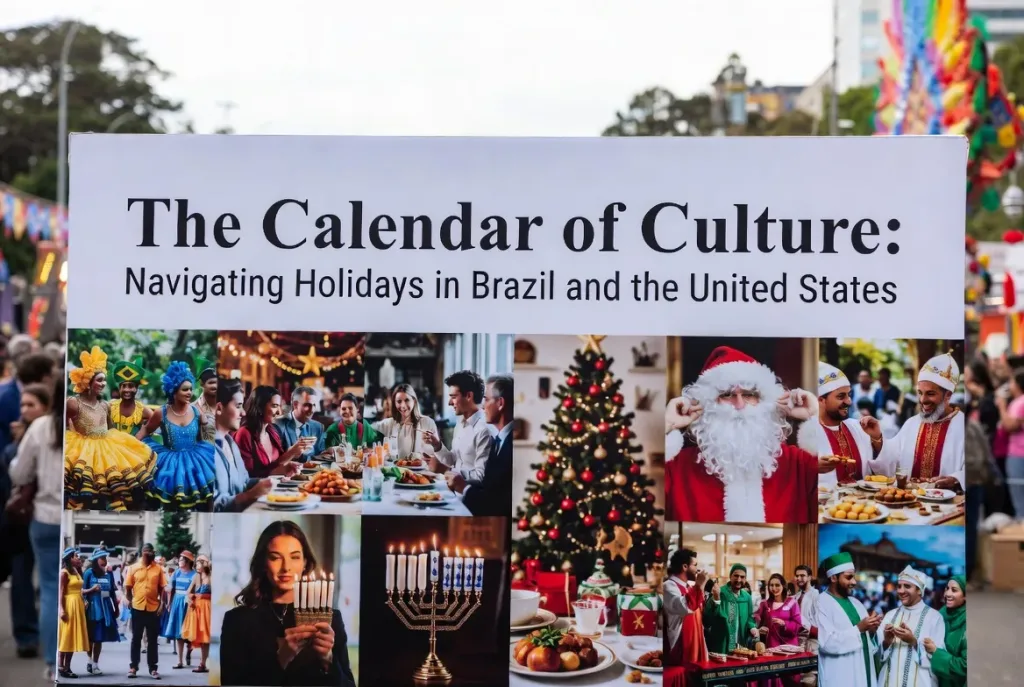
Holidays are more than just days off from work; they are the rhythmic heartbeat of a nation’s economy and a mirror of its cultural soul. While both Brazil and the United States share a Western heritage, their holiday calendars reveal distinct priorities, historical trajectories, and consumer behaviors. Understanding these differences is crucial for businesses operating across borders, as the timing and nature of these celebrations dictate the flow of billions of dollars in goods and services.
1. Cultural Foundations: Secularism vs. Tradition
The American holiday calendar is heavily influenced by a mix of patriotism and commercialism. Federal holidays like Independence Day (July 4th) and Thanksgiving serve as the primary anchors of the American identity. These dates are fixed and often result in massive domestic travel and retail “events.”
In contrast, the Brazilian calendar is deeply intertwined with Catholic tradition and civic history. Beyond universal dates like New Year’s Day, Brazil observes numerous religious holidays such as Corpus Christi, Our Lady of Aparecida, and All Souls’ Day. Furthermore, Brazil’s penchant for “enforcando” (squeezing) holidays—the practice of taking a bridge day between a Thursday holiday and the weekend—creates extended periods of leisure that significantly impact productivity and consumption differently than the American “Monday holiday” system.
2. The Heavyweights: Carnival vs. Thanksgiving
Perhaps the most stark contrast lies in each nation’s “signature” holiday.
In Brazil, Carnival is an economic powerhouse. While it is technically a pre-Lenten festival, it has evolved into a week-long (or month-long, in some regions) suspension of normal business activity. For the service sector—specifically tourism, hospitality, and beverage industries—Carnival is the peak season. In cities like Rio de Janeiro and Salvador, the influx of international and domestic tourists creates a surge in demand for short-term rentals, flights, and event services. However, for the manufacturing and industrial sectors, Carnival represents a significant “stop” in production, often slowing down the national GDP for the first quarter.
In the U.S., Thanksgiving serves a similar role as a cultural anchor but with a purely domestic, family-centric focus. Economically, it acts as the “starting gun” for the holiday shopping season. Unlike Carnival, which is about public celebration and street parties, Thanksgiving is about the home. This drives massive sales in the grocery sector (turkey, produce) and home goods. However, the true economic impact of Thanksgiving is its immediate successor: Black Friday.
3. Retail Dynamics and the “Black Friday” Phenomenon
The evolution of Black Friday is a fascinating case study in economic globalization. Originally a uniquely American event occurring the day after Thanksgiving, it has been aggressively exported to Brazil.
- In the United States: Black Friday (and now Cyber Monday) is a high-volume, low-margin event designed to clear inventory before the end of the fiscal year. It is the lifeblood of the electronics, apparel, and toy industries.
- In Brazil: Known as “Black Friday Brasil,” the event has been adopted enthusiastically but faces different challenges. Because Brazil does not celebrate Thanksgiving, the date often feels disconnected from a cultural anchor, serving purely as a commercial discount day. Furthermore, the Brazilian retail sector must contend with “Custo Brasil” (high logistical costs and taxes), which sometimes leads to “Black Fraude”—a term used by locals when retailers raise prices weeks before only to “discount” them back to the original price on the day.
Despite these differences, both countries see a massive shift toward e-commerce services during these windows, straining logistics and delivery networks to their limits.
4. Summer vs. Winter: The Seasonal Flip
A critical factor often overlooked by international marketers is the hemispheric reversal.
In the United States, the major year-end holidays (Christmas and New Year) occur in the dead of winter. This drives the sale of winter apparel, heating services, and indoor entertainment. The “holiday season” is a cozy, home-bound experience.
In Brazil, Christmas and New Year coincide with the peak of summer. This fundamentally changes the basket of goods consumed. Instead of heavy coats and snow shovels, Brazilians are buying beer, swimwear, air conditioners, and barbecue supplies. The service industry in coastal regions sees a total saturation of capacity. For a multinational brand, this means their “Winter Collection” marketed in New York must be replaced with a “Summer Collection” in São Paulo during the exact same month.
5. Labor Laws and Service Availability
The impact of holidays on the service sector is also dictated by labor regulations.
In the U.S., many businesses (especially in retail and hospitality) remain open on holidays, often incentivizing staff with “time-and-a-half” pay. It is common to find grocery stores or pharmacies open even on Thanksgiving or Christmas Day.
In Brazil, labor laws and collective bargaining agreements are often stricter regarding holidays. In many cities, shops are legally required to close on major holidays, and opening requires special municipal authorization and higher compensatory pay for workers. This creates a “feast or famine” dynamic for the service industry: total closure followed by intense demand the following day.
6. The Impact on B2B Services
While B2C (Business to Consumer) sectors thrive on holiday spending, B2B (Business to Business) services experience significant friction.
In the U.S., the period between Christmas and New Year is often a “dead zone” for corporate decision-making, but the rest of the year remains relatively consistent. In Brazil, the period from Christmas through Carnival (which can fall as late as March) is often viewed as a slow season for major corporate contracts and government bureaucracy. International companies often find it difficult to close deals in Brazil during January and February, as many decision-makers are on extended summer vacations.
Conclusion
The differences between Brazilian and American holidays are rooted in history but manifest in the modern economy through consumer behavior and logistics. While the U.S. holidays are highly optimized for retail throughput and “Monday-holiday” efficiency, Brazilian holidays are expansive, social, and deeply tied to the seasons.
For businesses, success in these markets requires more than just a calendar; it requires an understanding of the emotion behind the date. Whether it’s the quiet gratitude of a Thanksgiving dinner or the exuberant chaos of a street bloco in Rio, these holidays dictate when people open their wallets and what they choose to value.