


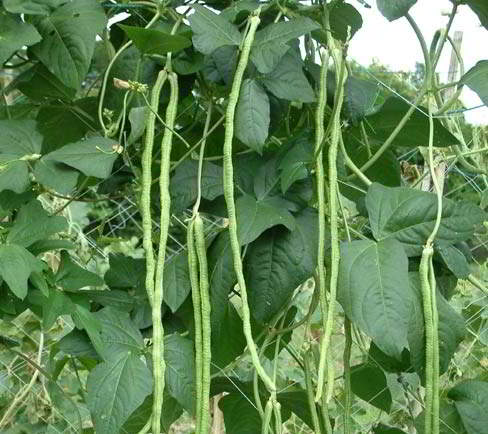
Introduction — Why Pole Sitao Still Matters
If you’ve ever grown vegetables in the Philippines, chances are you’ve planted sitaw or pole sitao at least once. These long, tender pods — a staple in Filipino dishes like adobong sitaw and pakbet — make pole sitao (Vigna unguiculata subsp. sesquipedalis) one of the most practical and profitable crops for both backyard and commercial farmers.
It’s fast-growing, resilient under tropical conditions, and can yield multiple harvests in a single planting season. But success doesn’t come just from planting — it depends on choosing the right variety, managing soil and water, protecting plants from pests, and handling pods properly after harvest.
This guide combines the latest verified data from national agencies with real field experience to help farmers improve yield, pod quality, and profitability.
The State of Pole Sitao Production in 2025
Across the Philippines, pole sitao remains an essential crop for both rural livelihoods and urban markets. Production thrives in provinces such as Nueva Ecija, Ilocos Norte, Palawan, Bukidnon, and Davao del Sur. While total production areas fluctuate yearly due to climate shifts and input costs, demand remains strong, supported by household consumption and institutional buyers.
The Department of Agriculture continues to identify pole sitao as one of the country’s high-value vegetables under its 2021–2025 Vegetable Industry Roadmap. Farmer cooperatives and local agripreneurs report steady market turnover, rising input prices, and growing interest in organic practices and integrated pest management.
These field realities highlight that sitao isn’t just a household vegetable — it’s a vital income source that supports food security and rural economies nationwide.
Recommended Pole Sitao Varieties
Choosing the right variety can increase yield and profitability. The Bureau of Plant Industry (BPI) and the National Seed Industry Council (NSIC) recommend the following high-performing varieties suited to Philippine conditions:
- NSIC Ps 4 “Hitik” – vigorous, early maturing, with long, market-preferred pods.
- NSIC Ps 5 “Rikit” – known for pest and disease tolerance, with dark green pods favored by traders.
- Hitik 2 and Hitik 3 – newer variants bred for improved disease resistance and adaptability.
- BPI-Ps series – adaptable lines for both wet and dry seasons.
Buy seeds only from accredited suppliers to ensure genetic purity and quality. To maintain steady supply and stable pricing, stagger plantings every 10 to 14 days.
Soil and Climate Requirements
Pole sitao thrives in well-drained loamy soil rich in organic matter, with a pH between 5.5 and 6.8. It grows best under full sunlight and warm temperatures ranging from 20 °C to 35 °C.
Avoid waterlogged areas, as excessive moisture leads to root rot and poor growth. In lowland rice zones, plant during dry months or after rice harvest; in upland farms, choose sites with irrigation access during flowering and pod formation.
Before planting, incorporate 3–5 tons of decomposed manure or compost per hectare to enhance soil fertility and structure.
Land Preparation and Planting
Proper field preparation is the foundation of a good harvest. Plow and harrow the soil until fine and level, then form furrows or raised beds for better drainage.
- Seeding rate: 10–12 kg per hectare using the hill method, or 15–18 seeds per meter for drill planting.
- Spacing: 30 cm between hills, 100 cm between rows for single-row trellises.
- Best planting months: May–June (wet season) and October–November (dry season).
- Pre-soaking: Soak seeds for 6–8 hours before planting to promote uniform germination.
- Optional: Treat seeds with rhizobium inoculant to boost nitrogen fixation naturally.
Trellising and Vine Training
Pole sitao is a vigorous climber, and trellising ensures better yields, straighter pods, and easier harvesting. Farmers often use bamboo poles, kakawate sticks, or galvanized wires for support.
Common trellis designs:
- Single-row vertical trellis – bamboo poles spaced 3–4 m apart with wire or string lines.
- A-frame double trellis – stable and ideal for windy conditions.
Train vines early — about two weeks after emergence — so they climb evenly. Apply rice straw or plastic mulch around the base to retain soil moisture and suppress weeds.
Fertilization and Nutrient Management
Balanced fertilization maintains vigorous plant growth and steady yields. Apply both organic and inorganic fertilizers according to soil condition and crop stage.
Suggested program:
- Basal application: 3–5 tons of compost or manure + 200–300 kg/ha 14-14-14 NPK.
- Side-dressing: Apply urea (46-0-0) three to four weeks after germination.
- Flowering and pod development: Add muriate of potash (0-0-60) to improve pod filling.
Avoid excessive nitrogen, which promotes leafy growth instead of pods. Foliar micronutrient sprays during flowering can enhance yield and pod appearance.
Water Management
Pole sitao requires consistent soil moisture, particularly during flowering and pod formation. Drip or furrow irrigation systems are ideal for efficient water use.
Avoid overwatering, which can cause flower drop and root diseases. In rainfed areas, schedule planting just before the rainy season to ensure adequate moisture throughout the crop cycle.
Integrated Pest and Disease Management
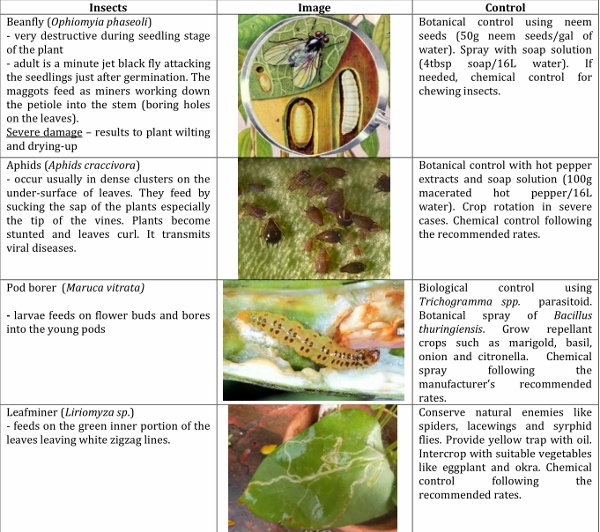
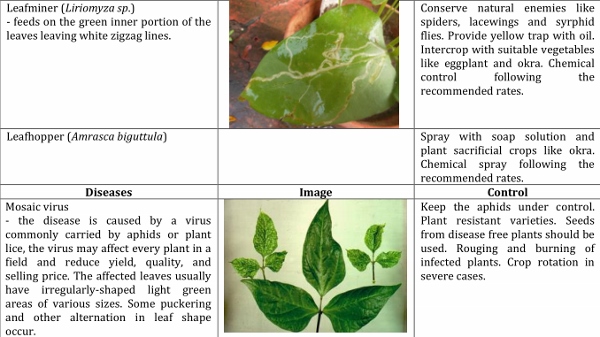
Common pests affecting pole sitao include aphids, pod borers, leaf miners, and bean flies. To manage these effectively, farmers are encouraged to adopt Integrated Pest Management (IPM) that blends cultural, biological, and chemical approaches.
Actionable IPM steps (what I use and recommend):
Field hygiene & crop rotation: Rotate pole sitao with non-legume crops to prevent pest buildup and avoid continuous monocropping. Keep the field weed-free, and promptly remove infested pods to minimize pest spread.
Cultural controls: Early morning scouting, hand-removal of infested pods, and timely rouging of off-types. Regular weekly field monitoring is essential for early detection and quick intervention.
Biologicals & botanicals: Use soap sprays for aphids, neem or botanical extracts for general suppression, and introduce beneficials (ladybugs, parasitoids) where possible. Local extracts (citronella, guyabano seed, turmeric mixes) are used by organic practitioners with reasonable results.
Use yellow sticky traps to monitor aphids and whiteflies, and choose pest-tolerant or resistant varieties whenever possible.
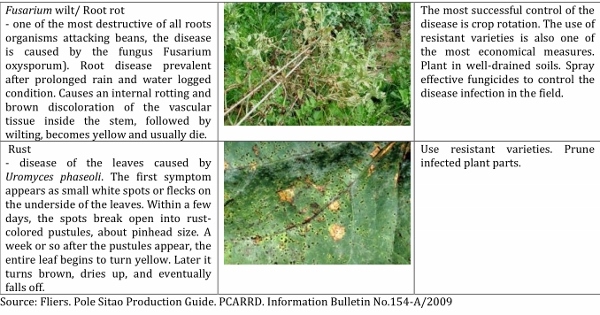
Major diseases affecting pole sitao include anthracnose, mosaic virus, and powdery mildew. To reduce disease outbreaks, plant only disease-free seeds, maintain proper spacing for airflow, and apply sulfur-based fungicides only when necessary.


Harvesting and Postharvest Handling
Pole sitao pods are ready for harvest 7–10 days after flowering. Frequent picking (every two to three days) encourages continuous pod production and prevents overmaturity.
Harvest early in the morning to preserve freshness. Handle pods carefully to avoid bruising, and sort them immediately by grade. Straight, tender, and uniform pods fetch the best market prices.
Postharvest tips:
- Keep harvested pods shaded at all times.
- Store at 12–15 °C and 90% humidity when refrigeration is available.
- Use ventilated crates or baskets for transport.
With proper cold storage, sitao can stay fresh for up to two weeks — ideal for long-distance trade.
Producing Quality Seeds
Select healthy plants for seed production and allow pods to mature and dry on the vine.
Steps:
- Isolate seed plots from other varieties by at least 10–50 m.
- Dry mature pods for two to three days under sunlight before threshing.
- Store clean seeds in airtight containers at around 10% moisture.
- Label containers with variety name and harvest date for traceability.
Market Prices and Farm Income Estimates (2025 Update)
Market Prices in 2025
- In September 2025, the PSA Price Situationer reports sitaw (under “selected agricultural commodities”) reaching ₱80.35 per kilogram in some markets.
- In prior reports, farmgate references for stringbeans / legumes were known (though not always separately listed) in PSA’s beans and legumes farmgate tables.
Thus, a realistic 2025 farmgate to retail spread for pole sitaw might range:
- Farmgate (wholesale to trader): ₱55 to ₱85 per kg
- Retail (wet market or direct to consumer): ₱80 to ₱110+ per kg
These vary by region, supply timing, and pod quality.
Estimated Farm Income in 2025
Using typical yield estimates and costs, we can project potential returns:
- If a smallholder achieves 10–12 tons per hectare (a conservative figure under good management)
- At ₱60 to ₱80 farmgate price/kg, gross income per hectare = ₱600,000 to ₱960,000
- Subtracting production costs (labor, fertilizer, trellising, pest control) — often ₱300,000 to ₱450,000 per hectare in many areas
- Net farm income per hectare per cycle may realistically be ₱150,000 to ₱500,000, depending on efficiency and losses
For small plots (say 0.5 ha), farmers could see ₱75,000 to ₱250,000 net income per crop cycle if all goes well.
These estimates are illustrative, based on observed 2025 market prices and input cost trends. Actual results may vary by region, farm size, and management efficiency. Nonetheless, these figures reaffirm that pole sitao remains one of the most reliable and income-generating vegetables for Filipino growers in 2025.
Common Mistakes to Avoid
- Overuse of nitrogen fertilizer leading to fewer pods.
- Skipping trellising or late vine training.
- Ignoring early pest signs.
- Poor grading and mixed quality produce.
- Mishandling during transport causing bruises and spoilage.
Small operational mistakes can cut profits significantly, so discipline and timing are crucial.
Policy & Institutional Developments
- In September 2025, the DA launched the “White Revolution” — an agricultural roadmap aimed at ensuring stable, year-round supply of vegetables through greenhouses, improved postharvest logistics, and protected cultivation systems. This has direct implications for sitao production, especially for regions near urban centers.
- The DA plans to develop new food corridors that bring production closer to markets, reducing transportation time and spoilage. These corridors are expected to include cold storage, mechanized postharvest facilities, and shared infrastructure. Sitao growers who can align with these corridors may benefit from better prices and less waste.
Varieties: What’s New by 2025
- In 2023, NSIC approved new pole sitao varieties “Hitik 2” and “Hitik 3” developed by BPI-Los Baños. These build on older varieties like NSIC Ps 4 (“Hitik”) and Ps 5 (“Rikit”). The newer Hitik 2 and 3 are selected for improved disease resistance, pod quality, and possibly better performance under variable rainfall.
- No further variety approvals for sitaw have been publicly announced (as of mid-2025) beyond those. Growers interested in sourcing seed should check local BPI seed centers for availability of Hitik 2 / 3.
Climate, Soil, and Site Trends in 2025
- Weather disruptions: recent storms, floods, and monsoon rains in parts of Luzon, Visayas, and Mindanao continue to cause interruptions in production of vegetables, including sitaw. The need for drainage and protected cultivation is now more being emphasized.
- Soil fertility remains a concern: many farmers report that soils with low organic matter yield lower pod quality and suffer more disease pressure. There is a renewed push (per DA policy speeches) for integrating organic amendments and better soil health practices.
Cultivation Practices in 2025 (Field-confirmed Observations)
While universal national data for sitaw are pending, many local extension offices report:
- Increased adoption of protected cultivation (polytunnels, shade nets, partial greenhouse) for sitaw, especially for markets demanding higher quality or year-round supply.
- Growers nearer to metro areas are layering postharvest cooling (simple shade → pre-cooling in coolers) to preserve freshness.
- Seed treatment and improved variety use (e.g. Hitik 2 / 3) are more common, especially among cooperatives.
Challenges Still Facing Sitao Growers
- Extreme weather (intense rain, flooding, high winds) is causing yield losses and delaying plantings.
- Input costs — fertilizers, labor, trellising materials — have risen, squeezing margins.
- Postharvest losses due to lack of cold chain, especially in remote areas.
- Market price volatility during “lean seasons” or when supply from flooded areas is delayed.
What Growers Can Do Right Now
Given the current environment, here are actions being taken by successful sitaw growers in 2025:
- Use disease-resistant varieties like Hitik 2 or 3 where available.
- Adopt protected cultivation or simple shade netting/infrastructure near markets.
- Plan plantings to avoid peak rain periods, or use raised beds/furrows for field drainage.
- Improve postharvest handling — harvest early morning, sort sharply by grade, deliver as soon as possible.
- Integrate organic soil amendments to reduce input costs and boost soil resilience.
Market Implications and Profit Potential
- With DA’s food corridor initiative and White Revolution, sitaw producers who can supply consistent, high-quality pods year-round stand to benefit from improved access to market hubs and possibly better pricing.
- Urban demand remains strong; restaurants, supermarkets, wet-markets still prefer long, straight, unblemished pods. Producers able to satisfy those specs command premium rates.
- Cost pressures mean that efficiency (lower losses, better harvesting, less spoilage) will increasingly determine profitability more than simply yield per hectare.
What We Don’t Yet Know (and What to Watch for)
- Specific 2025 data on area planted, yield per hectare, and national production volume for pole sitao has not yet been published. PSA’s Crops Production Survey (CrPS) is expected to deliver these numbers later in the year.
- How the White Revolution initiatives (protected cultivation, corridors, postharvest cold chain) will be rolled out in rural sitaw-growing areas.
- Consumer preference changes, particularly from urban buyers, may demand stricter grading and packaging, which could raise costs.
Conclusion
Pole sitao continues to be a reliable, valuable vegetable crop in the Philippines, and 2025 promises shifts in how it is produced and marketed. With government emphasis on reliable supply, protected cultivation, and better postharvest systems, growers who lean into variety improvement, efficient handling, and resilience to weather challenges will likely gain the most.
For farmers and extension workers, now is the time to align with the emerging structure — food corridors, upgraded cold chain, better seed options — so that sitaw remains not just a survival crop, but a strong source of livelihood in the years ahead.
References and Data Sources
- Philippine Statistics Authority. Price Situationer of Selected Agricultural Commodities, September 2025.
https://psa.gov.ph/content/price-situationer-selected-agricultural-commodities-first-phase-september-2025 - Philippine Statistics Authority. Farmgate Prices of Agricultural Commodities (Beans and Legumes). https://openstat.psa.gov.ph/PXWeb/pxweb/en/DB/DB__2M__NFG/0032M4AFN03.px
- Department of Agriculture. Vegetable Industry Roadmap 2021–2025. https://www.da.gov.ph
- National Seed Industry Council / BPI-Los Baños. NSIC approves new pole sitao varieties Hitik-2 and Hitik-3. Los Baños Times, Sep. 2023 (still relevant and seed available 2025). https://lbtimes.ph/nsic-approves-three-new-bpi-plant-varieties/
- Food and Agriculture Organization (FAO). Crop Production Statistics for the Philippines (2025 update). https://www.fao.org/faostat
- Philippine News Agency. DA Pushes Vegetable Self-Sufficiency through Local Production. https://www.pna.gov.ph/articles/1255322
- Department of Agriculture. DA plots a ‘White Revolution’ to boost vegetable supply. (21 September 2025). https://www.da.gov.ph/da-plots-a-white-revolution-to-boost-vegetable-supply/
- Department of Agriculture. DA devising strategy to expand local veggie supply. (22 September 2025). https://businessmirror.com.ph/2025/09/22/da-devising-strategy-to-expand-local-veggie-supply/
- Philippine Statistics Authority. La Union 1st Quarter 2025 Crops Production Survey (CrPS). (data covering crops other than palay/corn). https://rsso01.psa.gov.ph/content/psa-la-union-carries-out-1st-quarter-2025-crops-production-survey-crps
dapat may potential yield
It is very nice information to everyone especially for those who want to plant pole sitao for their additional income.
KathyLeah Lagorin 22.00/kg.
gd evening po @rhealyn abiog ,, pwedi ba magtanong ng national marktable yield standard ng pole sitao in case alam mo po.. smile emoticon salamat
gd evening po @dan olaso ,, pwedi ba magtanong ng national marktable yield standard ng pole sitao in case alam mo po.. 🙂 salamat
itatanong ko lang po sana ang national marketable yield standard ng pole sitao?
napakalaking tulong eto sa katulad kung agricultural student
napakagandang ambag kaalaman pra sa tulad kung agriculture student ….
MashaAllah…
napakagandang ambag kaalaman para sa tulad kung agricultre student.